HVAC Marketing Ideas: 12 Plays That Keep Your Trucks Booked All Year
Quick answer
The HVAC marketing ideas that pay off first are the ones closest to the phone call: a correctly set up Google Business Profile, Local Services Ads (now moving into Google Ads as a pay-per-lead Performance Max campaign), Google search ads for emergency and replacement terms, a page for every city you serve, and a steady flow of fresh reviews. Then add the plays that smooth out the seasons: spring AC and fall furnace tune-up campaigns, a maintenance membership, fast after-hours call handling, financing offers worded to meet lending rules, and email or text to past customers. One timing warning: the federal 25C tax credit ended for equipment placed in service after December 31, 2025, so update any old “tax credit” ads.
These HVAC marketing ideas are written for owners of residential service and replacement companies who want more booked calls, not more dashboards. Every idea below ties back to one of three jobs: get found when someone’s system dies, get chosen over the two other companies on the screen, and stay in touch so the next repair, tune-up and replacement comes back to you.
The rules and numbers come from Google’s help pages, the IRS, ENERGY STAR, federal regulations and named surveys, each linked where it appears. Where something varies by state, utility or account, I tell you where to check.
Numbers every HVAC owner should know
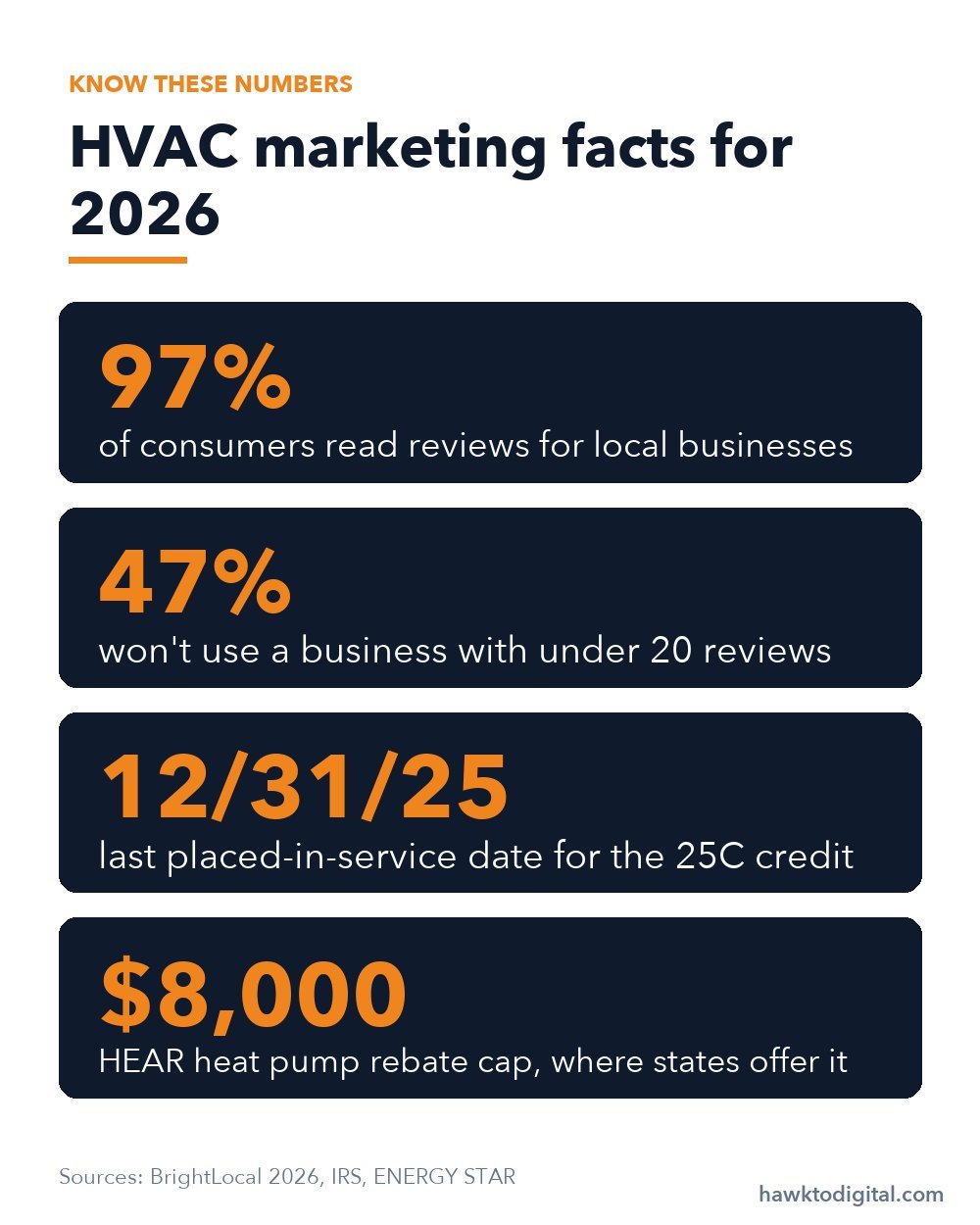
97%
of U.S. consumers read reviews when choosing a local business
Source: BrightLocal, 2026
47%
skip any business showing under 20 reviews
Source: BrightLocal consumer survey, 2026
20
maximum service areas on one Google Business Profile
Source: Google Business Profile Help
Dec 31, 2025
last placed-in-service date for the federal 25C home improvement credit
Source: IRS
$8,000
cap on a HEAR heat pump rebate, only where your state runs the program
Source: ENERGY STAR
10 days
business days, at most, to honor a “stop” request on marketing texts
Source: 47 CFR 64.1200
In this guide
- Google Business Profile and Maps
- Local Services Ads and the 2026 change
- Google Ads for emergency and replacement searches
- Service area and city pages
- Review generation that stays inside the rules
- Speed to lead and after-hours calls
- Maintenance agreements as a marketing engine
- HVAC marketing ideas by season
- Financing, tax credit and rebate messaging
- Email, texts and referrals
- Trucks, yard signs and offline advertising
- How to split your marketing budget
- Frequently asked questions
- Sources
1. Google Business Profile and Maps: get the free listing right first
When a furnace quits on a cold night, most homeowners search on their phone and call one of the businesses in the map pack. Google says local results are ranked mainly on three things: relevance, distance and prominence, and that more reviews and positive ratings can help a business’s local ranking (Google Business Profile Help). You can’t move your shop closer to every customer, so you work on the other two.
Pick the right primary category
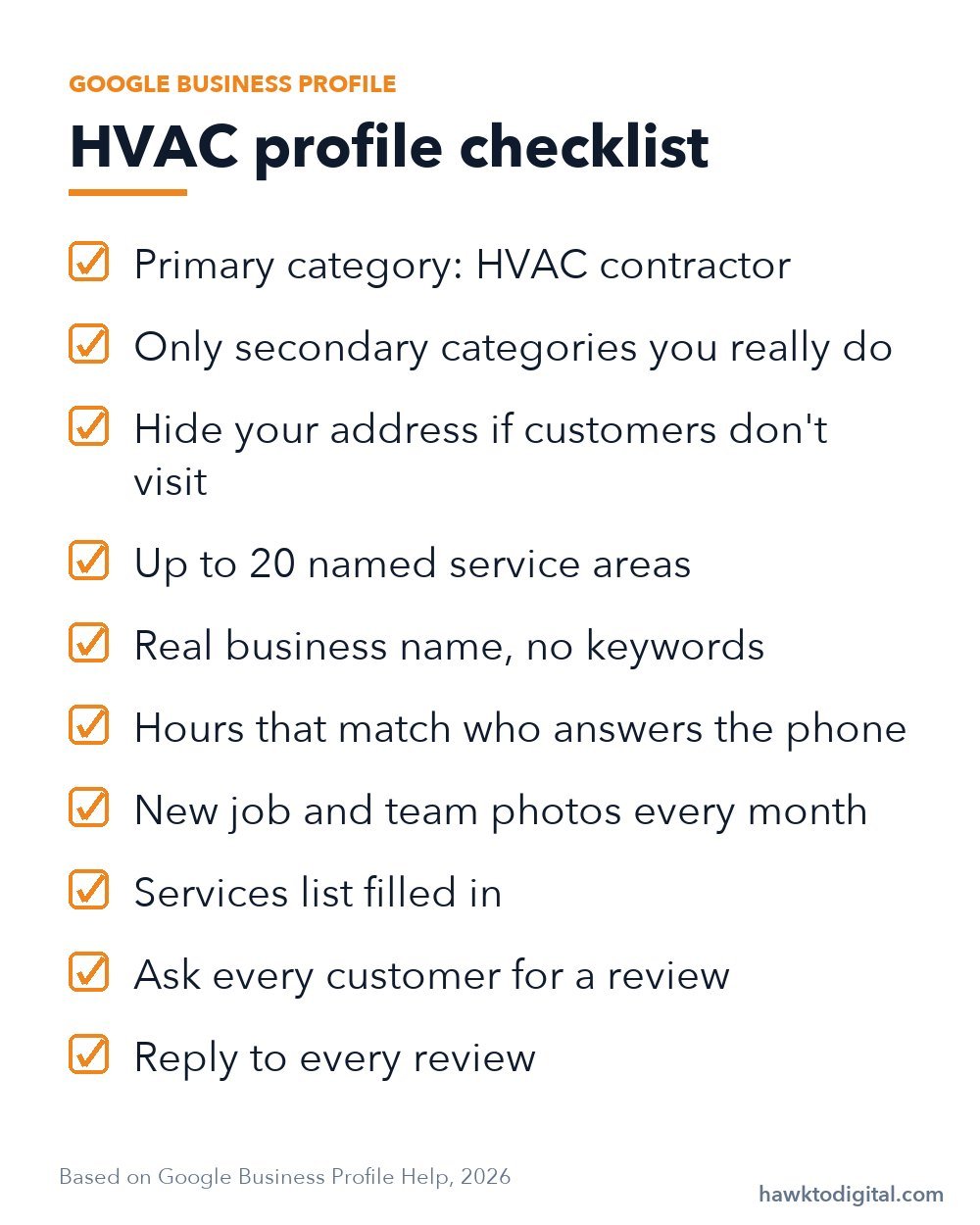
Of everything on the profile, the primary category does the most to tell Google which searches you fit. Google’s guidelines say to “use as few categories as possible” and to pick ones that are “as specific as possible, but representative of your main business” (Google Business Profile guidelines). For a company that does both heating and cooling, “HVAC contractor” is the usual primary choice. Add secondary categories only for work you really do, such as air conditioning repair service, furnace repair service or heating contractor. Type each one into the category box to confirm the exact wording Google offers in your country.
Set your service area the way Google wants
- Hide the address if customers don’t visit you. Google’s guidelines tell service-area businesses to hide the business address, and say an HVAC-style business run from home should remove it (Google).
- Use named places, not a radius. You can add up to 20 service areas, defined by cities, postal codes or other named areas, and the whole area “shouldn’t be more than about 2 hours of driving time” from your base (Google Business Profile Help).
- Keep the name clean. Google says the name should match your real-world name, and extra information in it isn’t permitted. “Smith Heating & Air” is fine; “Smith Heating & Air AC Repair Dallas 24/7” can get the profile suspended.
Photos, services and posts
Google treats photos as a way to show what you offer, not as a ranking factor, but homeowners look at them before calling. Upload real pictures of techs, wrapped vans and finished installs every month, fill in the services list with the jobs you want more of, and post your seasonal offers.
For the full walkthrough, see the Hawkto guide on how to rank higher on Google Maps, or have us handle it through Google Business Profile optimization. To see where you show up across your area right now, run the free Google Maps rank checker for a search like “furnace repair” from a few points in your territory.
I go through the profile setup step by step in this video:
2. Google Local Services Ads: pay per lead, and what changed in 2026
Local Services Ads (LSAs) are the ads with a verification badge that sit at the very top of many “AC repair near me” searches. You pay for leads, not clicks: Google says you “pay only for leads related to your business and the services you offer,” and the customer can call or message you straight from the ad (Google Local Services Help).
The badge and the screening
To run LSAs, a home service business passes Google’s verification. Google says the process varies by category and location, and can include background, business registration, insurance, license and minimum review checks (Google). Depending on your category you’ll see the badge called Google Guaranteed or Google Screened. Start the paperwork in your slow season: the license and insurance documents take longer to gather than you expect.
How bad leads are handled now
Google now handles lead credits automatically. Its help page says leads judged invalid or low quality at first contact are not charged, charged leads can be re-checked and credited later, and credits usually show on your balance within 30 days (Google, automated lead credits). Google also calls its lead feedback survey “crucial” for steering the leads you get. Rate every lead, and mark wrong-service calls (a water heater call when you only do HVAC, say) so the system learns.
The move into Google Ads
The big 2026 change: Google is migrating existing Local Services Ads into a specialized Performance Max campaign inside Google Ads. The first phase began in August 2026 for select U.S. home and storefront service advertisers, and Google lists HVAC by name. Broader groups, including service-area businesses without storefronts, follow in late 2026, and remaining categories in 2027. After migration you lose access to the old LSA dashboard and its old performance reports, so download them first; lead history moves across. Your average weekly budget is divided by 7 to set a daily average, and manual bidding such as a maximum cost per lead is no longer supported (Google Ads Help).
What this means for owners: export your LSA reports this week.
If your account hasn’t migrated yet, download your lead and performance reports from the redirection page before the switch. Without them you lose your own history of cost per lead by season, which is the number you need to set next summer’s budget.
This video from Building Blocks Digital walks through the LSA setup screens for an HVAC company:
3. Google Ads search campaigns for emergency and replacement jobs
Search ads give you control over keywords, copy, landing pages and hours. Split campaigns by intent: a “no heat” caller and a “heat pump cost” researcher need different ads.
| Campaign | Example searches | What the ad and page should do |
|---|---|---|
| Emergency repair | “no heat repair near me”, “ac not cooling”, “emergency hvac” | Lead with response time and a phone number; send clicks to a short page with a big call button |
| Replacement | “new furnace cost”, “ac replacement”, “heat pump installation” | Offer a free in-home estimate and financing; show brands you install and real install photos |
| Maintenance | “furnace tune up”, “ac service” | Run in spring and fall; push the membership plan, not just a one-off visit |
| Brand | Your company name | Cheap insurance so a competitor’s ad doesn’t sit above your own name |
Three settings matter more than clever copy. First, add a call asset and schedule it: Google lets you show the number only on certain days and hours, “only when your business can accept calls” (Google Ads Help, call assets). If nobody answers at 2 a.m., don’t pay for 2 a.m. calls. Second, target your real service area by city or ZIP code and match it to your Business Profile. Third, add negative keywords like “jobs”, “salary”, “school” and “DIY” so you don’t pay for technicians job-hunting or homeowners watching repair videos.
If you’d rather not manage bids yourself, Hawkto offers Google Ads management. Either way, ask for a report that counts booked jobs by campaign, not clicks.
4. Service area and city pages on your website
A “Service Areas” page listing 30 towns does little. A page per main city, with real local detail, gives Google and homeowners a reason to pick you there. Start with the places on your Business Profile.
What a useful city page includes:
- The services you offer there and your typical arrival window in that town.
- Photos of jobs done in that city (with the customer’s permission and no house numbers).
- Reviews from customers in that city, quoted with their permission.
- Local details that matter for HVAC: common home ages, typical systems you see there, and the utility that serves the area so you can point to its rebate page.
- A click-to-call button, a short booking form, and the same business name and phone number as your profile.
Link each city page to your service pages. If you want to know what this kind of work costs before you start, the Hawkto breakdown of local SEO cost explains the usual pricing models.
5. Review generation that stays inside the rules
Reviews are your proof, and the bar keeps rising. BrightLocal asked 1,002 American consumers in early 2026: 68% said they would only use a business rated four stars or higher, 74% look for reviews from the last three months, and 89% expect owners to respond (BrightLocal, 2026).
A simple system techs will actually follow
- Before leaving, the tech asks: “Would you mind leaving a quick Google review about today’s visit?”
- The office or your field service software texts the direct review link within the hour, while the house is warm again.
- One reminder two or three days later, then stop.
- Reply to every review within a few days, naming the job and the town in plain words, never copy-paste replies.
What you can’t do
Google’s policy bars offering incentives such as payment, discounts or free service in exchange for reviews, and bars selectively soliciting positive reviews from customers, often called review gating (Google Maps user contributed content policy). The FTC’s rule on fake reviews also bans incentives conditioned on a particular sentiment and bans suppressing negative reviews through threats or intimidation (FTC). So ask every customer, not just the happy ones, and don’t put a “leave a review, get $25 off” card in the truck.
6. Speed to lead and after-hours call handling
Every other idea here produces calls; this one decides how many become jobs. Research in Harvard Business Review (Oldroyd, McElheran and Elkington, 2011) found most companies are not responding to online leads nearly fast enough. A homeowner with no cooling in July just calls the next company.
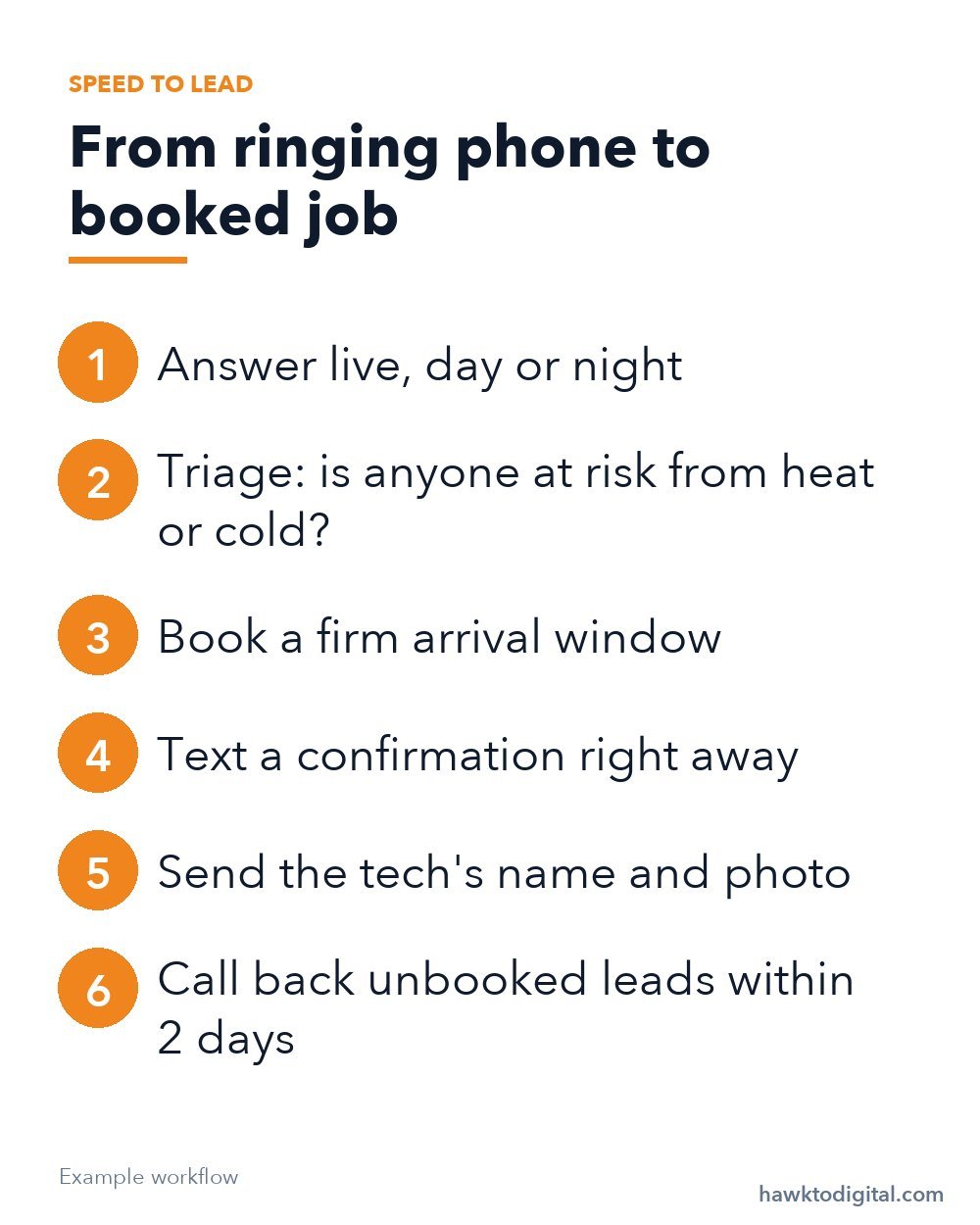
- Answer live 24/7 or say clearly when you don’t. Use an on-call rotation or an HVAC-trained answering service that can book into your schedule. Set your Business Profile hours and call asset schedule to match reality.
- Script the first 60 seconds. Name, address, system type, “is anyone in the home at risk from heat or cold?”, then a firm arrival window.
- Call back form leads in minutes. Set your website and LSA message leads to ping a phone, not just an inbox.
- Track missed calls weekly. Use call tracking numbers by channel so you can see which campaigns ring when nobody answers.
- Follow up on open estimates within two days, and again a week later.
7. Maintenance agreements as a marketing engine
A maintenance agreement (call it a club, membership or comfort plan) turns one-time customers into people you see twice a year. ENERGY STAR advises checking the cooling system in spring and the heating system in fall, because contractors get busy once summer and winter arrive, and suggests tying check-ups to the spring and fall time changes (ENERGY STAR maintenance checklist). That gives you a built-in reason to contact every member twice a year.
Why this is one of the strongest marketing ideas for HVAC companies:
- Tune-ups fill the shoulder seasons, when the phone is quietest.
- Members already trust you, so when their 16-year-old system fails, you’re the first and often only call.
- Each visit is a chance to ask for a review and a referral.
Keep the offer simple: two visits a year, priority scheduling and a repair discount. Sell it on every call and invoice, add a signup page to your website, and check your state’s automatic renewal rules, since some require specific disclosures.
8. HVAC marketing ideas by season: a 12-month calendar
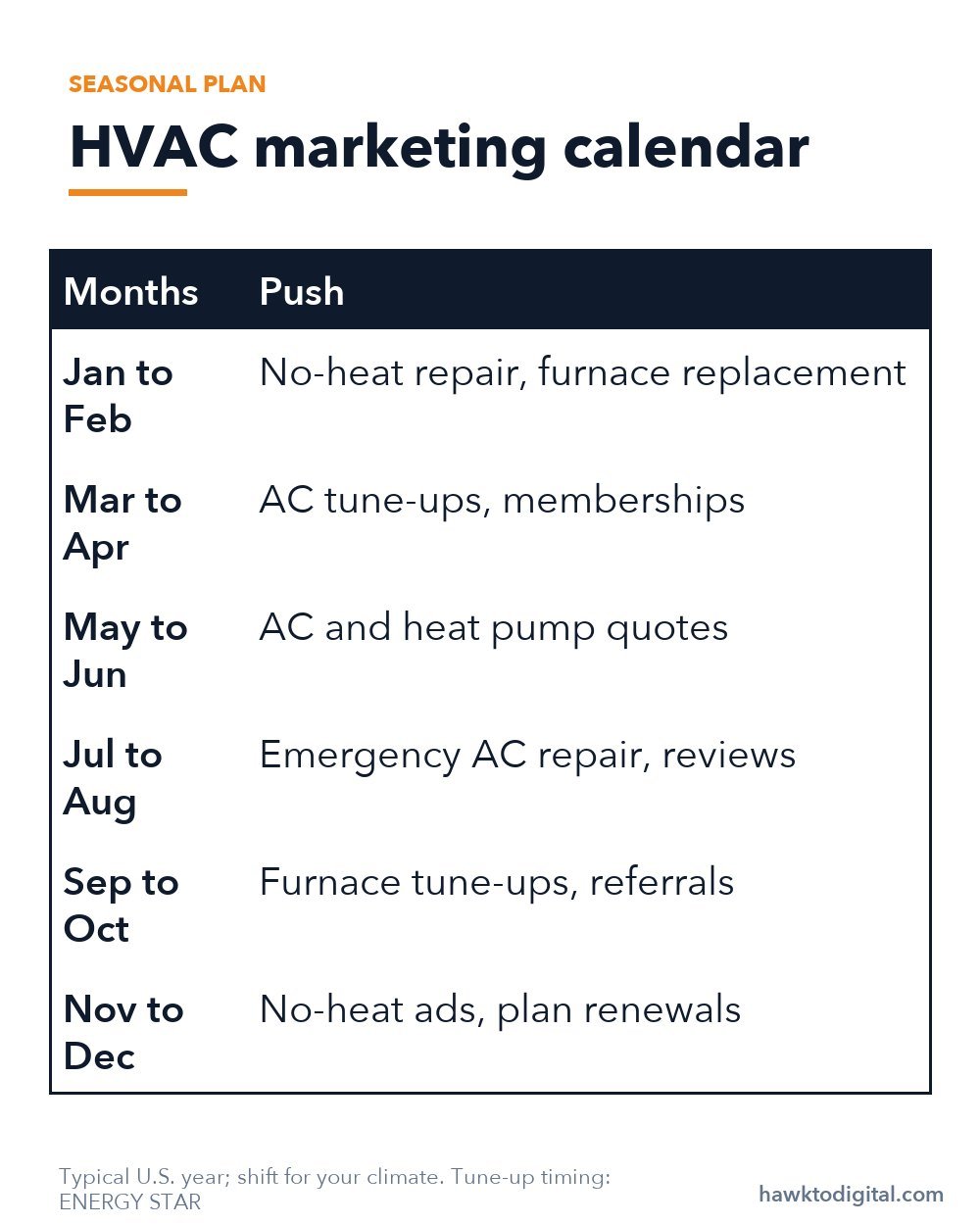
Demand swings with the weather, so your messages should too. These HVAC promotion ideas follow a typical U.S. heating and cooling year; shift them a month either way for your climate. In the U.S., daylight saving time starts on the second Sunday in March and ends on the first Sunday in November, which lines up neatly with the ENERGY STAR tune-up timing.
| Months | What homeowners are thinking | Campaigns to run | Behind the scenes |
|---|---|---|---|
| Jan to Feb | No heat, high bills, old furnaces failing | No-heat emergency ads, furnace and heat pump replacement with financing | Plan spring tune-up campaign; refresh photos and city pages |
| Mar to Apr (shoulder) | Spring cleaning, allergy season | AC tune-up push around the March clock change, indoor air quality offers, membership drive | Train CSRs on summer scripts; book members first |
| May to Jun | First hot days, “is my AC going to make it?” | AC replacement and heat pump quotes, raise LSA and search budgets | Confirm after-hours coverage before the first heat wave |
| Jul to Aug | No cooling, urgency, price matters less | Emergency AC repair ads, review requests after every job | Watch missed calls daily; trim ads you can’t staff |
| Sep to Oct (shoulder) | “Get ready before it’s cold” | Furnace tune-ups, heat pump and dual-fuel quotes, referral push | Email and text members to book fall visits |
| Nov to Dec | First cold snap, holidays, year-end budgets | No-heat ads around the November clock change, plan renewals, gift a tune-up | Pull the year’s numbers by channel and set next year’s budget |
What this means for owners: market the shoulder seasons hardest.
In peak season the weather sends you calls. In March, April, September and October, the work you book comes from your own list, your members and your tune-up offers, so that’s where an extra hour of marketing effort pays back most.
9. Financing offers, tax credit and rebate messaging in 2026
Replacement is a big, unplanned purchase, so financing and incentives belong in your ads, estimates and website. But several rules changed, and old wording can now be wrong.
The federal 25C tax credit has ended
The Energy Efficient Home Improvement Credit (section 25C) used to allow up to $2,000 a year for qualifying heat pumps and up to $600 per item for qualifying central air conditioners and furnaces (IRS). Under the 2025 law known as the One, Big, Beautiful Bill (Public Law 119-21), the IRS says the credit is not allowed for any property placed in service after December 31, 2025 (IRS FAQ). Equipment installed in 2026 doesn’t qualify. Search your website, Business Profile posts, ads and printed leave-behinds for “tax credit” and remove or rewrite anything that promises it. Homeowners who had equipment placed in service in 2025 may still claim it on their 2025 return; send them to the IRS or a tax professional rather than giving tax advice yourself.
Rebates: state by state, so check before you advertise
The Home Electrification and Appliance Rebates (HEAR) program can cover a heat pump for space heating and cooling up to $8,000, with up to 100% of cost for households below 80% of area median income and no more than 50% for households between 80% and 150% (ENERGY STAR). These rebates are run by states, and availability varies. An October 2026 S&P Global report described the rebates as delayed in parts of the country as the winter heating season began (S&P Global). Only advertise a rebate after you’ve confirmed it on your state energy office or utility site, and word it as “may qualify for” with a link to the program. Many utilities run their own rebates too; your city pages are the natural place to list them.
Financing ads: watch the “triggering terms”
“Financing available” and “0% APR on approved credit” are common, but be careful with monthly payments. Under federal Truth in Lending rules (Regulation Z), stating the amount of any payment, the number of payments or the repayment period, a down payment amount or a finance charge in a closed-end credit ad triggers extra disclosures, including the APR and the full repayment terms (CFPB, 12 CFR 1026.24). So “$89 a month” on a yard sign needs the rest of the terms. Ask your finance partner for pre-approved ad wording and use it word for word.
10. Email, texts and referrals: market to people who already know you
Your customer list is the cheapest channel you own: everyone in it already let you into their house.
- Two seasonal emails. Spring (“book your AC tune-up before the first heat wave”) and fall (“furnace check before the cold”), each with one button to book.
- Age-of-system emails. Customers with systems past 12 to 15 years get a replacement planning message with financing, not a hard sell.
- Texts for reminders, with consent. Federal rules require prior express written consent for autodialed or prerecorded marketing calls and texts to cell phones, and opt-out requests such as replying “stop” must be honored within a reasonable time not to exceed ten business days (47 CFR 64.1200). Add a clear consent checkbox to your booking forms and work orders.
- A referral program. A thank-you credit or gift card for each referred customer who books a paid job is common; tell customers about it on invoices, in the tech’s leave-behind and after a five-star review. Keep referral rewards separate from review requests.
These are the least flashy HVAC marketing tips here, and often the ones that keep paying for years.
11. Trucks, yard signs and other offline HVAC advertising examples
Offline marketing works best when it points to the same name, number and reviews people find online.
- Wrapped vans. Your trucks are parked in driveways all day. Keep the design simple: name, what you do, phone number and website, readable from across the street.
- Yard signs at install jobs. With the homeowner’s permission, a sign for a week after a replacement tells the neighbors who they trust. Check HOA and city sign rules first.
- Leave-behinds that matter. A fridge magnet or sticker on the furnace with your phone number is still how many homeowners find you during the next breakdown.
12. How to split your HVAC marketing budget across channels
There’s no official HVAC marketing budget. One widely quoted rule of thumb comes from a 2012 U.S. Small Business Administration blog post: businesses with under $5 million in revenue should spend 7% to 8% of revenue on marketing (archived SBA blog). Treat it as a starting point and adjust for how much growth you want and how much capacity your crews have.
The table compares channels by how you pay. It leaves out cost-per-lead numbers on purpose: they vary too much by market and season, and your own tracking will tell you within a few months.
| Channel | How you pay | Speed to first calls | Best for |
|---|---|---|---|
| Google Business Profile | Free listing; your time or an agency fee | Weeks to months | Steady map calls, reviews, every other channel’s trust |
| Local Services Ads | Per lead (calls, messages, bookings) | Days once verified | Repair and emergency calls at the top of search |
| Google search ads | Per click | Same day | Replacement and specific services you choose |
| Website and local SEO | Build cost plus ongoing work | Months | Lower cost per job over time, city coverage |
| Email, texts, referrals | Software plus discounts or rewards | Same week | Tune-ups, memberships, repeat and replacement work |
| Trucks and signs | One-time cost | Slow, builds over years | Name recognition and branded searches |
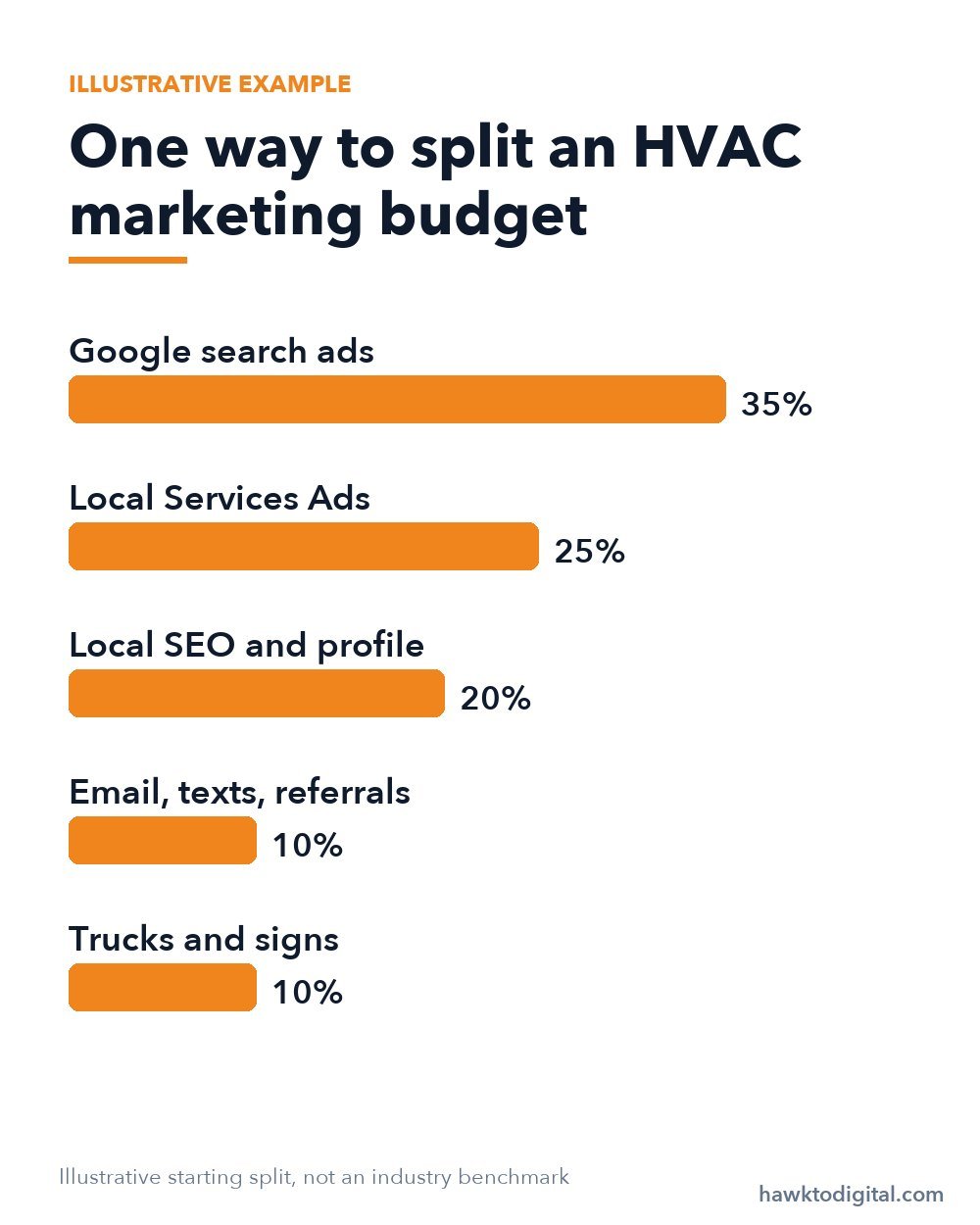
Here is an illustrative example, not a benchmark: a company with $2 million in revenue using the 7% rule of thumb would have about $140,000 a year, or about $11,700 a month. A sensible starting split might put 35% into Google search ads, 25% into Local Services Ads, 20% into local SEO and the Business Profile, 10% into email, texts and referrals, and 10% into trucks and signs. After 90 days, compare booked jobs and revenue per channel, then move money from the weakest channel to the strongest. Raise paid budgets ahead of peak season and lower them when crews are booked out.
What this means for owners: track booked jobs, not leads.
Give each channel its own tracking number, tag every job in your field service software with its source, and review cost per booked job each month. That one habit turns these HVAC marketing strategies from guesses into decisions.
If you’d like a team to set up the profile, ads, city pages and tracking together, see Hawkto’s HVAC marketing services.
HVAC marketing FAQ
Frequently asked questions
Short answers to the questions HVAC owners ask most about marketing.
QWhat are the best HVAC marketing ideas for a small company?
Start with the channels closest to the phone call: a correctly set up Google Business Profile with the right primary category and service areas, steady Google reviews, Local Services Ads and Google search ads for emergency and replacement terms. Then add a maintenance membership and seasonal emails to past customers to fill the spring and fall shoulder seasons.
QAre Google Local Services Ads worth it for HVAC?
They can be, because you pay per lead rather than per click and the ads sit at the top of many searches. Google now credits invalid leads automatically, usually within 30 days, and from August 2026 is moving Local Services Ads into Google Ads as a Performance Max campaign. Track cost per booked job, not cost per lead, to judge them.
QCan I still advertise the federal tax credit for heat pumps and AC?
Not for new installs. The IRS says the 25C Energy Efficient Home Improvement Credit is not allowed for property placed in service after December 31, 2025. Remove or rewrite old tax credit claims, and only advertise state or utility rebates after confirming they are open in your area.
QWhen should HVAC companies run tune-up promotions?
ENERGY STAR advises checking cooling systems in spring and heating systems in fall, before contractors get busy, and suggests timing check-ups around the spring and fall clock changes. That makes March to April and September to October the natural windows for AC and furnace tune-up campaigns.
QHow much should an HVAC company spend on marketing?
There is no official figure. An archived 2012 SBA blog post suggested 7% to 8% of revenue for businesses under $5 million in revenue. Use it as a starting point, then shift money toward the channels that book jobs at the lowest cost in your market.
QCan I offer customers a discount for leaving a Google review?
No. Google’s policy bars incentives such as payment, discounts or free service in exchange for reviews, and bars asking only happy customers. The FTC’s rule on fake reviews also bans incentives tied to a positive or negative sentiment. Ask every customer and reply to every review instead.
Sources
Sources
Checked in November 2026.
- Google Business Profile Help: how local ranking works (answer 7091)
- Google Business Profile Help: business representation rules (answer 3038177)
- Google Business Profile Help, Manage your service area
- Google Local Services Help, Getting started with Local Services Ads
- Google Local Services Help, Google Guarantee definition
- Google Local Services Help, Automated Local Services Ads lead credits
- Google Ads Help, Local Services Ads transition to Performance Max campaigns with pay-per-lead goals
- Google Ads Help, About call assets
- Google Maps, User contributed content policy (fake engagement)
- Federal Trade Commission, Final rule banning fake reviews and testimonials, August 2024
- BrightLocal 2026 consumer review research (U.S. adults)
- Harvard Business Review, The Short Life of Online Sales Leads, March 2011
- ENERGY STAR, Maintenance checklist
- IRS, Energy Efficient Home Improvement Credit
- IRS, FAQs for modification of sections 25C, 25D and others under Public Law 119-21 (One, Big, Beautiful Bill)
- ENERGY STAR, HEAR program
- S&P Global Market Intelligence, DOE energy efficiency rebates delayed as winter heating season begins, October 2026
- Consumer Financial Protection Bureau, Regulation Z 12 CFR 1026.24, Advertising
- Cornell Law School LII, 47 CFR 64.1200 (TCPA rules)
- U.S. Small Business Administration blog (archived 2012), How to set a marketing budget
Want more booked HVAC calls next season?
Hawkto Digital sets up and runs Google Business Profiles, Local Services Ads, Google Ads and websites for local service companies. Start with a free look at where you rank on Google Maps today.

Written by Mehedi Hasan
Mehedi runs Hawkto Digital and holds Google, HubSpot and Semrush certifications. His work covers Google Business Profiles, local SEO, Google Ads and websites for U.S. local businesses. More about Mehedi and Hawkto pricing.