Mobile Home Park Marketing: 12 Ways to Fill Lots and Sell Homes Faster
Quick answer
The mobile home park marketing ideas that work best are: a complete Google Business Profile with steady resident reviews, a website with an up-to-date page of available homes and lots, listings on MHVillage and rental sites, Facebook and Google ads that follow the housing ad rules, partnerships with manufactured home dealers, and fast follow-up on every lead. Then keep residents longer with monthly communication and a referral reward.
Every empty lot and unsold park-owned home costs you money every month. Demand for affordable housing is strong, but many parks still rely on a sign at the entrance and word of mouth, while the people looking for a home are searching on their phones.
I market a long-term RV park in Oklahoma, Country Home Estates, where residents stay for months at a time, along with self storage facilities and real estate businesses. Long-term residents look for many of the same things as mobile home renters: a fair monthly price, clear rules, good reviews and a well-kept place to live. This guide shares 12 mobile home park marketing ideas, grouped by what each one does, with links to deeper guides wherever you want more detail.
In this guide
For RV park owners
Want this done for your park?
I have marketed a long-term RV park in Oklahoma since 2023: Google Maps, Google Ads, Facebook ads, the website and resident newsletters. See how I can help with RV park marketing.
First, know your three audiences
Many parks market to three different groups at once. Each one searches differently and needs a different message:
| What they search | What convinces them | Best channels | |
|---|---|---|---|
| Home buyers | “Mobile homes for sale [city]”, “manufactured homes for sale near me” | Price, monthly cost, photos, lot rent | MHVillage, Google Ads, Facebook video ads |
| Renters | “Mobile homes for rent near me”, “rent to own mobile homes [city]” | Monthly rent, pets, move-in costs, reviews | Google Business Profile, rental sites, Facebook ads |
| Owners moving a home | “Mobile home lots for rent [city]” | Lot rent, lot size, rules, utilities | Google Ads, dealer partnerships, your lots page |
Give each group its own page on your website and its own ads. If your park also has RV sites, my guide to marketing to overnight and long-term RV guests shows how to split those audiences too.
12 mobile home park marketing ideas that fill lots
Part 1 · Get found by people looking for a home
1. Set up your Google Business Profile for every park
People searching “mobile home parks near me” or “mobile homes for rent in [city]” see a map of nearby parks before any website. Your Google Business Profile decides whether your park is on that map and whether they call.
- Choose Mobile home park as your primary category. The primary category has a big effect on which searches you show up for.
- Write a description that covers what people filter on: lot sizes, whether you allow single-wide and double-wide homes, pet policy, utilities, and nearby schools and employers.
- Upload real photos of the entrance, the streets, available homes, the office and any amenities. People want to see the neighborhood before they visit.
- Post your available homes and open lots every week, so the profile always looks active.
Google ranks local results on relevance, distance and prominence. If you would rather have this done for you, it is exactly what my Google Business Profile optimization service covers.
2. Get reviews from happy residents
Future residents read reviews closely, because they are choosing a neighborhood, not just a home. Your current residents are your best source. Ask them at lease renewals, after a maintenance job is done well, and in your resident newsletter.
For Country Home Estates, a long-term RV park I market in Oklahoma, I created a themed email newsletter for existing residents built specifically to bring in Google reviews. Reply to every review, good or bad. My Google Maps guide explains how to get more Google reviews every month and how to reply to them.
3. Build a website with an “Available homes” page
Many park websites show little more than a photo, an address and a phone number. Yours should answer every question online:
- An Available homes page with photos, price or rent, size and bedrooms for every home, updated every week.
- A Lots for rent page with lot rent, what it includes, lot sizes and the rules for moving a home in.
- An online application or “schedule a tour” form, so people can take the next step at night or on weekends.
- Community rules, pet policy, utilities and a map of nearby schools, shops and employers.
If you run several parks, give each one its own location page, which helps every Google Business Profile rank. A site like this is what I build through website development for local businesses, live in 7 to 14 days.
4. List your homes where buyers and renters already look
Many manufactured home shoppers start on listing sites. MHVillage describes itself as the nation’s largest website dedicated to manufactured housing, so list every park-owned home and rental there. Add rentals to the major rental sites and Facebook Marketplace, and keep your park name, address and phone number identical on every listing. Consistent details build trust with people and with Google.
Part 2 · Run ads that follow the housing rules
5. Use Facebook and Instagram ads under the Housing category
Facebook and Instagram are where many future residents spend time every day. Short video tours of an available home, the street and the amenities work well, paired with a lead form that asks one or two qualifying questions, such as move-in timeline and whether they own a home to move in.
Ads for homes and lots must run under Meta’s Housing special ad category. That means no targeting by age, gender or ZIP code, and at least a 15-mile radius around a location. I explain every restriction, and how to get good leads anyway, in my guide to Meta’s housing ad rules. If your park legally qualifies as 55+ housing, you still can’t target by age, but you can say “55+ community” in the ad itself. See how I run Meta ads for local businesses.
6. Use Google Ads on searches with intent to move
Searches like “mobile homes for rent near me”, “mobile home lots for rent [city]” and “manufactured homes for sale [city]” come from people who are actively looking. Google Ads puts your park at the top of those results, with a call button and directions.
Google has housing rules too. In the US, Google’s housing policy, which names mobile homes and retirement communities, does not allow personalized ads for housing to target by age, gender, parental status, marital status or ZIP code. Target your city or a radius around the park instead, and use keywords to reach the right people.
Before you spend, run the quick break-even check in my Google Ads guide, and make sure your ads only show to people in your area. It is the same setup I use in my Google Ads management service.
Want to know why your lots are still empty?
In a free 30-minute call I will review your Google Business Profile, website, listings and ads against the parks near you, and show you what to fix first.
Part 3 · Turn interest into move-ins
7. Show the monthly math
Affordability is a big reason people choose manufactured housing. Make the comparison easy to see on your website and in your ads: “Own a 3-bedroom home for $X a month, lot rent included, versus $Y for a 2-bedroom apartment nearby.” Use your real numbers, and keep the example simple.
The demand is there. According to the Manufactured Housing Institute, more than 22 million people in the US live in manufactured homes, and the average new manufactured home sold for about $134,800 in April 2026, according to Census data on FRED.
8. Partner with manufactured home dealers
Dealers sell homes to buyers who need somewhere to put them. Introduce your park to every dealer within driving distance, share your available lots and lot rent, and make the move-in process simple. Ask them to recommend your park, and recommend them when buyers want a new home for one of your lots.
9. Answer every lead within minutes
Housing leads go cold fast, because people often contact several parks at once. Send every form, call and Facebook lead straight to the phone of whoever handles tours, and call back within minutes. If they don’t answer, text right away and try again later that day. My Facebook ads guide covers this in detail, including why the first five minutes matter.
10. Make the park look ready on the day of the tour
Every tour starts at the entrance. Clean signs, mowed lots, tidy common areas and a clear “Homes available” sign with your phone number turn drive-by traffic into calls. Hold a monthly open house day for available homes, and promote it on your Google Business Profile, Facebook and your website.
Part 4 · Keep residents longer
11. Talk to residents every month
Every resident who stays is a lot you don’t have to fill again. A short monthly email or text with community news, maintenance updates, events and reminders keeps people informed and feeling at home. It is also your best channel for review requests. If you want this handled for you, my newsletter service is a one-time $300 setup and $50 per newsletter. My RV park guide shows how email brings guests back, and it works the same way for parks with long-term residents.
12. Reward residents for referrals
Happy residents know people who need affordable housing: family, friends and coworkers. Offer a clear reward, such as a rent credit when someone they refer signs a lease or buys a home in the park. Announce it in your newsletter, at the office and on resident notices.
What to track every month
Good mobile home park marketing shows up as move-ins, not clicks. Check these numbers every month:
| What to track | Where to find it |
|---|---|
| Vacant lots and unsold park-owned homes | Your property management software |
| Leads, tours and move-ins, by source | A simple lead tracker or your CRM |
| Calls, direction requests and website clicks | Your Google Business Profile performance report |
| Cost per lead and per move-in from ads | Google Ads and Meta Ads Manager, with conversion tracking |
| New reviews and average rating | Google Business Profile |
If you are weighing up local SEO against ads, my breakdown of whether local SEO is worth the cost walks through the math with real prices.
Real results from a long-term park
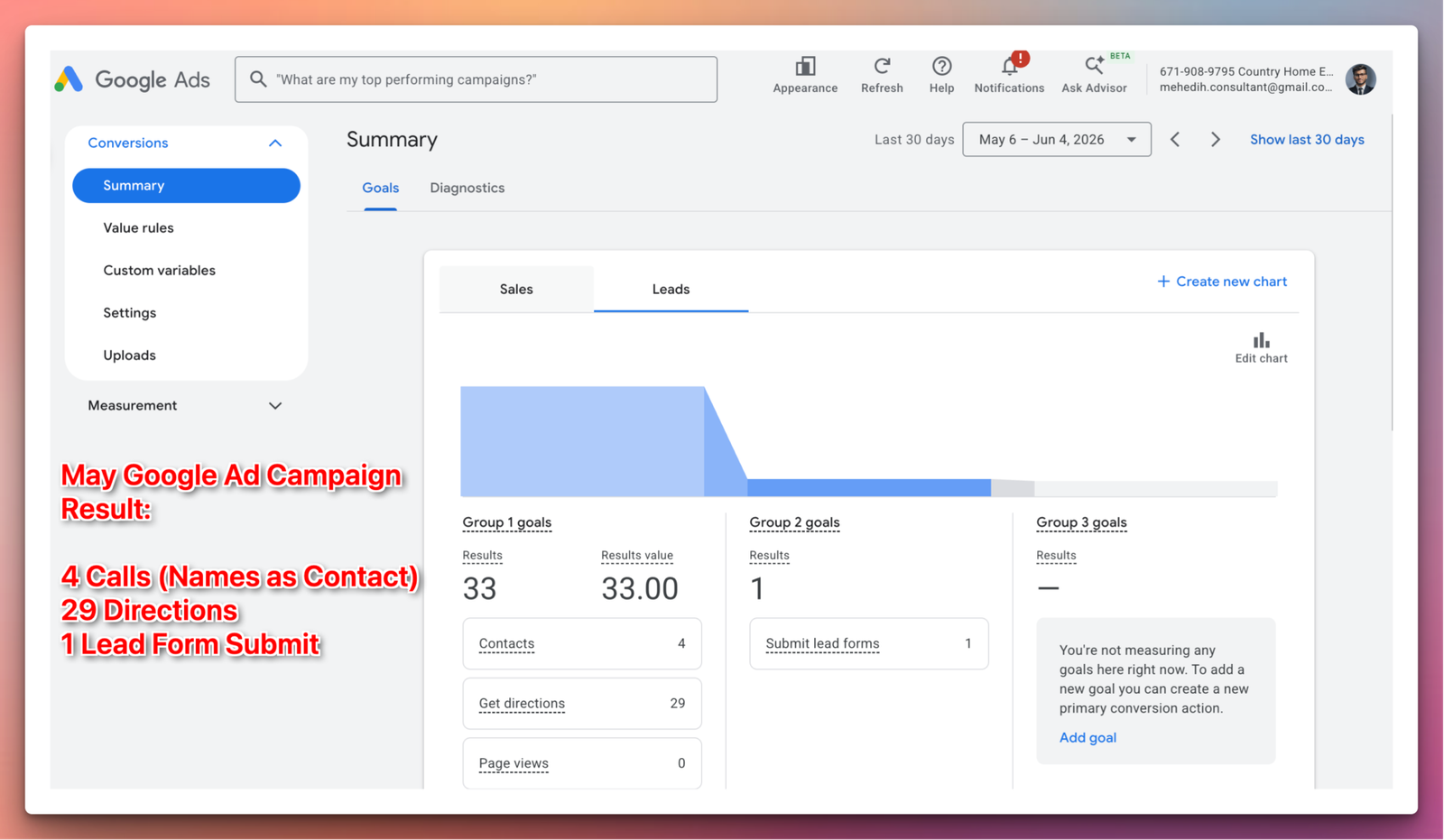
I have handled marketing for Country Home Estates, a long-term RV park in Oklahoma, since 2023, covering Google Ads, Meta ads, local SEO, the website and resident newsletters. In May, its Google Ads produced 29 direction requests, 4 phone calls and a lead form, all tracked through Google Tag Manager so every result can be tied back to the ads.
The same local search work drives results in other industries too. For a self storage facility in Texas, a fully optimized Google Business Profile brought in 252 calls in six months, which I break down in my self storage marketing guide.
Keep reading
Related guides for park owners
RV parks
RV Park Marketing: 12 Proven Ways to Get More Bookings
Fill nightly and monthly sites with Google, ads, reviews and email.
Housing ads
Facebook Ads for Real Estate: 66 Leads at $11.65 Each
How to get good leads inside Meta’s housing ad rules.
Google Maps
How to Rank Higher on Google Maps
The 12-step process to get your park into the map results.
Google Ads
Is Google Ads Worth It for a Small Business?
Real 2026 costs and a 2-minute break-even check.
Mobile home park marketing FAQ
Frequently asked questions
Answers to what park owners and managers ask most about filling lots and selling homes.
QHow do I market my mobile home park?
Start with a complete Google Business Profile, steady reviews from residents, and a website with an up-to-date page of available homes and lots. List your homes on MHVillage and rental sites, then add Facebook and Google ads that follow the housing ad rules, and call every lead back within minutes.
QHow do I fill vacant lots in a mobile home park?
Make lot rent, lot sizes and move-in rules easy to find online, partner with manufactured home dealers whose buyers need a lot, run Google Ads on searches like “mobile home lots for rent [city]”, and consider placing park-owned homes on empty lots to sell or rent.
QDo Facebook ads work for mobile home parks?
Yes, when they run under Meta’s Housing special ad category, show real video of available homes and the park, and use a short lead form with one or two qualifying questions. You can’t target by age, gender or ZIP code, so the ad itself has to attract the right people.
QCan I advertise my 55+ mobile home community on Facebook or Google?
Yes, but neither platform lets housing ads target by age. Choose the housing category, target the area around your community, and say clearly in the ad that it is a 55+ community, as long as your community legally qualifies as housing for older persons.
QWhat should a mobile home park website include?
A page of available homes with photos and prices, a lots-for-rent page with lot rent and move-in rules, an online application or tour form, community rules and pet policy, photos of the park, and a map of nearby schools, shops and employers. It should load fast on a phone.
QHow much does mobile home park marketing cost?
It depends on the channels. My local SEO plans start at $300 a month, Google Ads management is $300 a month, Meta ads management is $300 to $400 a month, plus ad spend paid to Google or Meta, and websites start at $400. All prices are on my pricing page.
Fill your empty lots faster
Book a free 30-minute call. I will look at how your park shows up on Google, compare you with the parks nearby and show you the quickest ways to bring in move-ins.

About the author
Mehedi Hasan is the founder of Hawkto Digital and is Google, HubSpot and Semrush certified. He markets long-term RV parks, self storage facilities and real estate businesses in the US, covering Google Business Profiles, local SEO, Google Ads, Meta ads, websites and resident newsletters. Read his story or see pricing.