Self Storage Marketing: 14 Proven Ideas to Fill More Units in 2026
Quick answer
The self storage marketing ideas that fill the most units are: a fully optimized Google Business Profile for every facility, location pages that rank for “storage near me”, a steady flow of Google reviews, clear prices and online rentals on your website, Google Ads on high-intent searches, and emails to existing tenants for reviews and referrals. Start with Google, because that is where most renters begin.
Filling storage units used to be simpler. Build in a good location, put up a sign, and wait for the phone to ring. In 2026, renters compare facilities on their phones in minutes, and the ones that show up first on Google with clear prices usually win the rental.
I market self-storage facilities in Texas for storage management companies, handling their Google Business Profiles, websites and social media. This guide shares the 14 self storage marketing ideas that consistently bring in rentals, grouped by where they fit in the renter’s journey, plus how to measure what is working.
In this guide
For storage owners and managers
Want this done for your facility?
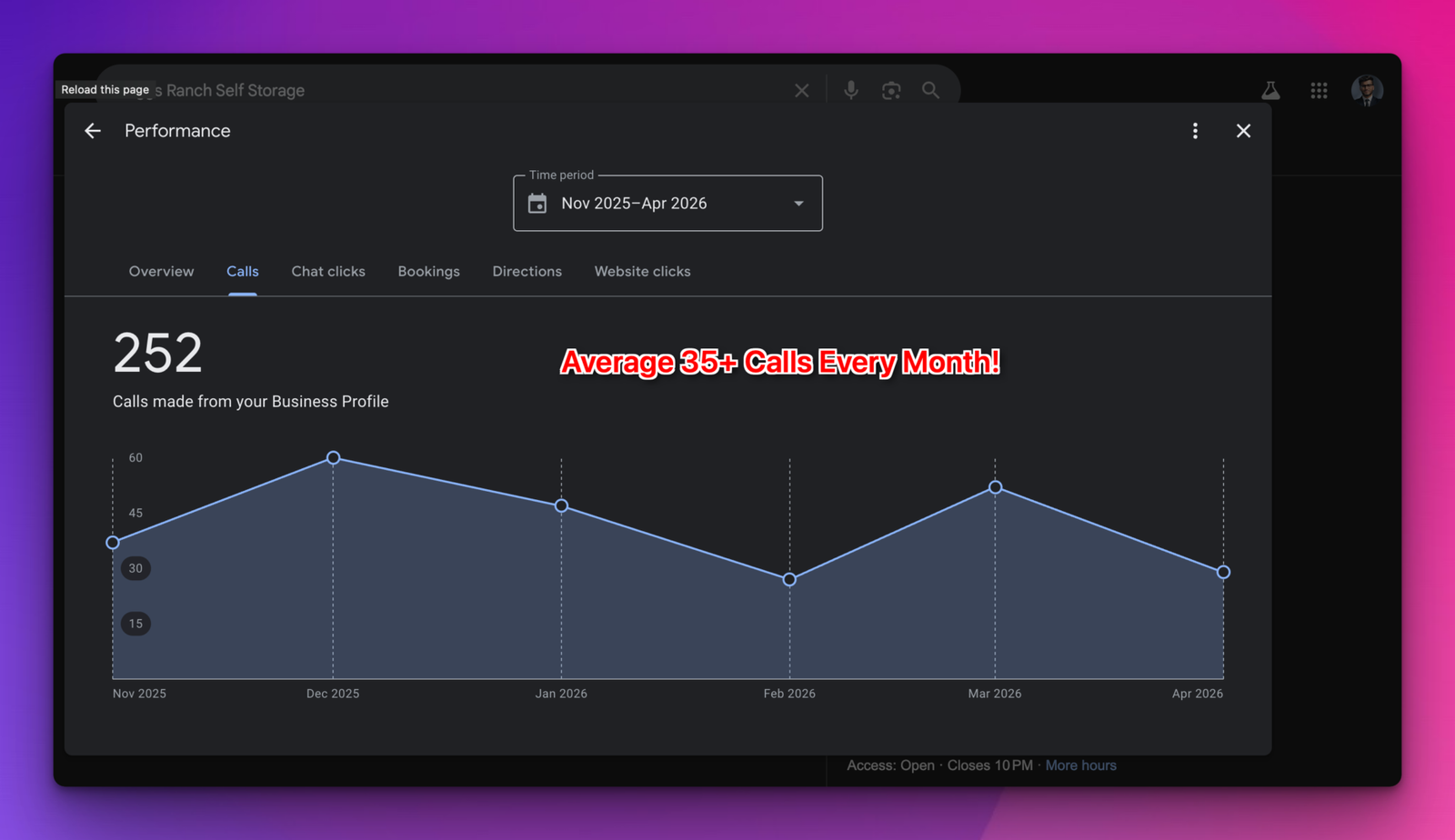
I market self storage facilities in Texas, including Briggs Ranch Self Storage, which got 252 calls from its Google Business Profile in 6 months. See how I can help with self storage marketing.
See self storage marketing servicesGet a free facility audit
Why self storage marketing is harder in 2026
Demand for storage is still strong. A 2026 StorageCafe survey found that 26% of respondents currently rent a storage unit and another 28% plan to. But competition for those renters has grown:
- National occupancy sat at about 77% at the end of 2025, essentially flat year over year.
- Average move-in rates fell to about $96, down 10.7% from the year before, as facilities competed on price.
- The five largest public operators control about 37.6% of rentable space, and they spend heavily on marketing.
Source: SpareFoot self-storage industry statistics, updated January 2026.
The good news: renters still care most about price and location, and they still start on Google. Independent and regional facilities that get the basics of self storage marketing right can beat the big brands in their own neighborhood.
14 self storage marketing ideas that fill units
Part 1 · Get found on Google
1. Optimize your Google Business Profile for every facility
When someone searches “storage units near me”, Google shows a map with three facilities before any website. Your Google Business Profile decides whether you are one of them. For most facilities, it is the single biggest source of calls.
- Set your primary category to Self storage facility, then add secondary categories only for what you really offer, such as RV storage facility or Boat storage facility.
- Add office hours and your gate access hours separately using “More hours”, so customers know when they can actually get to their unit.
- List every unit type as a service: climate-controlled units, drive-up units, vehicle parking, packing supplies.
- Upload real photos every month: the gate, the office, clean hallways, cameras, a few unit interiors.
- Give each location its own profile with its own address and phone number.
Google says local rankings come down to relevance, distance and prominence. For a deeper walkthrough, read my guide on how to rank higher on Google Maps.
2. Win the “storage near me” search with a page for each location
Google needs to see that your website backs up your profile. Each facility should have its own page with the city in the title and main heading, the full address and phone number, gate and office hours, unit sizes, an embedded map, directions from nearby landmarks and real reviews.
Link your Google Business Profile to that page, not just your homepage. A matching location page is often what pushes a facility from fourth or fifth on the map into the top three.
3. Ask every tenant for a Google review
Reviews are part of how Google judges prominence, and they are what renters compare when two facilities look the same. The best moments to ask are right after move-in, when the experience is fresh, and after the first smooth month.
Create your review link or QR code from inside your profile (Google shows how here), put it on move-in paperwork and the office counter, and include it in your welcome email. Ask every tenant, not just the happy ones, and never offer discounts in exchange for reviews; Google prohibits it. Reply to every review, especially the negative ones, within a day or two.
4. Keep your listings consistent across the web
Your facility’s name, address and phone number should match exactly on Apple Business Connect, Bing Places, Yelp, Facebook, the BBB and storage directories. Mismatched details from an old management company or a previous phone number weaken Google’s trust in your information. Search your facility name and old numbers, then fix every listing you find.
Part 2 · Turn searches into rentals
5. Show unit sizes and prices on your website
In a 2026 StorageCafe survey of 1,430 people, affordability was the most-mentioned factor when choosing a storage facility, cited in 28% of responses, with location second at 17%. Renters want to compare prices before they call. If your site makes them hunt for rates or “call for pricing”, many will simply book the facility that shows them.
Show every unit size with its price, features (climate control, drive-up, first floor) and availability. If you run a move-in special, put it next to the price, not buried on another page.
6. Let people rent or reserve online, any time
Many people look for storage in the evening or on weekends, often in the middle of a move. If your website only offers a phone number during office hours, you lose those renters to the facility down the road that lets them reserve in two minutes. Connect your management software’s online rental or reservation tool to your website and make the “Rent now” button impossible to miss on every unit.
7. Make your website fast and easy on a phone
Most storage searches happen on phones, often in a car or a half-packed apartment. Your site should load quickly, show prices without zooming, and have a tap-to-call button and directions on every page. Google’s Core Web Vitals targets are a good benchmark: LCP under 2.5 seconds, INP under 200 ms and CLS under 0.1.
If your facility site is slow, outdated or built on an old template from a previous manager, it is costing you rentals every week. That is the kind of site I rebuild through website development for local businesses.
8. Publish a unit size guide
“What size storage unit do I need?” and “What fits in a 10×10?” are questions renters search before they ever look for a facility. A simple size guide on your website, with a photo or diagram of each unit and examples like “a one-bedroom apartment” or “a garage full of tools”, answers that question, builds trust and gives Google more reasons to show your site. Link each size straight to its rental page.
Want to know where your facility is losing rentals?
I will review your Google Business Profile, website and top three competitors in a free 30-minute call, and show you the fixes that would bring in the most rentals first.
Part 3 · Paid ads that pay for themselves
9. Run Google Ads on high-intent searches
Organic rankings take months to build. Google Ads can put your facility at the top of the page this week, which is especially useful for a new facility, a lease-up or a slow season. Keep it tight:
- Target searches with clear intent such as “storage units near me”, “climate controlled storage [city]” and “RV storage [city]”.
- Limit ads to a few miles around each facility, where your renters actually come from.
- Use call assets and send clicks to the matching location page, not your homepage.
- Track calls and online rentals as conversions so you know your cost per move-in.
I manage Google Ads for local businesses with call tracking set up from day one, so every dollar can be tied to calls and rentals.
10. Use Facebook and Instagram ads around moving season
Demand for storage rises with moving season in late spring and summer. Meta ads let you reach people within a few miles of your facility with a clear offer, such as a move-in special or a free lock, and retarget people who visited your website but did not rent. Short videos of a clean, secure facility work far better than stock photos. If you want help with this, see how I run Meta ads for local businesses.
11. Use storage marketplaces, but do not depend on them
Aggregator sites such as SpareFoot can send real rentals, especially for new facilities. They typically charge a fee for each rental they send you, so treat them as a top-up channel in your self storage marketing, not your foundation. The more rentals you win through your own Google Business Profile, website and ads, the less you pay in commissions over time.
Part 4 · Keep units full
12. Email and text your existing tenants
Your tenant list is your most underused marketing asset. A simple email program can welcome new tenants, ask for reviews, remind people about online payments, promote referral rewards and announce seasonal offers, without paying for a single ad.
I run tenant newsletters for clients such as an Oklahoma RV park, including campaigns built specifically to drive Google reviews from existing tenants. If you want this done for you, my newsletter service is a one-time $300 setup and then $50 per newsletter.
13. Partner with movers, realtors and apartment managers
The people who talk to your future renters every day are local movers, real estate agents, apartment and property managers, and college housing offices. Offer them a simple referral card or a discount code for their clients. One good mover partnership can send you rentals every month.
14. Post on Google and social media every week
Weekly posts on your Google Business Profile, Facebook and Instagram keep your facility looking active and trustworthy: new security upgrades, a freshly paved drive, seasonal tips for storing furniture, a move-in special. Posts alone will not fill a facility, but they make every other channel convert better. I produce monthly social media post packs for several storage facilities, and consistency matters more than volume.
How to measure what is working
Good self storage marketing is measured in move-ins, not likes. These are the numbers worth checking every month:
| What to track | Where to find it |
|---|---|
| Calls, direction requests and website clicks from Google | Your Google Business Profile Performance report |
| Online reservations and rentals | Your storage management software |
| Which searches bring visitors to your site | Google Search Console |
| Cost per call and cost per rental from ads | Google Ads and Meta Ads Manager, with conversion tracking |
| New reviews and average rating each month | Your Google Business Profile |
| Occupancy and move-ins by facility | Your storage management software |
To judge whether marketing is worth it, compare its cost to what a tenant is worth. SpareFoot puts the average 10×10 non-climate unit at about $119 a month and the average stay at 18.5 months. That makes one new tenant worth roughly $2,200 in rent. If a channel brings in rentals for less than that, it is making you money.
Real results from storage facilities
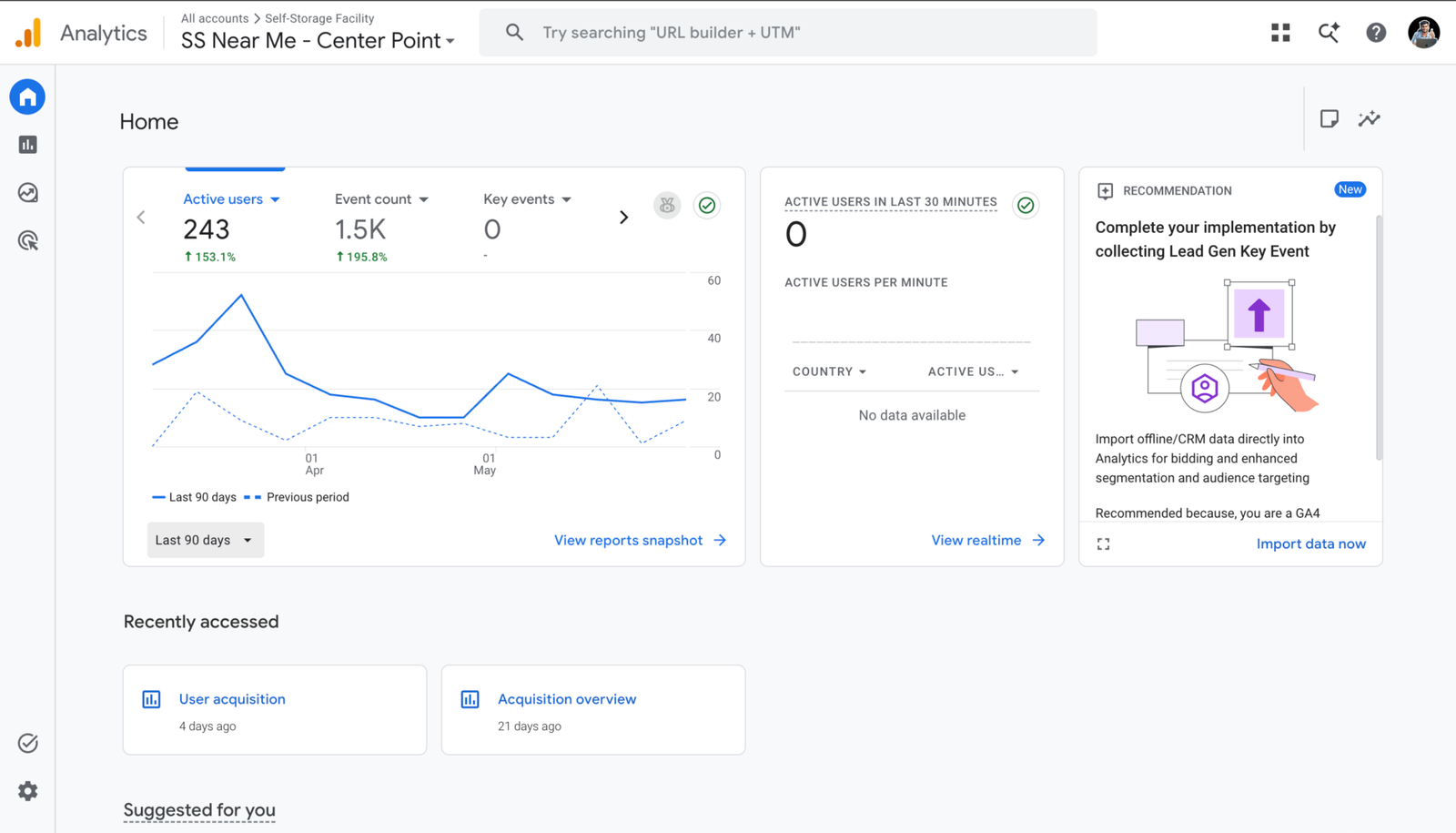
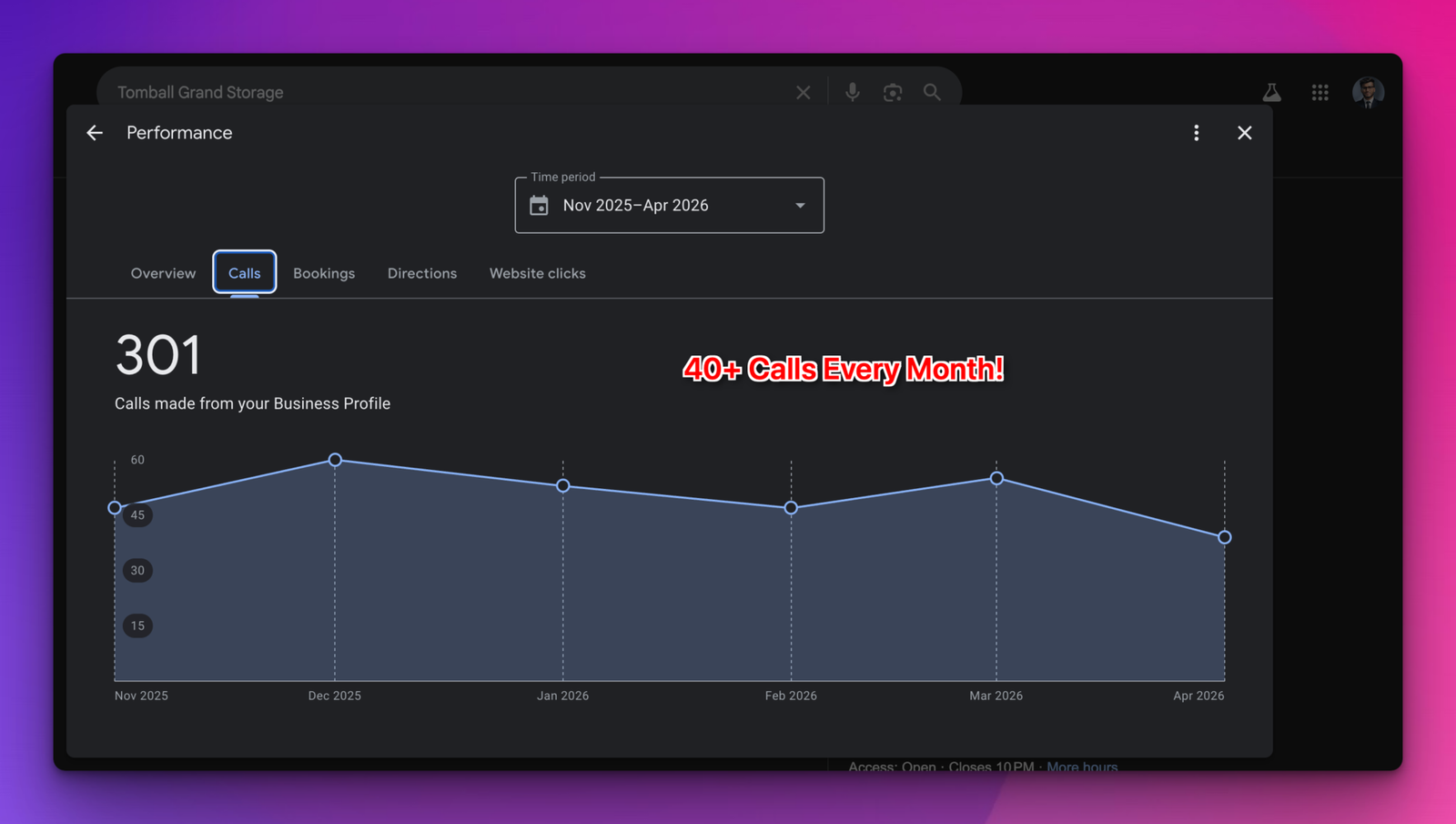
These are storage facilities I work with. Briggs Ranch Self Storage received 252 calls from its Google Business Profile in six months, an average of more than 35 a month. Tomball Grand Storage saw the same pattern after a full profile optimization.
Curious what this would cost for your facility? My prices are published on the pricing page, and I have also broken down what local SEO costs in 2026 in general.
Self storage marketing FAQ
Frequently asked questions
Answers to what storage owners and managers ask most about marketing their facilities.
QWhat is the best way to market a self storage facility?
Start with your Google Business Profile and a fast website that shows prices and lets people rent online. Most storage renters search on Google and choose a facility nearby, so ranking in the map results for “storage near me” usually brings the best return. Add Google Ads for faster results and reviews and tenant emails to keep growing.
QHow do I get more storage rentals online?
Make sure you appear in the Google Maps results for searches near your facility, show unit sizes and prices clearly, let people reserve or rent online at any time, and collect a steady flow of Google reviews. Then track calls and online rentals so you know which channels are working.
QHow much should a storage facility spend on marketing?
Work backwards from what a tenant is worth. With an average 10×10 renting for about $119 a month and an average stay of about 18.5 months, one new tenant is worth roughly $2,200. Local SEO starts at $300 a month with my plans, so it only needs to bring in a single extra rental every few months to pay for itself.
QIs SpareFoot worth it for self storage?
It can be, especially for new facilities that need rentals quickly. Because marketplaces usually charge a fee for each rental, it is smart to build your own Google Business Profile, website and ads at the same time so you rely on them less over time.
QWhen is the busiest season for self storage?
Demand usually peaks during moving season in late spring and summer, when people move homes and students move in and out. Plan your ads, offers and review requests so they are running before the busy months, not after they start.
Fill more units without guessing
I already market storage facilities for management companies in Texas. Book a free 30-minute call and I will show you exactly where your facility is losing renters to competitors, and what to fix first.

About the author
Mehedi Hasan is the founder of Hawkto Digital and is Google, HubSpot and Semrush certified. He markets self-storage facilities and RV parks for operators in the US, covering Google Business Profiles, local SEO, Google Ads, websites, social media and email. Read his story or see pricing.