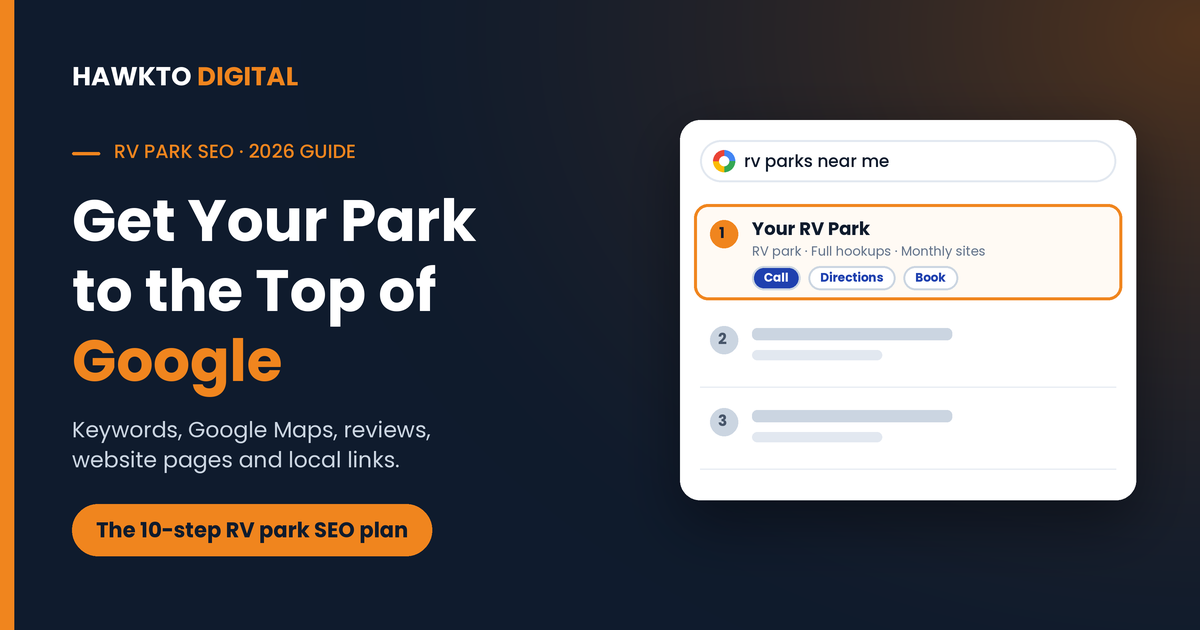
RV Park SEO: How to Get Your Park to the Top of Google in 2026
Quick answer
RV park SEO means getting your park into Google’s map and top results when travelers search for places to stay. The steps that matter most are: a fully optimized Google Business Profile with RV park as the primary category, steady reviews on Google and RV sites like Campendium and RV LIFE, consistent listings everywhere, a website with a page for rates, sites, monthly stays, directions and nearby attractions, fast mobile pages, structured data, and links from local tourism and event websites.
RV travel demand is strong. According to KOA’s 2026 Outdoor Hospitality Report, more than 52 million North American households camped in 2025 and 47% of campers prefer RVs. Many of those travelers pick their next stop on a phone, from whatever Google shows first.
That is what RV park SEO decides. I have marketed Country Home Estates, a long-term RV park in Oklahoma, since 2023, covering local SEO, Google Ads, Meta ads, the website and resident newsletters. This guide is the SEO deep dive: the 10 steps I use to get a park ranking for the searches that bring in nightly travelers and monthly guests. For the full marketing picture, including ads and email, start with my RV park marketing guide.
In this guide
For RV park owners
Want this done for your park?
I have marketed a long-term RV park in Oklahoma since 2023: Google Maps, Google Ads, Facebook ads, the website and resident newsletters. See how I can help with RV park marketing.
The 10-step RV park SEO plan
Part 1 · Know what RVers search
1. Build your keyword list around how RVers search
RV park SEO starts with the words travelers actually type. They fall into a few clear groups, and your park should have a page that answers each one:
| Search type | Examples | Page that should rank |
|---|---|---|
| Near me and city | “RV park near me”, “RV parks in [city]”, “RV camping [city]” | Your homepage and Google Business Profile |
| Near an attraction | “RV parks near [lake / state park / stadium]” | A guide page for that attraction |
| Along a route | “RV parks off I-40 [town]”, “RV parks on Route 66” | Your directions page, with highway and exit details |
| Monthly and long-term | “Monthly RV lots [city]”, “long-term RV parks near [city]” | A dedicated monthly sites page |
| Feature searches | “Pet friendly RV park [city]”, “RV park with full hookups [city]”, “big rig friendly” | Your sites and amenities pages |
Search each one yourself on a phone. Note which parks show in the map and the top results. Those are the parks you are competing with, not the campground two states away.
Part 2 · Win the Google map
2. Make your Google Business Profile the strongest in your area
For “RV park near me” searches, the map comes first, and the map is driven by your Google Business Profile. Google ranks it on relevance, distance and prominence. You can’t move your park, so focus on the other two:
- Relevance: choose RV park as your primary category, add Campground only if you take tents or cabins, and list the features RVers filter on in your services and description.
- Prominence: a steady flow of reviews, regular photos and weekly posts.
My guide on how to rank higher on Google Maps walks through all 12 steps, and my RV park marketing guide covers the RV-specific profile settings. If you would rather hand this off, it is what my Google Business Profile optimization service does.
3. Get reviews on Google and on the RV review sites
RVers read reviews in two places: Google, and RV-specific sites such as RV LIFE Campground Reviews, Campendium and Good Sam. Both matter. Google reviews help your map ranking, and RV site reviews win the travelers who plan their route in those apps.
- Ask every overnight guest at checkout or with a short text the next day, and ask monthly residents once they have settled in.
- Put a QR code for your Google review link in the office and the laundry room.
- Reply to every review on every site. Future guests read your replies as closely as the reviews.
For long-term residents, email works especially well. For Country Home Estates, a long-term RV park I market in Oklahoma, I built a themed email newsletter for existing residents specifically to bring in Google reviews. My Google Maps guide explains how to reply to reviews the right way.
4. Keep your park details identical everywhere
Your park is listed on many sites you may not even remember: Good Sam, Campendium, RV LIFE, Hipcamp, Yelp, Facebook, Apple Maps, Bing Places, the local chamber and tourism sites. Search engines compare these listings. Make sure the park name, address, phone number, website and site specs are the same everywhere, and fix any old phone numbers or closed seasons that are still showing.
Read more about why this matters in keeping your name, address and phone number consistent.
Want to know where your park ranks right now?
In a free 30-minute call I will check where your park shows up for the searches that matter, compare you with the top parks nearby and show you what to fix first.
Part 3 · Build a website Google wants to rank
5. Create one page for each thing travelers need
A single-page website can’t rank for twenty different searches. These are the pages most RV park websites should have, each with a clear title and heading that matches the search it targets:
- Rates: nightly, weekly and monthly prices on one page.
- Sites and hookups: pull-through or back-in, 30 and 50 amp, maximum rig length, surface type, with a site map.
- Amenities and rules: Wi-Fi, laundry, bathhouse, pool, dog park, quiet hours, pet policy.
- Monthly RV sites: monthly rates, what utilities are included, deposits and rules.
- Directions: from each nearby highway, with exit numbers and a map.
- Things to do nearby: attractions, events, restaurants and employers.
Put your park name and town in each page title, for example “Monthly RV Sites in Tulsa, OK | Your Park Name”. Link the pages to each other and to your booking page.
6. Write local guides that win “near [attraction]” searches
Travelers often search for the thing they are visiting, not the park. A helpful guide to the lake, state park, stadium or event venue near you can rank for those searches and bring in trip planners months before they book.
Make every guide genuinely useful: distance and driving time from your park, parking for big rigs, best times to visit, and nearby fuel and dump stations. End each guide with your rates and a booking link. Write one strong guide per major attraction rather than many thin pages that only swap the town name, which Google treats as low quality.
7. Make the site fast, mobile-friendly and easy to book
Many RVers search from a phone, often on a weak signal. Google’s Core Web Vitals measure real users’ experience: a page’s main content should load within 2.5 seconds, react to taps within 200 milliseconds and not jump around while loading.
- Compress photos before uploading them. Big photo galleries are a common cause of slow park websites.
- Put the phone number and a “Book now” button at the top of every page.
- If your reservation system runs on another domain, set up tracking across both so you can see which pages lead to bookings.
If your site is slow or dated, that is exactly what I fix through website development for local businesses, live in 7 to 14 days.
8. Add structured data so Google understands your park
Structured data is code that tells search engines exactly what your business is, where it is and when it is open. Schema.org has a dedicated RVPark type, and a Campground type for parks that also take tents and cabins. Add your name, address, phone, hours, price range and photos, and add FAQ markup to pages that answer common questions. It won’t lift rankings on its own, but it helps Google read your pages correctly. Most SEO plugins, such as Rank Math, let you add it without writing code.
Part 4 · Earn trust from other websites
9. Get local links and mentions
Links from relevant local websites are an important signal that your park is a real, trusted part of the community. Good sources for RV parks:
- Your local tourism board, visitor center and chamber of commerce.
- Events and venues nearby: rodeos, fairs, races, festivals. Offer event rates and ask to be listed as recommended lodging.
- Local employers and contractors who house traveling workers.
- RV clubs and rally organizers, if you host groups.
Never buy links in bulk. They rarely help and can hurt.
Part 5 · Measure what matters
10. Track bookings, not just rankings
Rankings are only useful if they bring in guests. Check these every month:
| What to track | Where to find it |
|---|---|
| Searches you appear for, clicks and average position | Google Search Console |
| Calls, direction requests and website clicks | Google Business Profile performance report |
| Bookings and where they came from | Your reservation software and Google Analytics |
| New reviews and average rating | Google and the RV review sites |
| Occupancy for nightly and monthly sites | Your reservation software |
Expect clear movement in 3 to 6 months. Map rankings can improve faster after profile fixes, while website rankings for competitive searches take longer.
RV park SEO mistakes to avoid
- Stuffing keywords into your business name. “Sunset RV Park Best RV Park Tulsa” can get your profile suspended. Use your real name.
- One page for everything. Rates, monthly sites, directions and attractions each need their own page to rank.
- Copy-paste town pages. Dozens of pages that only swap the town name look like spam to Google. Write fewer, better guides.
- Ignoring RV review sites. Many travelers check Campendium or RV LIFE before booking, even after finding you on Google.
- Out-of-date seasons and prices. Wrong hours or rates on any listing cost you bookings and trust.
- Heavy, slow photo galleries. Big images make pages slow on the weak signal many travelers have on the road.
Real results from an RV park
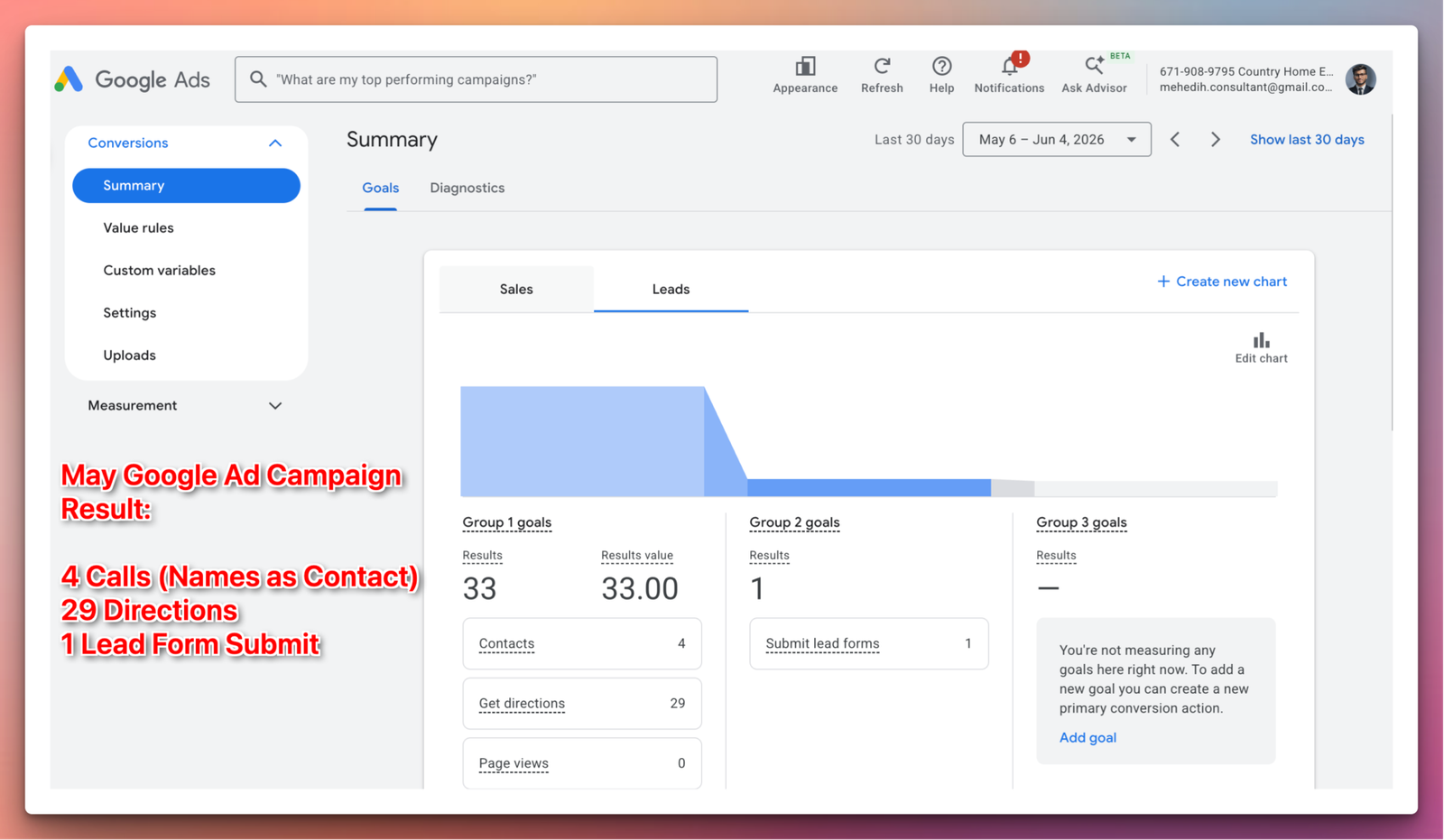
For Country Home Estates, I run local SEO alongside Google Ads, with every call, form and direction request tracked through Google Tag Manager. In May, the Google Ads campaign alone produced 29 direction requests, 4 phone calls and a lead form, while SEO builds the rankings that bring guests in without paying for each click.
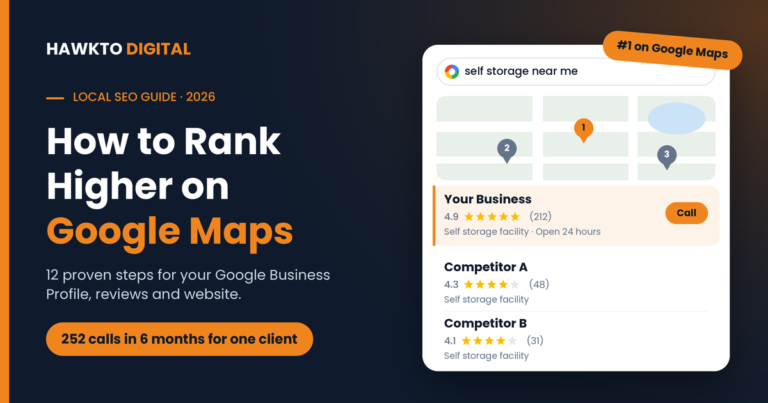
For a look at how a fully optimized Google Business Profile performs over time, my self storage guide shows a facility that got 252 calls in six months. To compare SEO with ads, read Google Ads vs SEO vs Facebook ads, and see what a plan costs in my breakdown of local SEO pricing in 2026.
Keep reading
Related guides for park owners
The full playbook
RV Park Marketing: 12 Proven Ways to Get More Bookings
Google, directories, ads, reviews and email for nightly and monthly guests.
Long-term residents
Mobile Home Park Marketing: 12 Ways to Fill Lots
For parks with manufactured homes, lots for rent and long-term residents.
Google Maps
How to Rank Higher on Google Maps
The 12-step process to get your park into the map results.
Paid search
Is Google Ads Worth It for a Small Business?
Real 2026 costs and a 2-minute break-even check.
RV park SEO FAQ
Frequently asked questions
Answers to what RV park owners and managers ask most about ranking on Google.
QWhat is RV park SEO?
RV park SEO is the work of getting your park to show up when travelers search on Google for places to stay, such as “RV park near me” or “RV parks near [attraction]”. It covers your Google Business Profile, reviews, listings on RV sites, your website’s pages and speed, and links from local websites.
QHow long does SEO take for an RV park?
Most parks see clear movement in 3 to 6 months. Fixes to your Google Business Profile can help map rankings within weeks, while ranking your website for competitive searches takes longer and depends on how strong nearby parks are.
QHow much does RV park SEO cost?
It depends on your market and how much work is needed. My Standard SEO plan is $300 a month for 6 months and Boosted SEO is $800 a month for 3 months. My local SEO cost guide breaks down typical prices across the industry.
QIs SEO or Google Ads better for an RV park?
They work best together. Google Ads can bring bookings within days for searches like “RV park near [city]”, while SEO builds rankings that keep bringing guests without paying for every click. A common approach is to start with ads while SEO builds up.
QDo I need a separate page for monthly RV sites?
Yes. Long-term guests search differently from overnight travelers, with searches like “monthly RV lots [city]”. A dedicated page with monthly rates, included utilities and rules gives Google a clear page to rank for those searches and gives guests what they need to decide.
QCan I do SEO for my RV park myself?
You can do a lot yourself: complete your Google Business Profile, ask every guest for a review, keep your listings consistent and add the key pages to your website. Hiring help makes sense when you don’t have time to keep it going every month or when nearby parks are already competing hard.
Get your park to the top of Google
Book a free 30-minute call. I already market an RV park in Oklahoma. I will show you where your park ranks today, what the top parks near you are doing, and the fastest fixes.

About the author
Mehedi Hasan is the founder of Hawkto Digital and is Google, HubSpot and Semrush certified. He has marketed a long-term RV park in Oklahoma since 2023 and helps RV parks, self storage facilities and other local businesses in the US rank on Google with local SEO, Google Business Profiles, Google Ads and fast websites. Read his story or see pricing.