I Audited 134 RV Park Websites. Here’s What Most Get Wrong
Quick answer
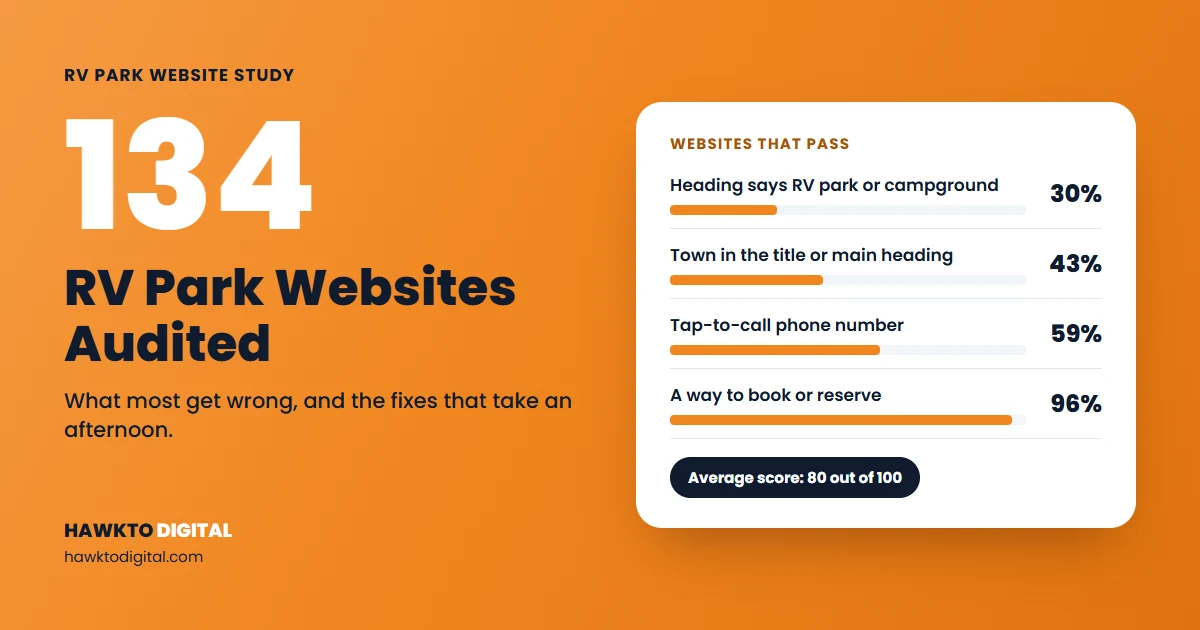
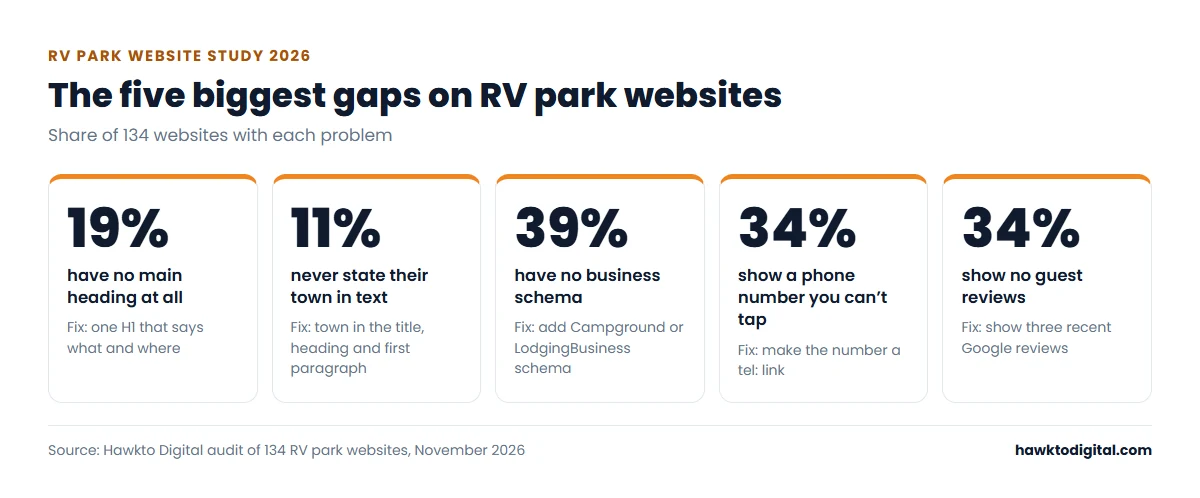
I ran the same 19 checks on 134 independent RV park websites in 12 US states. The average score was 80 out of 100. The basics are mostly in place: 96% offer a way to book, reserve or check availability and 94% are set up for phones. The gaps are in telling Google what and where the park is. Only 30% have a main heading that says RV park or campground, only 43% name their town in the title or main heading, 39% have no business schema, and 34% show a phone number you can’t tap to call.
Updated 14 November 2026. I re-ran this study with a stricter version of the audit tool. It now also reads each site’s contact, rates and reviews pages, recognises more kinds of maps, review widgets and phone formats, and leaves out sites it can’t read properly instead of scoring them. The figures below replace the first set, which under-counted maps, addresses and phone numbers.
Most RV park owners I talk to assume their website is fine because it loads and the photos look good. Whether Google can tell what the park is, and where, is a separate question, and it decides whether you show up for “RV park near me”.
It matters because search is now where campers start. In the RMS 2026 report, 64% of campers said they use online search to find campsites (RMS). Google says it ranks local results on relevance, distance and prominence (Google). You can’t change distance, but relevance starts with the words on your own RV park website.
So I measured it. I built a free RV park SEO audit tool that reads a park’s homepage and the key pages it links to, runs 19 checks, and then ran it on a sample of RV park websites across the country. This post is what came back. No park is named; the point is the pattern.
In this study
For RV park owners
Want this done for your park?
I have marketed a long-term RV park in Oklahoma since 2023: Google Maps, Google Ads, Facebook ads, the website and resident newsletters. See how I can help with RV park marketing.
The overall scores
Each check is worth a set number of points. A pass earns all of them, “needs work” earns half, and a miss earns none. A check the tool could not confirm on a particular site is left out of that site’s score. Across the 134 websites:
- The average score was 80 out of 100, and the median was 82.
- 58% scored 80 or more, which means the site covers the basics well.
- 41% scored between 50 and 79: a workable site with clear gaps.
- 1% scored under 50. The lowest score was 40 and the highest was 100.

All 19 checks, ranked from worst to best
“Needs work” means the item is partly there, for example a phone number that is shown but can’t be tapped, or an address that is on the contact page but not the homepage.
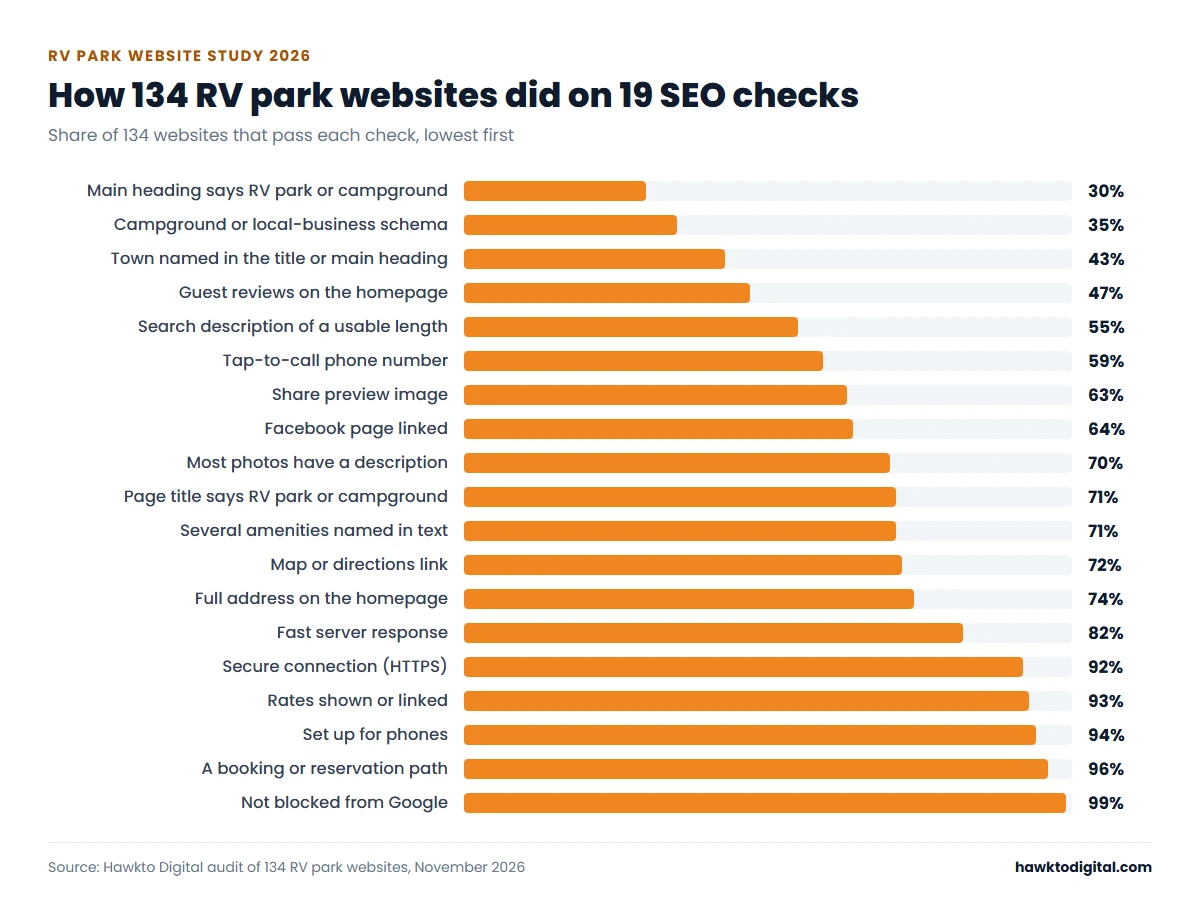
The same numbers in full. “Can’t confirm” covers sites where a part of the page loads after it opens, so an automated check can’t be sure either way:
| Check | Pass | Needs work | Missing | Can’t confirm |
|---|---|---|---|---|
| Main heading says RV park or campground | 30% | 51% | 19% | – |
| Campground or local-business schema | 35% | 26% | 39% | – |
| Town named in the title or main heading | 43% | 46% | 11% | – |
| Guest reviews on the homepage | 47% | 5% | 34% | 14% |
| Search description of a usable length | 55% | 25% | 19% | – |
| Tap-to-call phone number | 59% | 34% | 4% | 3% |
| Share preview image | 63% | 37% | 0% | – |
| Facebook page linked | 64% | 35% | 0% | 1% |
| Most photos have a description | 70% | 19% | 11% | – |
| Page title says RV park or campground | 71% | 29% | 0% | – |
| Several amenities named in text | 71% | 25% | 2% | 1% |
| Map or directions link | 72% | 16% | 0% | 12% |
| Full address on the homepage | 74% | 13% | 7% | 7% |
| Fast server response | 82% | 17% | 1% | – |
| Secure connection (HTTPS) | 92% | 0% | 8% | – |
| Rates shown or linked | 93% | 7% | 0% | – |
| Set up for phones | 94% | 0% | 6% | – |
| A booking or reservation path | 96% | 0% | 4% | 1% |
| Not blocked from Google | 99% | 0% | 1% | – |
Share of 134 RV park websites. Rows may not add up to 100% because of rounding.
The five biggest gaps and how to fix them
1. The main heading doesn’t say what the park is
Only 30% of homepages had one main heading (the H1) that mentions RV park or campground. 19% had no main heading at all, and 51% had a heading that says something else, usually “Welcome” or a slogan, or had several competing headings.
Fix: one H1 that says what and where, such as “RV Park in Shawnee, Oklahoma”. Keep the welcome line as a smaller heading underneath.
2. The town isn’t where Google looks first
43% of sites name their town in the page title or main heading. Another 46% mention the town somewhere on the page but not in those two places, and 11% never state it in text on the homepage at all. A map or a logo with the town in it doesn’t count, because Google reads words.
Fix: put the town and state in the page title and the main heading, and again in the first paragraph. The RV park keyword list shows which place-based searches to build pages around.
3. No business schema
Schema is a small block of code that tells Google your name, address, phone and business type in a format it can read without guessing. 39% of sites had none, and 26% had only a generic type. 35% had a local business type.
Fix: add Campground or LodgingBusiness schema with the same name, address and phone number as your Google Business Profile. Most SEO plugins can do this from a settings screen.
4. Phone numbers you can’t tap
Most RV guests search from a phone, often from the road. 59% of sites had a tap-to-call link on the homepage. On 34% the number was there but couldn’t be tapped, or only appeared on an inner page, and on 4% the tool found no phone number on any page it read.
Fix: make the number a link at the top of every page. It is a one-line change for whoever edits your site.
5. Reviews and the address are missing from the homepage
39% of homepages don’t show or mention guest reviews. 19% don’t have a full address with state and ZIP on the homepage; on 13% it is on the contact page only, and on 7% I couldn’t find it on any page read. A map or directions link was found on 72% of sites; on 16% I found none, and 12% couldn’t be confirmed either way.
Fix: show three recent Google reviews on the homepage, put the full address in the footer exactly as it appears on your Google profile, and embed your map with a “Get directions” link. The review guide and the Google Business Profile guide cover both.
Smaller gaps worth an hour
- Search description: 19% have none, so Google writes its own from whatever text it finds, and 25% are too short or too long.
- Page title: 71% pass. 29% have a title that never says RV park or campground, or is long enough to be cut off.
- Photo descriptions: on 11% of sites, most photos have no description at all.
- Share image: 37% have no preview image set, so links shared on Facebook or in messages look bare.
What most parks already get right
The base is in better shape than I expected:
- 96% offer a way to book, reserve or check availability.
- 93% show or link to their rates.
- 82% of servers answered quickly, and 92% load over HTTPS.
- 94% are set up for phones.
So for most parks the job is not a rebuild. It is an afternoon of edits to the title, the heading, the phone link and the footer.
A 60-minute fix list for your own website
If you only have an hour, do these in order. Each one is a change in your website’s editor, and none needs a developer.
- Page title (5 minutes): “Park Name | RV Park in Town, ST”, under about 60 characters. Google explains how it builds title links here.
- Main heading (5 minutes): one H1 on the homepage that says what the park is and where.
- Phone link (5 minutes): make the number at the top of the page a tap-to-call link.
- Search description (10 minutes): one or two sentences, about 150 characters, with what you are, the town and one reason to choose you. Google’s guidance on descriptions is here.
- Footer (10 minutes): full address with state and ZIP, written the same way as on your Google profile, plus an embedded map.
- Reviews (10 minutes): three recent Google reviews on the homepage, with a link to the rest.
- Schema (15 minutes): turn on local business schema in your SEO plugin and choose Campground or LodgingBusiness. Google lists the fields it reads here.
Then run the audit tool again and watch the score move. If your site needs more than an hour, the RV park website design guide covers what a booking-focused park site should include.
The half this study can’t see: Google Maps
A good RV park website makes you relevant. It does not, on its own, put you in the map results, where most “near me” searches end. That depends on your Google Business Profile, your reviews and how many other sites mention you. I checked none of those here, so a park can score 95 in this study and still sit below three competitors on the map.
I walk through the Maps side step by step in this video:
For the written version, see the Google Business Profile guide for RV parks and the full RV park SEO guide.
Need the wider market picture? See RV park and campground industry statistics for 2026: parks by state from Census data, RV shipments, RV ownership and camping trends.
How the study was done, and its limits
- Sample: RV parks listed in OpenStreetMap with a website and a town, in 12 US states: California (15), Arizona (14), Florida (14), Missouri (13), Georgia (13), Washington (12), Michigan (11), North Carolina (11), Colorado (11), Texas (10), Oklahoma (8), New York (2). I removed chains, government-run parks, booking portals and social media pages, kept one entry per website, shuffled the list and took up to 18 per state.
- Reach: 190 websites were attempted in November 2026. 56 are excluded: 20 did not respond, 11 returned an error page, 13 sat behind a security screen, and 12 build their whole page with JavaScript, which an automated check can’t read reliably. That leaves 134.
- Pages read: the homepage, plus up to three pages it links to: contact or location, rates, and reviews. An inner page was read for 78% of sites.
- Checks: the same 19 checks as the public audit tool, run once per site.
- Accuracy check: I loaded the sample homepages in a real browser, with JavaScript running, and compared what it saw with what the tool reported. On the 51 homepages both could read, they agreed on the main heading for all 51, on a tap-to-call link for 49 and on a Facebook link for 48. The tool said a map was missing where the browser could see one on a single site, which serves different content from one visit to the next. On reviews and addresses, the disagreements were almost all site builders loading that block late, which the tool reports as “can’t confirm” instead of “missing”.
What this study can’t tell you:
- It reads a few pages per site, not the whole site. Something that only appears on a page it didn’t open is not counted.
- Some site builders load maps and widgets after the page opens. Where the tool couldn’t be sure, it reports “can’t confirm” and leaves that check out of the score, rather than calling it missing.
- RV Park websites listed in OpenStreetMap are not a perfect cross-section of the country. Businesses with no website aren’t here at all, and only 11 states have eight or more sites in the sample.
- It does not measure Google rankings, Google Business Profiles, review counts or links. Those decide the map results, and they need a person to check.
RV Park website study FAQ
Frequently asked questions
About the sample, the checks and what the numbers mean.
QHow many RV park websites did you check?
190 websites were attempted and 134 could be read reliably. The other 56 did not respond, returned an error, sat behind a security screen or were built entirely with JavaScript, so they are left out rather than guessed at.
QWhere did the list of parks come from?
From OpenStreetMap, the public map database. I took places tagged as RV parks (caravan sites) in 12 US states that list a website and a town, removed chains, government-run parks, booking portals and social media pages, kept one entry per website, and capped each state at 18 so no state dominates.
QWhat is the most common problem on RV park websites?
The main heading. Only 30% of homepages had a single main heading that says RV park or campground. 19% had no main heading at all.
QDoes a high score mean a park ranks well on Google?
No. The score covers the website. Rankings on Google Maps depend heavily on the Google Business Profile, reviews and links, which this study did not measure.
QCan I check my own park the same way?
Yes. The same 19 checks run in the free RV park SEO audit tool. It takes about 30 seconds and you don’t need an account.
Sources
Sources
Study data collected in November 2026.
- Hawkto Digital, audit of 134 RV park websites with the RV park SEO audit tool (this study)
- OpenStreetMap contributors, the source of the list
- Google Business Profile Help, Tips to improve your local ranking on Google
- Google Search Central, Influencing your title links in search results
- Google Search Central, Control your snippets in search results
- Google Search Central, Local business structured data
- RMS, 2026 State of the Outdoor Accommodation Report (via Hospitality Net)
See how your park compares
Run the same 19 checks on your own website. It takes about 30 seconds, it’s free, and each problem comes with a plain-English fix.

About the author
Mehedi Hasan is the founder of Hawkto Digital and is Google, HubSpot and Semrush certified. He has run local SEO, reviews, email, Google Ads and Meta ads for a long-term RV park in Oklahoma since 2023, and marketing for local businesses across the US. Read his story or see pricing.