RV Resort Marketing: How Premium Resorts Fill Sites at Higher Rates
Quick answer
RV resort marketing works when you sell the experience and price each site by what it’s worth. Tier your sites (in 2026 pricing data, luxury-labeled sites averaged $198.05 a night), let guests choose and lock their exact site, use dynamic pricing, and sell add-ons during booking. Then show the resort in professional photos and video, rank for amenity searches like “RV resort with pool”, advertise the experience instead of discounts, and turn every stay into a recent review and a repeat booking.
An RV park sells a place to stay. An RV resort sells an experience: the view, the pool, the clubhouse, the space between sites, the feeling of a vacation. That changes how you market it. Resort guests compare photos, amenities and reviews before price, and they’ll pay more for the right site if you show them why it’s worth it.
I’ve marketed Country Home Estates, a long-term RV park in Oklahoma, since 2023, across local SEO, Google Ads, Meta ads, the website and newsletters. This guide combines what works in that day-to-day work with the latest industry data, including a 2026 pricing study of 2,110 campgrounds and Campspot’s review of 3.7 million reservations, so every recommendation has a reason behind it.
In this guide
For RV park owners
Want this done for your park?
I have marketed a long-term RV park in Oklahoma since 2023: Google Maps, Google Ads, Facebook ads, the website and resident newsletters. See how I can help with RV park marketing.
RV resort vs RV park marketing
There’s no official definition of an RV resort. In practice, resorts offer more amenities, more space and more service than a typical RV park, and charge for it. That shifts what your marketing has to do:
| RV park | RV resort | |
|---|---|---|
| What guests buy | A convenient, clean place to stay | An experience and a destination |
| What wins the booking | Location, hookups, price, availability | Views, amenities, activities, reviews |
| Key marketing assets | Google profile, rates, directions | Photos, video, site tiers, amenity pages |
| Pricing approach | Mostly one rate per site type | Tiered sites, dynamic rates, add-ons |
| Biggest growth lever | Showing up in “near me” searches | Repeat guests, reviews and premium sites |
Many parks sit somewhere in between. If you have even a few premium sites or a standout amenity, the strategies below will help you earn more from them.
12 RV resort marketing strategies
Part 1 · Price and package the stay
1. Tier your sites and name them for what they’re worth
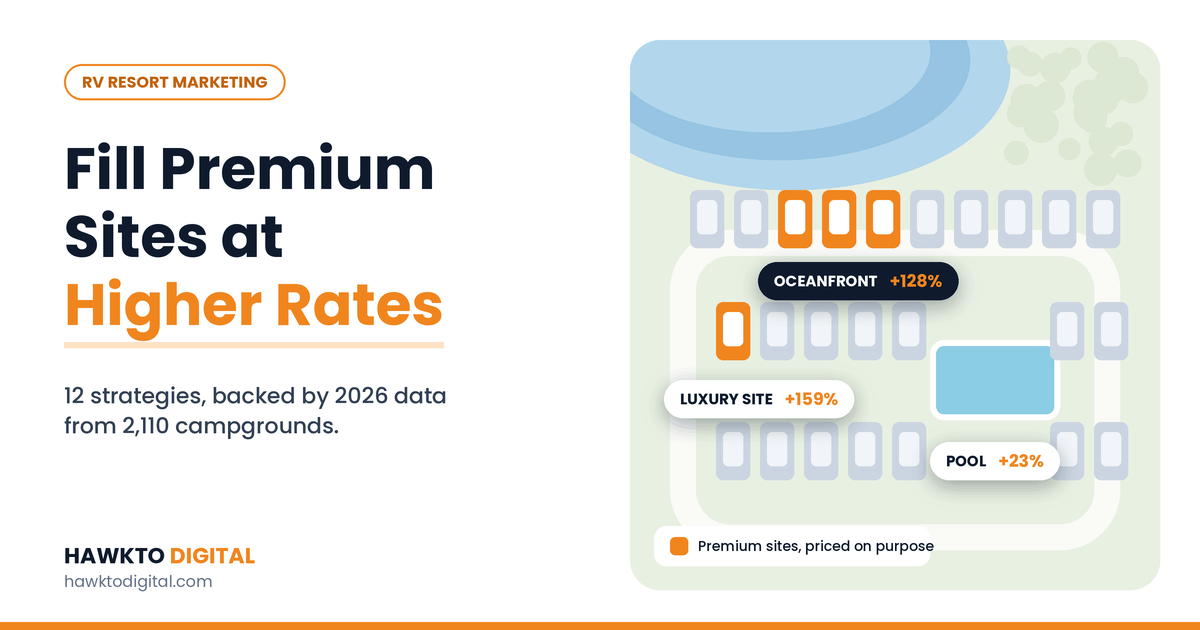
A resort doesn’t sell “a site”. It sells a lakefront site, a patio site, a big-rig pull-through or a site steps from the pool. The Insider Perks 2026 pricing report, which analyzed 609,863 data points across 2,110 campgrounds, shows how much the label and the location matter:
| Site or feature | Price difference in the data |
|---|---|
| Sites labeled “Luxury” | Average $198.05 a night, 159.4% above the dataset average |
| Oceanfront sites | Average $157.66 a night, 128% above non-waterfront sites |
| Full hookups | 57% more than dry camping, about $25.58 a night |
| Swimming pool | 23.3% higher average rates |
| Dog park | 18.2% higher average rates |
| Pull-through sites | Only 3.6% more than back-in sites |
That last line is an opportunity. Big-rig owners value an easy pull-through, yet most parks barely charge for it. These are averages across many parks, not a guarantee for yours, but they show where guests are willing to pay more.
Do this first: Group your sites into three or four named tiers, describe what makes each one better, and price the gap on purpose instead of by habit.
2. Let guests pick, and pay to lock, their exact site
Premium guests care about where they park: the view, the shade, the distance to the pool or the bathhouse. In the RMS 2026 State of the Outdoor Accommodation Report, nearly 85% of campers said they’re more likely to book when they can select their exact site in advance.
Many reservation systems also let you charge a small fee to guarantee a specific site. Campspot reports its Lock Site feature generated $22.9 million for parks in 2025, up 12% on the year before (Campspot 2025 year in review).
Show an interactive site map on your booking page with photos of each site type, so guests can see exactly what they’re paying for.
Do this first: Turn on site selection in your booking system, add photos to each premium site, and test a site lock fee on your most requested sites.
3. Use dynamic pricing instead of one rate all year
Dynamic pricing raises rates when demand is high (holidays, events, peak season) and lowers them to fill slow nights. Campspot reports that campgrounds using dynamic pricing make 70.3% more on average (Campspot). That figure comes from the software maker and compares parks that chose to use the feature, so treat it as a sign of direction rather than a promise.
The pricing data supports it. The most aggressive parks in the Insider Perks report charge over $480 more on peak holidays than on their slowest nights, and resorts in Florida and Arizona charge 12% to 20% more in winter than in summer (Insider Perks).
It matters even more when demand softens. Campspot found transient bookings were down 2.2% year over year through May 2026, as gas prices passed $4 a gallon, and it recommends dynamic pricing to avoid underpricing slow periods while still earning more on busy ones (Campspot 2026 demand report).
Do this first: Set three price levels (peak, regular and value) for each site tier, and review them every month against your occupancy.
4. Package add-ons and experiences
Guests spend money around their stay. The KOA 2026 Outdoor Hospitality Report found average daily spending per person exceeded $200 in 2025, not counting accommodation. A resort can capture part of that with add-ons offered during booking:
- Golf cart, kayak or bike rentals
- Early check-in or late checkout
- Firewood, welcome baskets or grocery pre-stocking
- Event, holiday and weekend packages
- Pet packages for dog-friendly resorts
It works at scale: Campspot parks added 300,301 add-ons to reservations in 2025, worth $43.6 million and up 13% on the year before (Campspot).
Do this first: Add your three most-requested extras to the booking flow and mention them in the confirmation email.
Part 2 · Show the experience
5. Invest in professional photos and video
A premium price needs premium proof. Guests decide from photos long before they read your amenity list. Hire a professional once a year to shoot:
- Each site tier with a real rig parked on it, awning out
- Your best amenities in use: the pool, the clubhouse, the dog park, the waterfront
- A drone shot showing the resort and its setting
- Short vertical videos for Instagram, Facebook and YouTube
Use the same library everywhere: your website, Google Business Profile, RV directories, booking sites and ads.
Do this first: Book a shoot for your best-looking month and get a mix of photos, drone footage and 15-second vertical clips.
6. Build amenity and site-type pages that book direct
Most RV park websites have one page that tries to say everything. A resort website should give each big selling point its own page: each site tier, the pool and recreation, pet amenities, monthly or seasonal stays, events and nearby attractions. Those pages rank for specific searches and give ads a better place to send people.
Every page needs real rates, photos, a site map and a “Book now” button that works on a phone. Direct bookings also give you the guest’s email, which you need for repeat stays. My guide to RV park website design lists the 15 must-haves.
Do this first: Start with one page per site tier and one for your top amenity, each with rates, photos and a booking button.
7. Make your Google Business Profile look like a resort
Your Google profile is often the first thing a guest sees, so it should look like a resort, not a parking lot. Upload photos of every amenity and site tier, fill in every attribute that applies, post upcoming events and seasonal offers, and answer common questions in your own words.
Keep your name, address and phone number the same everywhere, and add new photos every month. My guide on how to rank higher on Google Maps covers the full checklist.
Do this first: Replace your oldest Google photos with your best resort shots, and post one event or offer this week.
Want a second opinion on your resort’s marketing?
In a free 30-minute call I’ll review your Google profile, website, rates page and ads next to the resorts you compete with, and show you what I’d change first.
Part 3 · Get found by premium guests
8. Rank for amenity and destination searches
Premium guests search for what they want, not just where they are. Searches like these are the core of RV resort SEO:
- “luxury RV resort [area]”
- “RV resort with pool near [city]”
- “big rig RV resort [state]”
- “pet friendly RV resort [area]”
- “RV resort near [lake, park or attraction]”
Match each search to a page (strategy 6), use the words guests use in your page titles and Google profile, and earn links from local tourism and event sites. My RV park SEO guide walks through the process, and my RV park SEO services page shows how I handle it for parks and resorts.
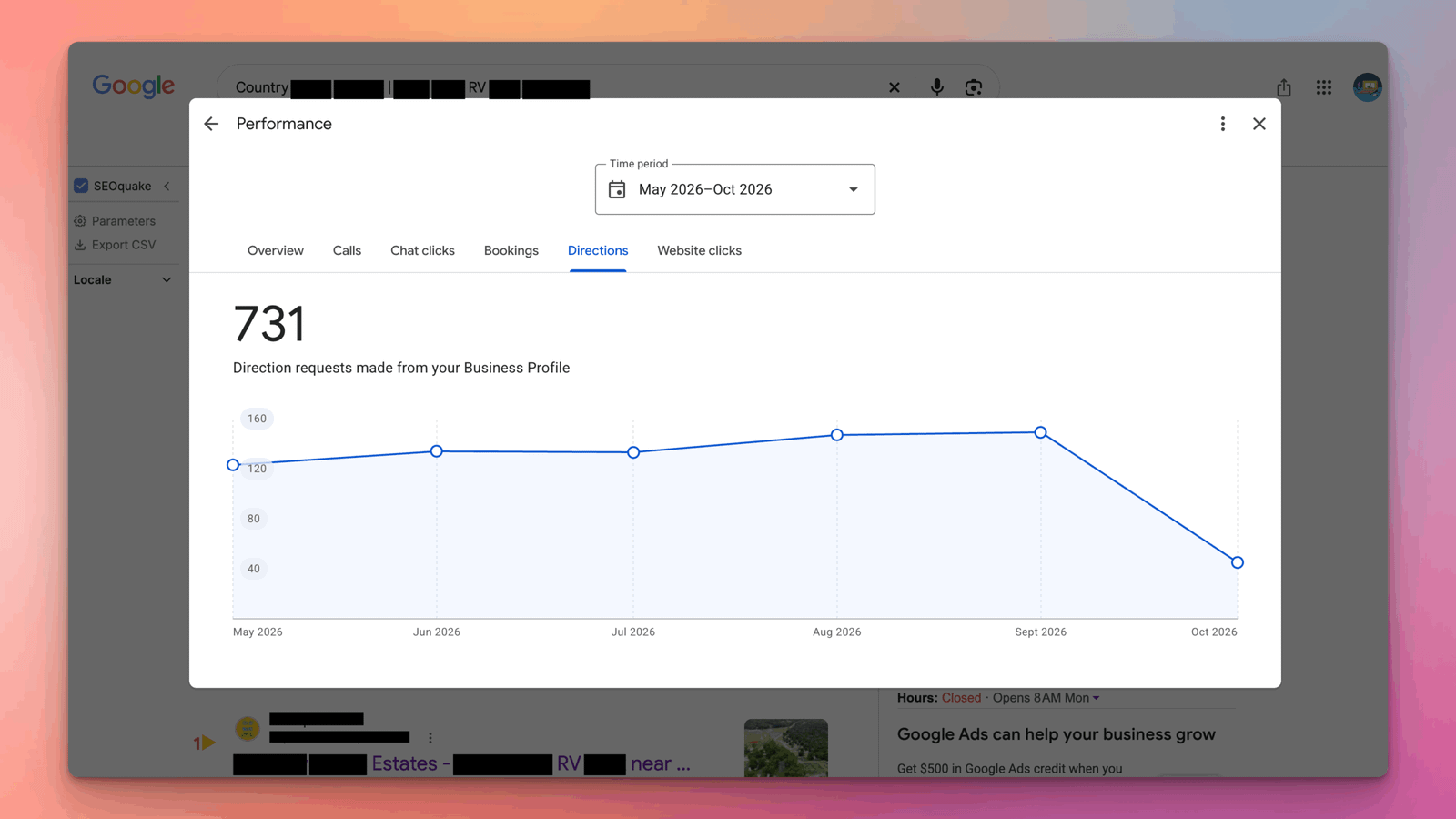
Do this first: List the five amenity or destination searches that best describe your resort, and check where you rank for each one.
9. Advertise the experience, not the price
Use Google Ads for high-intent searches like “RV resort near [attraction]” and “luxury RV resort [area]”. Use Facebook, Instagram and YouTube to show the experience to people planning trips, and target the cities and states your guests drive from. Winter resorts in the Sun Belt can reach snowbirds in their home states before they plan the season.
Lead with the view, the amenities and a reason to book now, not a discount. My guide to RV park advertising compares 15 options with real costs, and the setups are in my Google Ads and Facebook ads guides for parks.
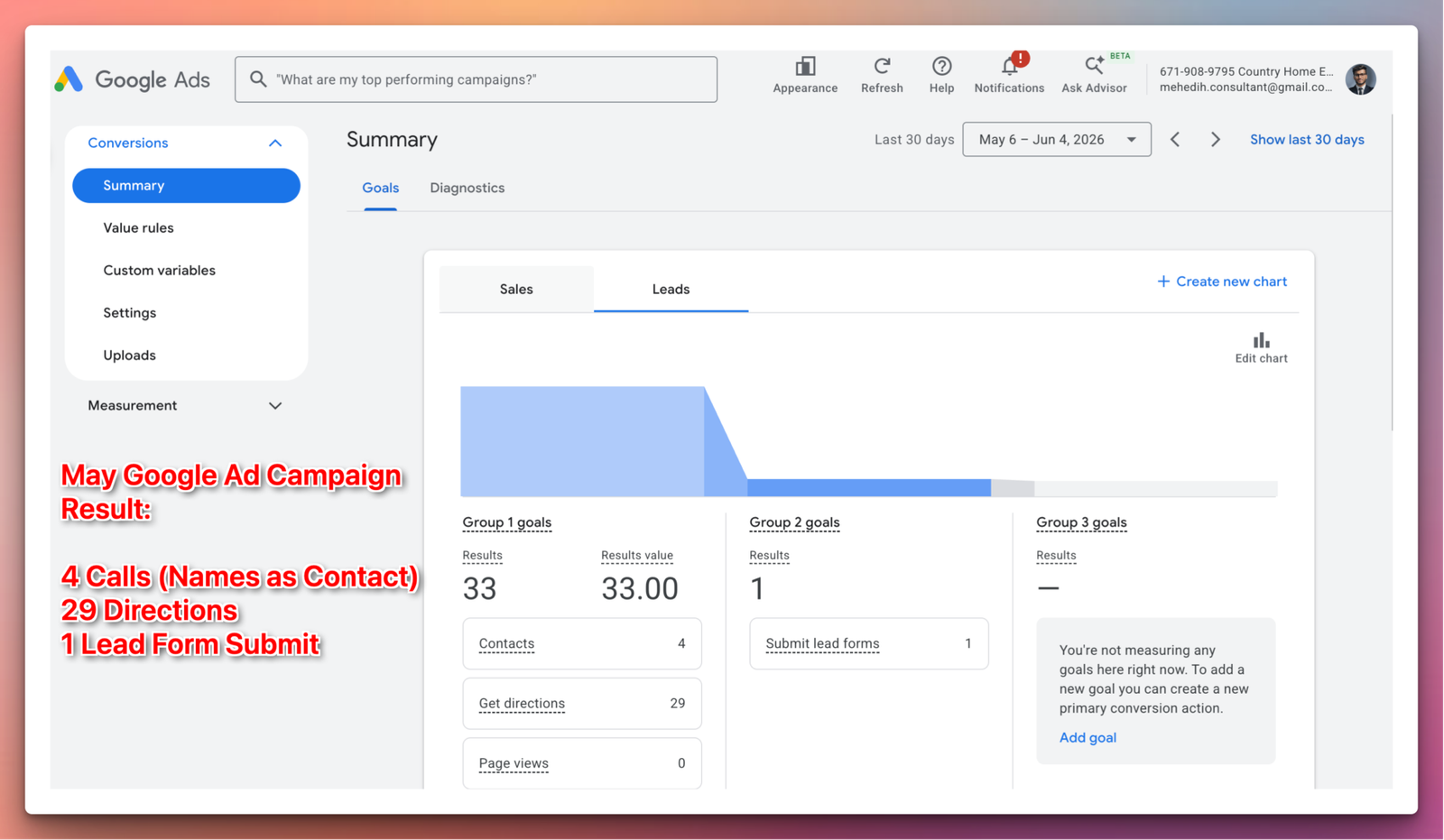
Do this first: Run one search campaign for your top amenity search and one video ad aimed at your top three feeder states.
10. Use marketplaces for new guests, then win them direct
Booking marketplaces bring you guests who have never heard of you. In 2025, the Campspot Marketplace drove 5% of campground bookings on its platform, and 73.4% of those bookers stayed at a campground they had never visited before (Campspot).
Use marketplaces to meet new guests, then make the second stay direct: collect emails at check-in, give a reason to book through your own website next time, and follow up after the stay.
Do this first: Make sure your rates, photos and site types match on every marketplace, and ask every marketplace guest to join your email list.
Part 4 · Turn stays into reviews and rebookings
11. Build a steady flow of recent reviews
For a premium resort, reviews are the proof behind the price. In BrightLocal’s 2026 Local Consumer Review Survey:
- 74% of consumers look for reviews written in the last three months.
- 31% will only use businesses rated 4.5 stars or higher.
- 80% are more likely to use a business that replies to all its reviews, but 50% are put off by generic, templated replies.
The pricing data points the same way: parks with more than 2,000 reviews charge 62% more on average than parks with fewer than 200 (Insider Perks). That doesn’t prove reviews cause higher rates, but well-reviewed parks clearly price with confidence. Ask every guest within a day or two of checkout, and write a personal reply to every review. My RV park review playbook has the templates.
Do this first: Add a review request to your checkout email or text, and reply personally to every review from the last 30 days.
12. Market to past guests and seasonal regulars
Your easiest bookings come from people who already stayed. Offer to rebook next season before guests leave, open next season’s dates to past guests first, and send a short email before your busy season and for events.
For seasonal and long-stay guests, a regular newsletter keeps the resort front of mind. For Country Home Estates, I send monthly resident newsletters, including a Route 66-themed campaign built to bring in Google reviews. My guide to long-term RV park tenants covers seasonal and monthly guests in more detail.
Do this first: Set up a “rebook before you leave” offer and a past-guest email that goes out before next season opens.
A 12-month RV resort marketing calendar
Resort bookings follow the seasons, so your marketing should too. This is the rhythm I recommend, adjusted to your own peak season:
| When | What to do |
|---|---|
| Every month | Ask for reviews and reply to all of them, post on your Google profile, check rates against occupancy |
| 4–6 months before peak | Open next season to past guests first, refresh photos and site pages, plan event packages |
| 6–8 weeks before peak | Raise ad budgets, launch video ads to feeder cities, email your full list |
| During peak | Use peak pricing, sell add-ons, collect emails and reviews from every guest |
| Shoulder and slow season | Midweek and length-of-stay offers, events, retargeting, lower dynamic rates |
| After every stay | Review request within a day or two, and a “book next season” offer |
How to measure RV resort marketing
Occupancy alone doesn’t tell you whether your marketing works, because you can fill every site by cutting prices. Track these instead:
- Average daily rate (ADR): site revenue divided by occupied site nights.
- Revenue per available site night (RevPAS): site revenue divided by all site nights you could have sold. A 100-site resort open 30 nights has 3,000 site nights; $150,000 in site revenue means a RevPAS of $50. This is the best single number for comparing months and seasons.
- Cost per booking for each marketing channel.
- Direct booking share: how many bookings come through your own website instead of a marketplace.
- Repeat guest rate and new reviews per month.
If RevPAS grows while your cost per booking holds steady, your marketing is working.
6 RV resort marketing mistakes
- Charging one rate for every site. Your best sites are your best profit.
- Leading with discounts. Constant deals train guests to wait and undercut your premium position.
- Old or amateur photos. They make a premium price look like a mistake.
- Hiding the amenities on one crowded page. Give each big selling point its own page.
- Letting marketplaces own the guest. Get the email and win the next stay direct.
- Templated review replies. Half of consumers are put off by them. Write a real reply.
Keep reading
Related guides for park owners
Advertising
RV Park Advertising: 15 Options Compared
What every advertising channel costs in 2026, and where to start.
RV resort marketing FAQ
Frequently asked questions
Answers to what resort owners and managers ask most.
QWhat is RV resort marketing?
RV resort marketing is how a premium RV park attracts and books guests who pay for the experience: amenities, views, activities and service. It covers pricing and site tiers, photos and video, the website, Google Business Profile, SEO, ads, booking marketplaces, reviews and email to past guests.
QHow is marketing an RV resort different from marketing an RV park?
An RV park mostly competes on location, hookups and price for guests who need a place to stay. An RV resort competes on the experience, so its marketing leans on site tiers, professional photos and video, amenity pages, events and reviews that justify higher rates.
QHow can an RV resort charge higher rates?
Tier your sites and price the differences on purpose, let guests choose and lock their exact site, use dynamic pricing for peaks and slow nights, sell add-ons during booking, and back it all with strong photos and recent reviews. In 2026 pricing data, luxury-labeled sites averaged $198.05 a night and waterfront sites 128% more than non-waterfront sites.
QShould RV resorts use dynamic pricing?
Usually, yes. It lets you earn more on holidays and events and fill slow nights with lower rates. Campspot reports that campgrounds using dynamic pricing make 70.3% more on average, a vendor figure worth testing against your own numbers.
QWhat is the best advertising for an RV resort?
Google Ads for high-intent searches like “luxury RV resort [area]” or “RV resort with pool”, plus Facebook, Instagram and YouTube video aimed at the places your guests travel from. Lead with the experience rather than discounts, and track bookings, not clicks.
QShould my RV resort list on booking marketplaces?
Yes, for reaching new guests. In 2025, 73.4% of Campspot Marketplace bookers stayed at a campground they had never visited before. Then work to make each guest’s second stay a direct booking through your own website.
QHow many reviews does an RV resort need?
There’s no magic number, but recency matters most: 74% of consumers look for reviews from the last three months. Aim for a steady flow every month and a personal reply to each one.
QCan you market my RV resort?
Yes. I offer SEO from $300 a month, Google Ads management for $300 a month and Meta ads management for $300 to $400 a month, plus ad spend paid directly to Google or Meta. See the pricing page or book a free call.
Sources
Sources
Data checked in October 2026. Industry averages describe many parks, not a promise for yours.
- Modern Campground, New Study Maps Effective Revenue Strategies for Campgrounds and RV Parks (Insider Perks 2026 pricing report)
- Campspot, 2025 Year in Review
- Campspot, Why Campground Demand Is Down in 2026
- RMS, 2026 State of the Outdoor Accommodation Report (via Hospitality Net)
- RV PRO, KOA Outdoor Hospitality Report: 52M Americans Camped in 2025
- PinMeTo, BrightLocal Local Consumer Review Survey 2026
Fill your premium sites at the rates they deserve
Book a free 30-minute call. I’ll review your resort’s Google profile, website, rates page and ads next to your competitors, then send you a written plan, whether you hire me or not.

About the author
Mehedi Hasan is the founder of Hawkto Digital and is Google, HubSpot and Semrush certified. He has run local SEO, Google Ads, Meta ads and newsletters for a long-term RV park in Oklahoma since 2023, and marketing for local businesses across the US. Read his story or see pricing.