
How to Increase RV Park Occupancy: 15 Ways to Fill More Sites Year-Round
Quick answer
To increase RV park occupancy, first find where your empty nights are (by day of week, month and site type), then fix the matching cause. Take bookings online 24/7 and close one-night gaps with smarter minimum stays. Fill weekdays and slow seasons with longer-stay offers, events, groups and seasonal stays. Build a base of monthly guests, and bring in new travelers through Google Maps, booking marketplaces and targeted ads. Then turn every guest into a repeat booking.
An empty site tonight can never be sold again. That’s what makes RV park occupancy so unforgiving, and why small leaks add up fast: a few empty weeknights, a one-night gap between bookings, a late cancellation on a holiday weekend.
2026 has made it harder. Campspot found transient bookings were down 2.2% through May as gas prices passed $4 a gallon (Campspot). But demand hasn’t gone away: 31% of campers plan to spend more nights camping this year than last (KOA). The parks that fill their sites are the ones that make booking easy and give people a reason to come.
I’ve marketed Country Home Estates, a long-term RV park in Oklahoma, since 2023, so filling sites, especially monthly ones, is my day-to-day work. This guide starts with a simple diagnosis, then gives you 15 ways to increase RV park occupancy, each with one thing to do this week.
In this guide
For RV park owners
Want this done for your park?
I have marketed a long-term RV park in Oklahoma since 2023: Google Maps, Google Ads, Facebook ads, the website and resident newsletters. See how I can help with RV park marketing.
Step 1: Find where your empty nights are
Occupancy is occupied site nights divided by available site nights. A 60-site park open for 30 nights has 1,800 site nights to sell. If 1,170 were occupied, occupancy was 65%.
That single number hides the real problem. Pull last year’s bookings from your reservation system and calculate occupancy separately by:
- Day of the week: weekends at 95% and weeknights at 50% is a very different problem from 65% every night.
- Month: which months are well below your peak?
- Site type: are your back-in or smaller sites empty while premium sites sell out?
- Length of stay and booking source: how many guests stay one night, and how many are new versus returning?
Then match your biggest gap to the ways that fix it:
| Your biggest gap | What it looks like | Start with ways |
|---|---|---|
| Weeknights (Sunday to Thursday) | Weekends sell out, weekdays sit half empty | #5, #10, #9 |
| One-night gaps | Busy weeks still show scattered empty nights | #2, #3 |
| Slow season | Whole months well below your peak | #9, #7, #6 |
| Late cancellations | Sold-out dates end up with empty sites | #4 |
| Not enough new guests | Few bookings from people who haven’t stayed before | #12, #13, #14 |
| Low repeat business | Guests don’t come back or refer friends | #15, #11 |
15 ways to increase RV park occupancy
Part 1 · Fix the leaks in your booking system
1. Take bookings online, 24/7, from a phone
Travelers book late at night, from the road and on their phones. If they have to call during office hours to check availability, many will book the next park that lets them do it in two minutes. Your website should show live availability and rates and take a deposit, on any phone, at any hour, including same-day bookings.
Let guests choose their exact site while they book. In the RMS 2026 State of the Outdoor Accommodation Report, nearly 85% of campers said they’re more likely to book when they can select their exact site in advance.
Do this week: Try to book your own park on your phone tonight. Time it, and fix every step that slows you down.
2. Close gap nights with smarter minimum stays
A single empty night between two bookings is almost impossible to sell. Campspot calls one-night gaps a revenue loss that can’t be recovered, because they strand inventory and block longer stays (Campspot). Two fixes:
- Flexible minimum stays. Require two or three nights on busy weekends, but let your system accept a shorter stay when it exactly fills a gap.
- Automatic site reshuffling. Some reservation systems move bookings between identical sites to open up longer windows. Campspot’s grid optimization only moves guests within the same site type, to a site at least as long with the same amenities, and stops 72 hours before arrival (how grid optimization works). Campspot says it generated $14 million for parks in 2025 (Campspot).
Do this week: Look at next month’s grid and count the one-night gaps. Then check your booking system for a gap-filling or minimum-stay setting.
3. Price to fill slow nights, not just to earn on busy ones
A single rate all year leaves money on the table twice: peak nights sell out too cheaply, and slow nights stay empty at a price nobody wants to pay. Dynamic pricing raises rates when demand is high and lowers them to fill quiet nights. Campspot reports that parks using it earn 70% more revenue on average, a figure from the software maker that’s worth testing against your own numbers (Campspot).
As Campspot puts it, “full doesn’t always mean optimized”: if your peak dates fill weeks ahead at your normal rate, they’re probably underpriced (Campspot). I cover pricing tiers in more detail in my RV resort marketing guide.
Do this week: Set three rates for each site type: peak, regular and value. Use the value rate for your weakest nights.
4. Refill cancellations with a deposit, a clear policy and a waitlist
A cancelled booking a few days out often becomes an empty site. Take a deposit at booking, publish a clear cancellation window, and keep a waitlist for your busiest dates so the system or your staff can offer a freed-up site within minutes. A cancellation on a sold-out holiday weekend should never become an empty site.
Do this week: Write your cancellation policy in one short paragraph, put it on your booking page, and start a waitlist for your next holiday weekend.
Part 2 · Fill weekdays and slow seasons
5. Make midweek and longer stays more attractive
Weekends fill themselves. Sunday to Thursday is where most parks lose occupancy. The median stay across Campspot parks in 2025 was 3 nights (Campspot 2025 year in review), so offers that stretch a stay to four or five nights fill the weekdays around a weekend:
- “Stay 3 nights Sunday to Thursday, pay for 2”
- Weekly rates that cost less than seven nightly rates
- Remote-worker packages that highlight fast Wi-Fi, quiet sites and a workspace
Do this week: Pick your emptiest weeknights from last year and create one offer for them.
6. Give people a reason to come: events at and near your park
People book for a reason. Build a calendar of local festivals, races, rodeos, concerts and holidays, then promote stays around each one weeks ahead. Add a few events of your own for slow periods: a chili cook-off, a holiday decorating contest, a fishing weekend or live music at the pavilion.
List every event on your website and your Google Business Profile, and send it to past guests. An event page also gives Google something new to rank.
Do this week: List the next six months of local events and add the biggest two to your website and Google profile.
7. Go after groups and rallies
One group booking can fill a section of your park on a weekend that would otherwise be quiet. RV clubs, caravans, family reunions, church groups and car or motorcycle clubs all plan trips, often for shoulder seasons when rates are lower.
Create a group page with a site map of the sites you can block together, a group rate, the shared spaces you can offer (pavilion, clubhouse, fire ring) and a simple enquiry form. Then reach out to clubs and organizers in your region.
Do this week: Build a simple group page and email three RV clubs or chapters within a day’s drive.
8. Market to guests within a short drive
Fuel costs change who travels. Campspot found transient bookings were down 2.2% through May 2026, with the decline starting in April when national gas prices passed $4 a gallon. Its conclusion: campers still want to camp, but the cost of getting there changed (Campspot 2026 demand report).
When long trips get expensive, the nearest cities become your best market. Target ads and offers at people within two or three hours’ drive, and promote short getaways they can take on a Friday afternoon. Demand hasn’t disappeared: the KOA 2026 Outdoor Hospitality Report found 31% of campers plan to spend more nights camping in 2026 than in 2025.
Do this week: Look up the three biggest cities within a three-hour drive and point your next ad and email at them.
9. Sell seasonal stays for your slowest months
A seasonal guest fills one site for months with one booking. If your slow season is someone else’s ideal season, such as winter in the Sun Belt or summer in the mountains, market seasonal stays to people who live where the weather is worse. Offer a seasonal rate that beats paying nightly, and open booking to past seasonal guests first.
Do this week: Calculate a seasonal rate for your slowest three months and offer it to every guest who stayed more than a week last year.
Not sure where your empty nights come from?
In a free 30-minute call I’ll look at your booking setup, Google profile, website and ads, and show you the three changes I’d make first to fill more sites.
Part 3 · Build a base of monthly guests
10. Market monthly sites to workers
Monthly guests turn occupancy from a weekly scramble into a steady base. Many of them are working: traveling nurses, construction and pipeline crews, wind and solar project teams, and seasonal workers. They search for “monthly RV parks in [city]” and call several parks at once.
Build a monthly sites page with prices, rules and what’s included. Then go where these guests come from: introduce yourself to large local employers, project contractors, hospital housing coordinators and staffing agencies. My guide on how to get long-term RV park tenants covers 11 ways in detail.
Do this week: Make a list of the five biggest employers or projects within 30 minutes of your park and contact one this week.
11. Keep the residents you already have
Every month a resident stays is a site you don’t have to refill. Fix problems quickly, keep the park clean and quiet, offer a small renewal incentive before a lease ends, and keep residents informed. For Country Home Estates, a long-term RV park in Oklahoma I’ve marketed since 2023, I send monthly resident newsletters, including a Route 66-themed campaign built to bring in Google reviews.
Do this week: Find every monthly guest whose stay ends in the next 60 days and offer a renewal now, not on their last day.
Part 4 · Get in front of more travelers
12. Rank on Google Maps for the searches that matter
Online search is now the top way campers find campsites: nearly 64% use it, overtaking word of mouth for the first time in the RMS 2026 report (RMS). For an RV park, that means the three parks Google shows on the map for “RV park near me” get most of the calls.
Complete your Google Business Profile, keep photos and hours current, collect reviews every month and build pages for your site types, monthly stays and nearby attractions. My RV park SEO guide shows the full process, and my RV park SEO services page shows how I handle it for you.
Do this week: Search “RV park near me” from a phone 10 miles away and note whether you’re in the top three.
13. List on booking marketplaces to reach new guests
Marketplaces put your park in front of travelers who don’t know you yet. In 2025, 73% of Campspot Marketplace bookers had never stayed at that park before, bringing more than 127,000 new customers to campgrounds (Campspot). Campspot also announced an Expedia partnership in 2026 to widen that reach (Campspot).
Keep rates, photos and site types identical everywhere, and make the next stay a direct booking by collecting each guest’s email.
Do this week: Check which marketplaces your reservation system can connect to, and make sure your listing photos are your best ones.
14. Run ads for the exact nights you need to fill
Ads work best when they target a specific gap: weeknights next month, a slow shoulder season, monthly sites. Use Google Ads for people searching now and Facebook and Instagram for offers and events, and retarget people who looked at your booking page but didn’t book.
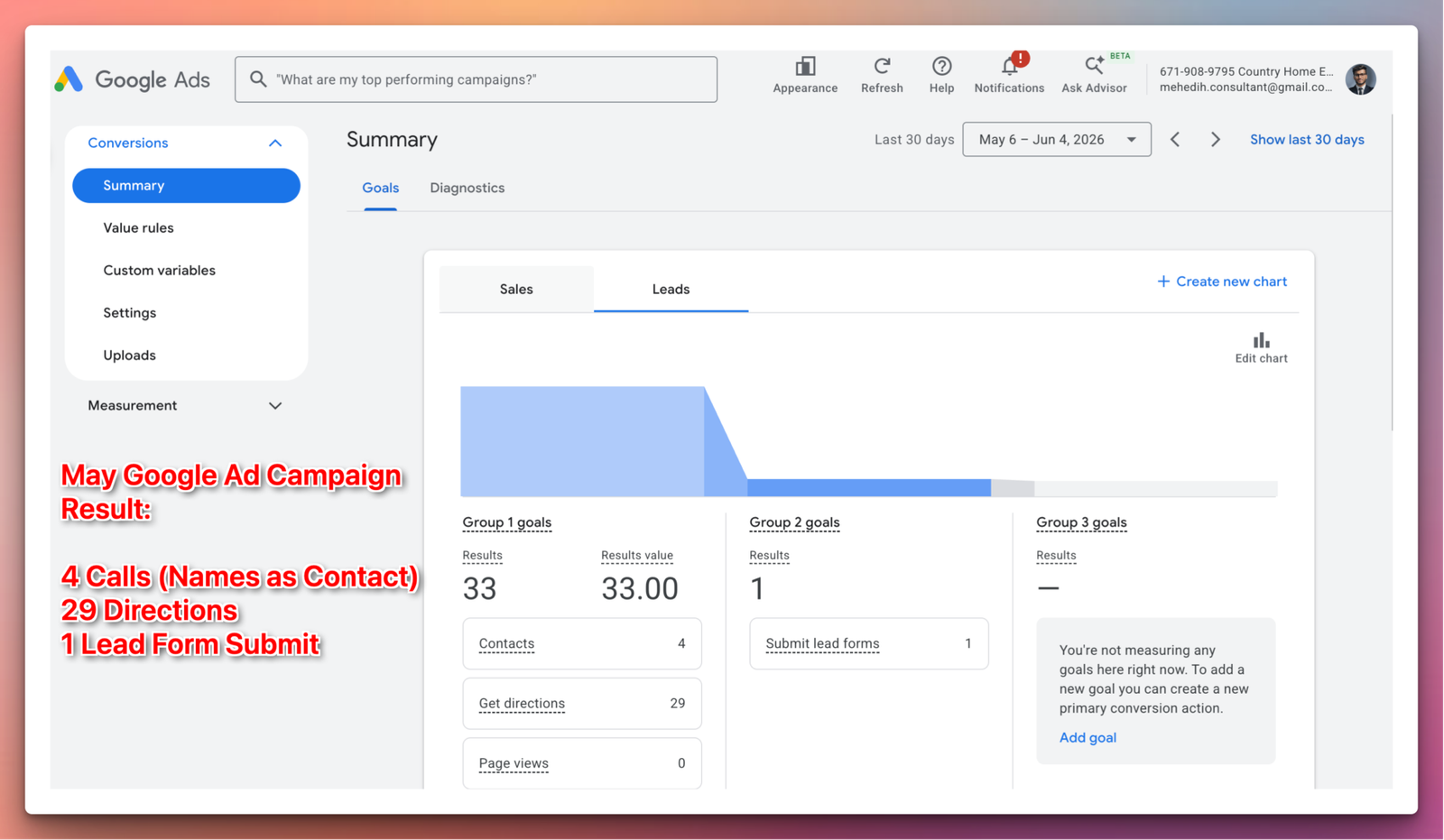
For Country Home Estates, tracked Google Ads with call and location assets brought in 29 direction requests, 4 calls and a lead form in May. My guide to RV park advertising compares 15 options with real 2026 costs.
Do this week: Pick one gap from your diagnosis and run one ad aimed only at it for two weeks.
15. Turn past guests into repeat bookings and referrals
Your past guests are the cheapest bookings you can get. Offer to rebook before checkout, email past guests before every slow period, and give a small credit for referrals. Ask every guest for a review: 74% of consumers look for reviews from the last three months (BrightLocal 2026), so a steady flow keeps new guests booking too. My RV park review playbook has the templates.
Do this week: Export last year’s guest emails and send one short “come back” offer for your next slow period.
A 90-day occupancy plan
You don’t need all 15 at once. This order fixes the cheapest leaks first:
| When | What to do |
|---|---|
| Days 1–30 | Run the diagnosis, fix online booking, set flexible minimum stays, publish a cancellation policy and waitlist, and update your Google profile |
| Days 31–60 | Launch one midweek offer, publish an events calendar and a group page, build a monthly sites page and contact local employers |
| Days 61–90 | Run ads aimed at your biggest gap, list on booking marketplaces, email past guests and start a monthly review routine |
| Day 90 | Compare occupancy by day, month and site type with the same period last year, and keep what worked |
Occupancy vs revenue: don’t fill sites at any price
Higher occupancy isn’t automatically better. Compare these two months for the same park:
| Occupancy | Average nightly rate | Revenue per available site night | |
|---|---|---|---|
| Month A | 70% | $50 | $35 |
| Month B | 80% | $40 | $32 |
Month B looks busier, but it earned less per site, with more wear on the park and more work for your staff. That’s why the goal isn’t just more occupied sites: it’s filling the nights that would otherwise be empty, at a price that still makes sense. Track revenue per available site night (site revenue divided by all the site nights you could have sold) next to occupancy every month.
6 occupancy mistakes
- Looking only at overall occupancy. The problem is usually specific nights, months or site types.
- Discounting every night. It trains guests to wait and lowers revenue on nights that would have sold anyway.
- Phone-only bookings. Travelers who can’t book at 10 pm book somewhere else.
- Rigid two-night minimums on every date. They create gaps no one can fill.
- Ignoring monthly guests. A steady base of monthly sites smooths out every slow week.
- Forgetting past guests. They’re the cheapest bookings you’ll ever get.
Keep reading
Related guides for park owners
Monthly sites
How to Get Long-Term RV Park Tenants
11 ways to fill monthly sites and keep residents longer.
Advertising
RV Park Advertising: 15 Options Compared
What every channel costs in 2026, and where to start.
RV park occupancy FAQ
Frequently asked questions
Answers to what park owners ask most about filling sites.
QWhat is a good occupancy rate for an RV park?
There’s no single benchmark, because location, seasons and the mix of nightly and monthly sites change everything. The most useful comparison is your own park: compare each month and each day of the week with the same period last year, and work on your weakest nights first.
QHow do I calculate RV park occupancy?
Divide occupied site nights by available site nights. A 60-site park open for 30 nights has 1,800 available site nights. If 1,170 were occupied, occupancy is 65%. Calculate it by day of week, month and site type to see where the empty nights are.
QHow can I fill my RV park midweek?
Offer stay-longer deals for Sunday to Thursday, weekly rates, remote-worker packages and events, and build a base of monthly guests who fill weekdays automatically. Use flexible minimum stays so short gaps between bookings can still be sold.
QHow do I fill an RV park in the off-season?
Sell seasonal stays to people from colder or hotter places, market monthly sites to workers, host your own events, target groups and RV clubs, and run ads with offers to people within a few hours’ drive.
QShould I lower prices to increase occupancy?
Only on your weakest nights, and only as part of a plan. Cutting prices across the board can raise occupancy while lowering revenue. Use dynamic pricing instead: lower rates for slow nights, higher rates for peak dates, and track revenue per available site night, not occupancy alone.
QDo booking marketplaces increase RV park occupancy?
They can, mainly by bringing new guests. In 2025, 73% of Campspot Marketplace bookers had never stayed at that park before. Then make each guest’s next stay a direct booking.
QHow long does it take to increase RV park occupancy?
Booking fixes, minimum stay rules, offers and ads can show results within weeks. Google Maps rankings and a strong base of monthly and repeat guests usually take three to six months to build.
QCan you help increase my park’s occupancy?
Yes. I handle SEO from $300 a month, Google Ads management for $300 a month and Meta ads management for $300 to $400 a month, plus ad spend paid directly to Google or Meta. See the pricing page or book a free call.
Sources
Sources
Data checked in October 2026. Software-maker figures describe parks on their platform, not a promise for yours.
- Campspot, Why Campground Demand Is Down in 2026
- Campspot, 5 Revenue Levers Park Operators Can Pull When Demand Is Soft
- Campspot, What Is Grid Optimization?
- Campspot, Revenue Management Myths That Are Hurting Your Campground
- Campspot, 2025 Year in Review
- RMS, 2026 State of the Outdoor Accommodation Report (via Hospitality Net)
- RV PRO, KOA Outdoor Hospitality Report: 52M Americans Camped in 2025
- PinMeTo, BrightLocal Local Consumer Review Survey 2026
Fill more of your sites, every night of the week
Book a free 30-minute call. I’ll look at your booking setup, Google profile, website and ads, then send you a written plan for your biggest occupancy gap, whether you hire me or not.

About the author
Mehedi Hasan is the founder of Hawkto Digital and is Google, HubSpot and Semrush certified. He has run local SEO, Google Ads, Meta ads and newsletters for a long-term RV park in Oklahoma since 2023, and marketing for local businesses across the US. Read his story or see pricing.