Self Storage Marketing Cost: What to Budget in 2026
Quick answer
Self storage marketing cost for one facility runs from $0, if you manage your own Google Business Profile and reviews, to roughly $300–$1,500 a month in management fees for SEO, Google Ads and Meta ads at my prices, plus whatever ad spend you set. A new website is a one-time $400–$1,200. No public survey covers storage specifically, so set your budget by working back from what one new tenant is worth.
Self storage marketing cost is the question I hear most from owners and managers, and the quotes they collect rarely compare like with like. One agency folds ad spend into its fee, another charges per facility, and the marketplace charges a fee on every move-in.
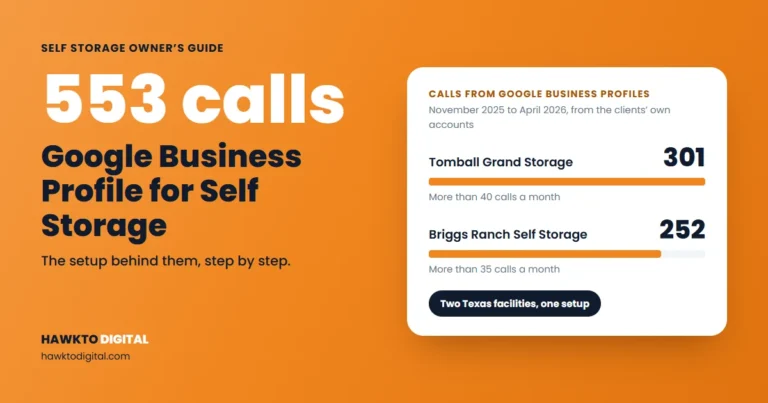
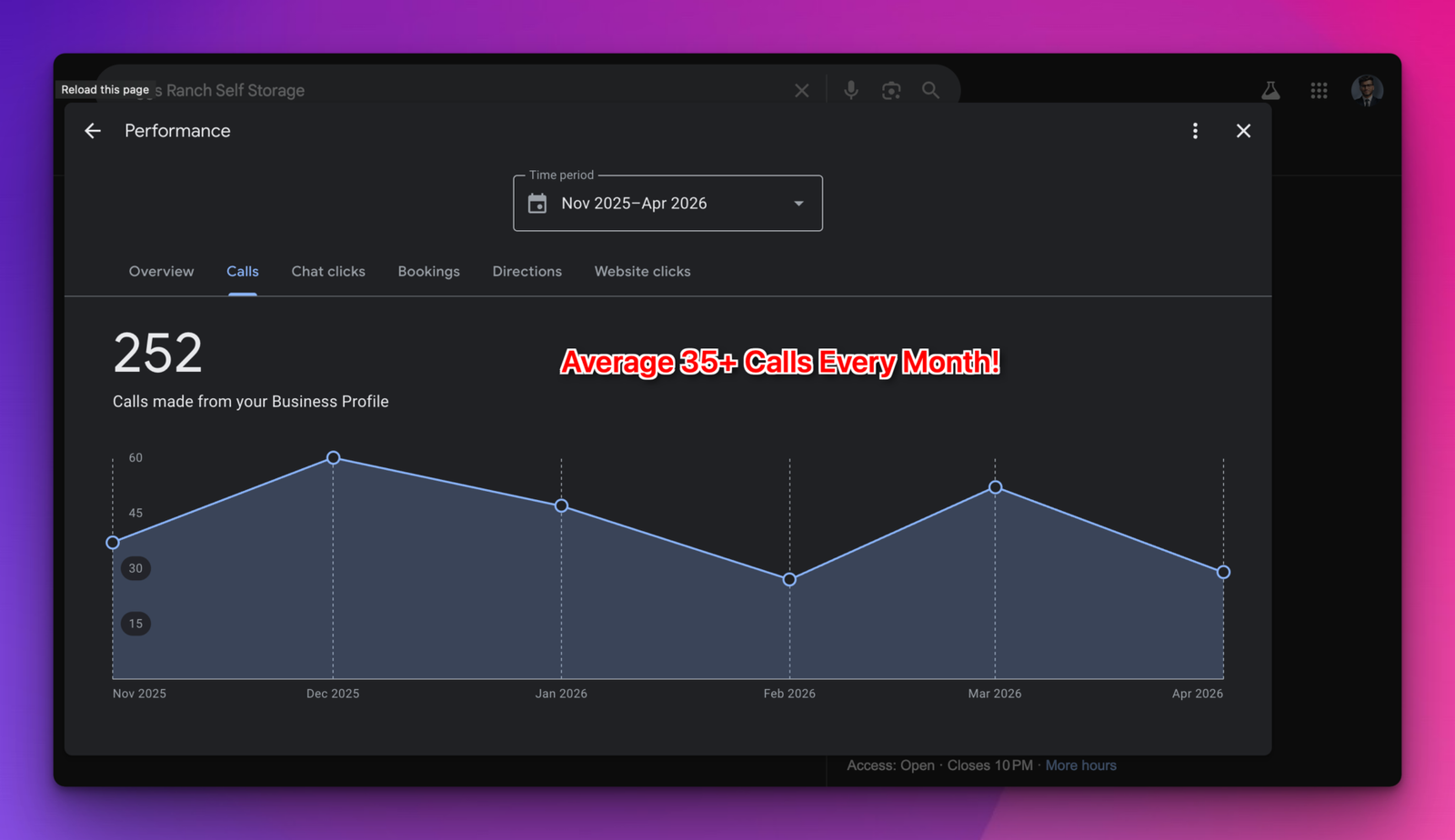
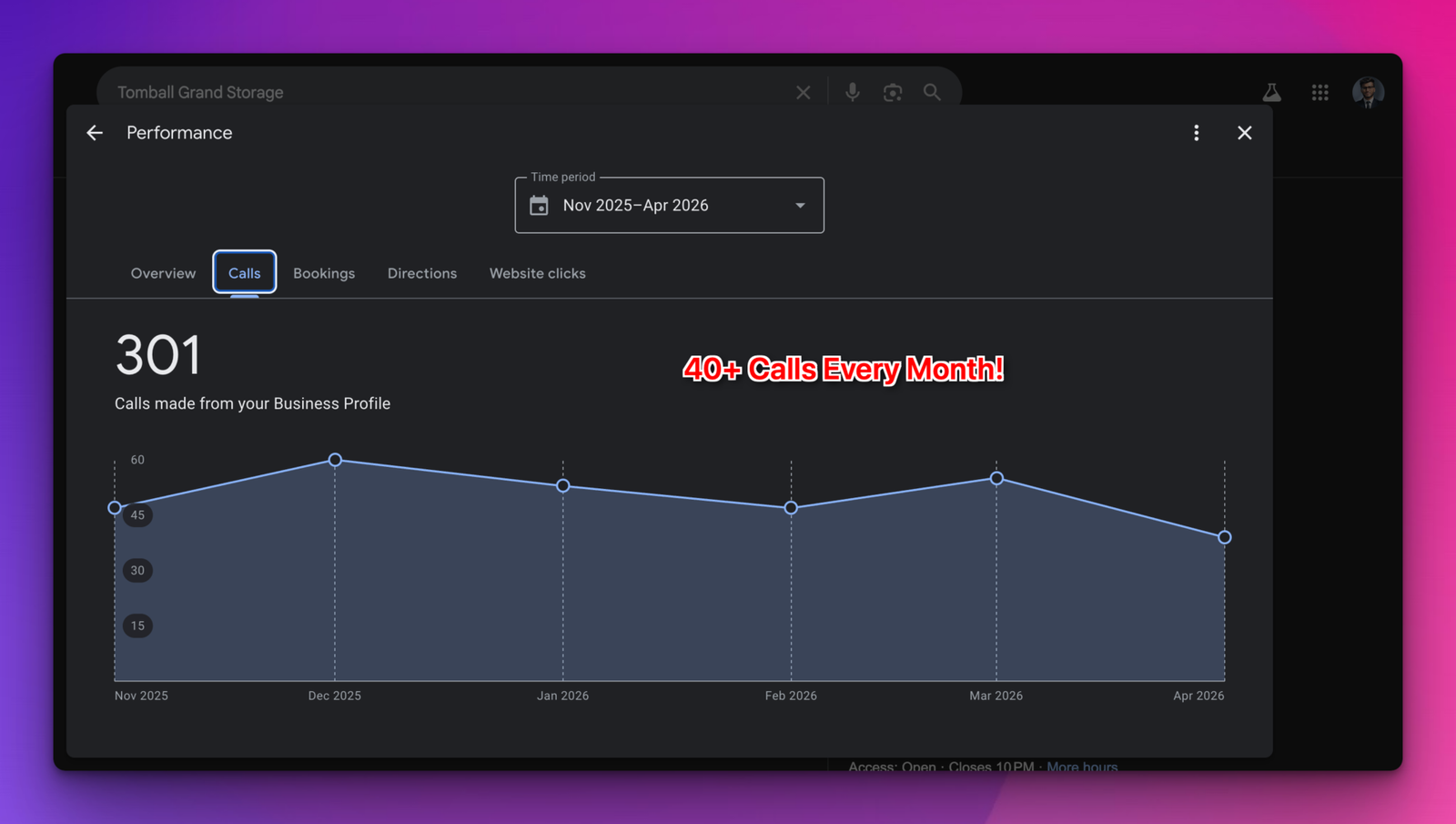
I market storage facilities managed by Joules Storage Management in Texas, handling their Google Business Profiles, websites and social media. Two Texas facilities I work with, Briggs Ranch Self Storage and Tomball Grand Storage, got 252 and 301 calls from their Google Business Profiles between November 2025 and April 2026. Below are real prices, mine included, and a way to check whether a budget pays for itself.
Before you spend anything, run your website through my free self storage SEO audit tool. Broken basics are the cheapest thing to fix.
In this guide
- Self storage marketing cost at a glance
- What drives the cost
- Budgets for one facility vs a portfolio
- What you get at each budget level
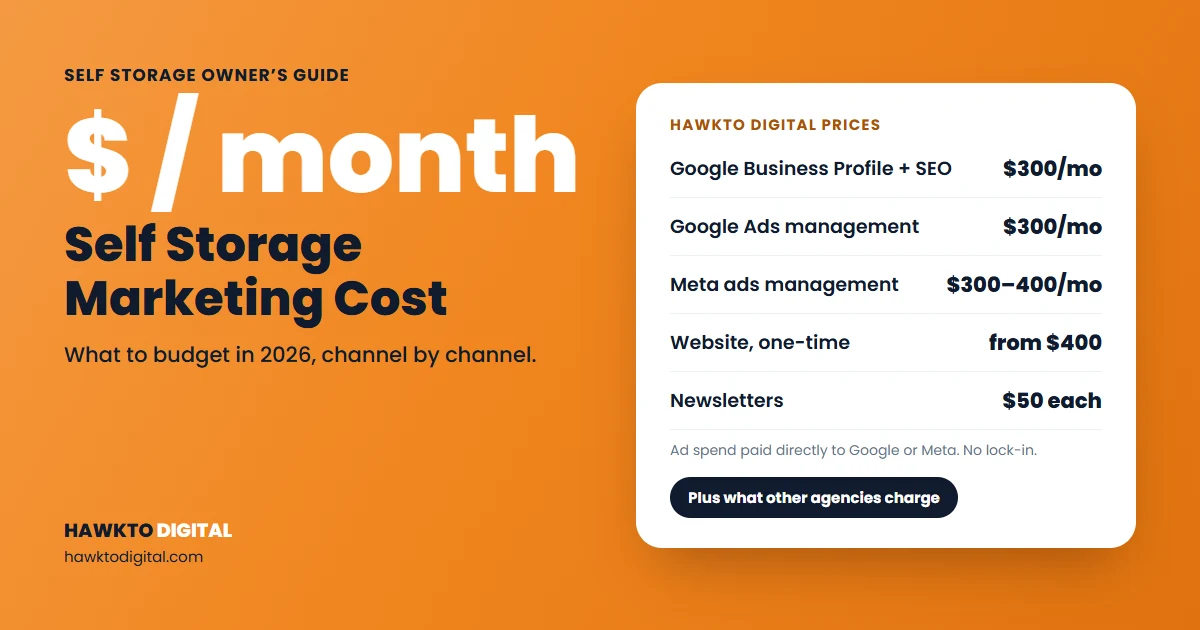
- Hawkto Digital’s prices
- The math: when marketing pays for itself
- Marketplace fees vs your own channels
- What the work looks like: two Texas facilities
- Red flags in cheap offers
- DIY or hire?
- Frequently asked questions
- Sources
For storage owners and managers
Want this done for your facility?
I market self storage facilities in Texas, including Briggs Ranch Self Storage, which got 252 calls from its Google Business Profile in 6 months. See how I can help with self storage marketing.
See self storage marketing servicesScore your facility website free
Self storage marketing cost at a glance
Here’s what each channel costs, with market figures where a published source exists and my own prices from the pricing page. Ad spend is always listed separately, because it goes to Google or Meta, not to the agency.
| Channel | Market cost | Hawkto Digital | What it does for a facility |
|---|---|---|---|
| Google Business Profile | Free to create and list (Google) | Optimization included in both SEO plans | Maps visibility and calls |
| Local SEO | Local SEO averages about $1,557 a month; most popular retainer $501–$1,000 (Ahrefs) | $300/month (6-month plan) or $800/month (3-month plan) | Rankings that keep working |
| Website | Varies widely; I found no published survey for storage sites | $400, $800 or up to $1,200, one-time | Turns visits into rentals |
| Google Ads management | No public survey for storage | $300/month | Top of search, right away |
| Google Ads spend | You set the budget; paid to Google | Not included; paid from your own account | Buys the clicks and calls |
| Meta ads (Facebook and Instagram) | Management fee plus spend you set | $300–$400/month; ad spend not included | Awareness and retargeting in lease-up |
| Reviews | Asking is free; review software is optional | Not listed as a separate service | Helps you win the click in Maps |
| Newsletters and tenant email | Email platform fees vary by list size | $300 one-time setup, then $50 per newsletter | Reviews, referrals, retention |
No public pricing survey covers self storage marketing on its own. The market figures are general SEO data: Ahrefs’ survey of 439 SEO providers (updated 2024) and Backlinko’s survey of over 300 SEO professionals (updated December 2025), which puts the average monthly cost of SEO services at $1,000–$2,500. Treat them as context, not a storage benchmark.
I found no reliable public click-cost benchmark for storage searches. Check “storage units [your town]” in Google’s Keyword Planner, which shows the average cost to appear for a keyword, before you set an ad budget (Google Ads Help).
What drives the cost
These four things decide most of the difference between quotes:
1. Number of facilities
Every facility needs its own Google Business Profile, its own reviews, its own page on the website and, if you run ads, its own targeting.
2. Local competition
A facility with no competitor nearby needs far less than one fighting national brands in the same Maps results. Search “storage units [your town]” on your phone and count who shows in the top three on the map. That’s your real competition.
3. Lease-up or stabilized
A new facility in lease-up needs rentals fast, so it usually leans on Google Ads, faster SEO and sometimes marketplaces while organic rankings build. A stabilized facility needs upkeep: a strong profile, steady reviews and ads for the busy season.
4. Your current website
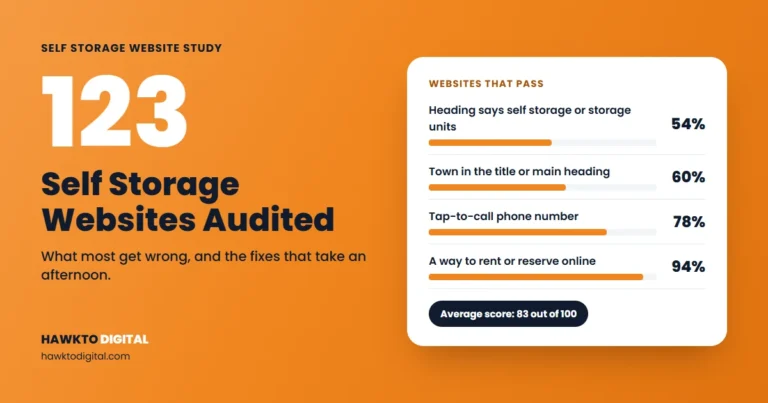
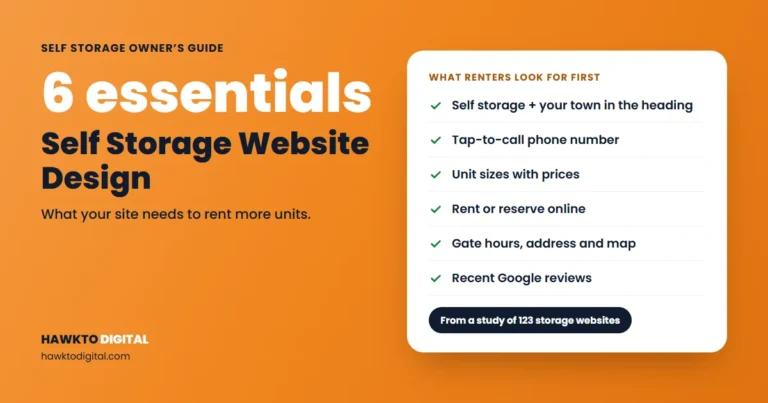
A weak website makes every other channel more expensive, because you pay to send people to a page that doesn’t convert. In my study of 123 independent self storage websites, 41% had no business schema, 16% showed a phone number that couldn’t be tapped, and 27% had no customer reviews anywhere on the site. Gaps like these are usually small fixes, and they make every paid channel work harder.
Budgets for one facility vs a portfolio
A single facility
Here are three realistic setups at my prices. Ad spend is on top and is your call.
- Stabilized, quiet market: Standard SEO at $300 a month. Ads are optional.
- Stabilized, competitive market: Standard SEO ($300) plus Google Ads management ($300): $600 a month plus ad spend.
- Lease-up: Boosted SEO ($800 a month on a 3-month plan), Google Ads management ($300) and Meta ads management ($300–$400). That’s $1,400–$1,500 a month plus ad spend, scaled back once occupancy climbs.
Add a one-time website cost if your current site can’t show unit sizes, prices and a way to rent or reserve. My self storage website design guide covers what the site needs.
A management company with several facilities
Costs scale with facilities, but one website, one newsletter template and one Google Ads account can serve them all. Each facility’s profile, reviews and local rankings can’t be shared.
Start with a pilot: the one or two facilities with the lowest occupancy, tracked for three to six months, then roll out what worked. My prices are listed per service, so use the free 30-minute call to map which facilities need what before you commit.
What you get at each budget level
$0: your own time
A complete Google Business Profile, a review request to every new tenant, and basic website fixes. Enough for a small facility with little competition.
Around $300 a month
One channel done properly, usually local SEO with Google Business Profile optimization and a monthly report. Right for most stabilized facilities.
$600–$1,100 a month plus ad spend
SEO plus Google Ads, so you can get calls while rankings build. Right for competitive markets.
$1,400 a month and up plus ad spend
Faster SEO, Google Ads, Meta ads and tenant newsletters. Right for lease-up or several facilities.
Rule of thumb: Ask for two numbers in writing: the management fee and the ad spend. Then ask for a list of what gets done each month. If a quote can’t separate those, you can’t judge it.
Hawkto Digital’s prices
I publish my prices so you can budget before any call. Both SEO plans include the same work: on-page and off-page SEO, keyword research and mapping, backlink building, a technical audit with fixes, local SEO and Google Business Profile optimization, and monthly reports.
Standard SEO · 6-month plan
$300 / month
Steady growth for a stabilized facility.
Boosted SEO · 3-month plan
$800 / month
The same work, done faster. Suits lease-up.
- Websites, one-time: Basic $400 (1–3 template-based pages), Amazing $800 (custom design, 5–7 pages), Complex up to $1,200 (10+ pages with e-commerce, booking or CRM integrations).
- Google Ads management: $300 a month. Ad spend isn’t included and is paid directly to Google from your own account.
- Meta ads and social media management: $300–$400 a month. Ad spend isn’t included.
- Blog writing: $50 per post of 1,500+ words, with a bulk quote for 10 or more a month.
- Newsletters: $300 one-time setup, then $50 per newsletter.
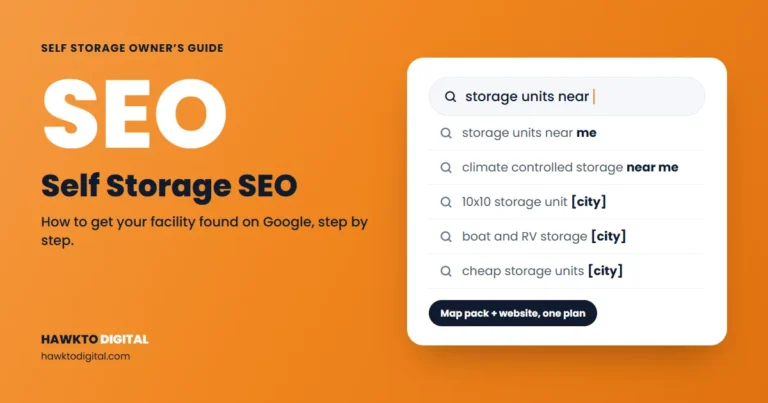
Every service comes with no long-term lock-in, monthly reporting, post-project support and a free 30-minute call, and you own every account. The SEO side is explained in my self storage SEO guide, and my local SEO cost guide compares these prices with the wider market.
Not sure where the first dollar should go?
Score your facility’s website with my free audit tool. If the basics are missing, start there before you pay for ads.
The math: when marketing pays for itself
Start with what one new tenant is worth, then work out how many a month your budget has to bring in. The numbers below are an example only. Pull your own average rent and average length of stay from your management software.
| Step | Example (use your own numbers) |
|---|---|
| Average monthly rent per tenant | Say $100 |
| Average length of stay | Say 12 months |
| Rent from one new tenant | $1,200 |
| Monthly budget: Standard SEO + Google Ads management + ad spend | $300 + $300 + say $400 = $1,000 |
| New tenants needed to cover it | About 1 a month |
With SEO alone at $300 a month, the same example tenant covers four months of fees. Two cautions keep this honest. First, it counts rent, not profit, so compare it with your margin. Second, you only know the answer if you track where move-ins come from. Ask every new tenant how they found you and use a tracked number on your Google profile and ads.
This week, write down your real average rent, average stay and move-ins per month. Those three numbers set your budget better than any quote.
Marketplace fees vs your own channels
Aggregators charge differently from an agency: you pay when a renter they send moves in. SpareFoot’s own help center explains its OneTime pricing: the fee for a move-in is the unit’s price multiplied by your bid, so a $100 unit at a bid of 2 costs a $200 fee. A facility whose move-in rate falls below a set minimum may also be charged an extra fee (SpareFoot Marketplace Knowledge Base).
The trade-off is simple:
- Marketplaces: low risk and quick volume in lease-up, but a fee on every move-in, with competitors listed beside you.
- Your own channels: cost money up front and take time, but carry no per-move-in fee.
You don’t have to pick one. Pull the last six months of move-ins by source and work out your cost per move-in for each. If the marketplace fee is higher than what your own channels cost per rental, shift budget toward the channels you own.
What the work looks like: two Texas facilities
These are calls from the two facilities’ own Google Business Profile accounts.
Briggs Ranch Self Storage, managed by Joules Storage Management, got 252 calls from its Google Business Profile after a full optimization, an average of more than 35 calls a month.
Tomball Grand Storage got 301 calls from its Google Business Profile over the same period, more than 40 a month.
The profile itself is free, which is why I put it first in any storage budget. My Google Business Profile guide for self storage walks through the setup step by step.
Red flags in cheap offers
Low prices are fine when you can see exactly what you’re paying for. Google’s advice on hiring an SEO says it plainly: “No one can guarantee a #1 ranking on Google” (Google Search Central). Walk away from any of these:
- Guaranteed rankings or a claimed special relationship with Google.
- Ad spend bundled into the fee, so you can’t see what went to Google.
- The agency owns your accounts. Your profile, ad accounts and website should be in your name.
- Paid or filtered reviews. Google’s Maps policy bans reviews bought with incentives and bans businesses from selectively asking only happy customers (Google Maps user contributed content policy). Ask every tenant the same way.
- Secretive methods or bulk link packages, both of which Google warns against.
- Long lock-ins with no reporting.
For ads, know how budgets behave: Google may spend up to twice your average daily budget on a busy day, but monthly charges are capped at 30.4 times that daily average for most campaigns (Google Ads Help). With cost-per-click bidding, you never pay more than the maximum you set for a click (Google Ads).
DIY or hire?
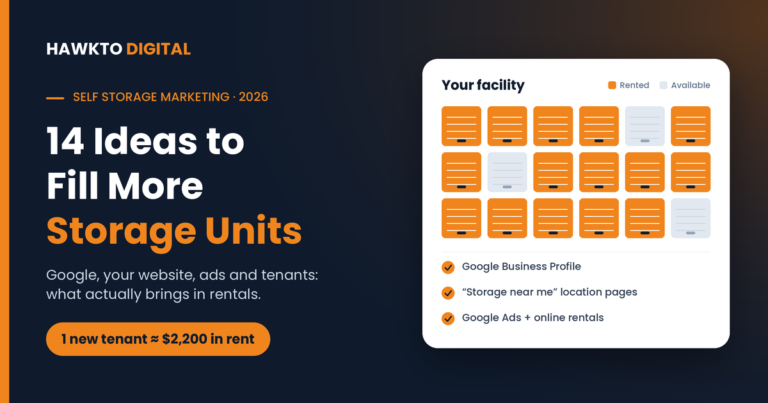
You can do a lot yourself. The Google Business Profile is free, reviews cost nothing to ask for, and fixes like a tap-to-call number are small jobs. If your facility is stabilized and the local competition is light, DIY may be all you need. My self storage marketing ideas post lists what to do first.
If you want to try the Google profile yourself, this video walks through the whole optimization:
Hiring makes more sense when:
- You’re in lease-up and every empty month costs real money.
- You want Google Ads. Ads are where inexperience wastes money fastest.
- You run several facilities and nobody has time to keep them all current.
- You’ve done the basics and your facility still isn’t in the top three on the map.
Either way, start by scoring your website with the free self storage SEO audit. It tells you whether your first dollar should go to fixes, SEO or ads. If you’d rather hand it off, see my self storage marketing services.
Self storage marketing cost FAQ
Frequently asked questions
Straight answers to what owners and managers ask most about marketing budgets.
QHow much should a self storage facility spend on marketing?
Work back from what one new tenant is worth: average monthly rent times average length of stay. Then pick a budget that needs only a few extra rentals a month to pay for itself. For a single stabilized facility, that often means $300 to $600 a month in fees plus any ad spend.
QHow much does self storage SEO cost?
No public survey covers storage on its own. General surveys put local SEO at about $1,557 a month on average, with $501 to $1,000 the most popular retainer. My plans are $300 a month on a 6-month plan or $800 a month on a 3-month plan, with the same work in both.
QHow much do Google Ads cost for a storage facility?
You set the ad spend, and it’s paid to Google. Click costs depend on your town and competitors, so check them in Google’s Keyword Planner. Management is a separate fee: mine is $300 a month, with ad spend paid from your own account.
QIs a marketplace like SpareFoot cheaper than my own marketing?
It can be during lease-up, because you pay only when a renter moves in. Under SpareFoot’s OneTime pricing, the fee is the unit price times your bid, and it applies to every move-in. Compare your cost per move-in by source and shift budget to whatever is cheapest.
QDo I need a new website before paying for SEO or ads?
Not always. If your site shows unit sizes and prices, has a tap-to-call number and lets people rent or reserve online, fixes are usually enough. If it can’t do those things, fix or rebuild it first, or you’ll pay to send renters to a page that loses them.
QCan I market my storage facility myself?
Yes. A complete Google Business Profile, a steady flow of reviews and a website with clear prices cover the basics at no cost beyond your time. Hiring help makes more sense during lease-up, for Google Ads, or when you run several facilities.
Sources
Sources
Checked in November 2026.
- Ahrefs, SEO pricing survey of 439 SEO providers (updated August 2024)
- Backlinko, SEO pricing survey of over 300 SEO professionals (updated December 2025)
- Google, Business Profile
- Google Ads Help, Use Keyword Planner
- Google Ads Help, About average daily budgets
- Google Ads, Bidding
- SpareFoot Marketplace Knowledge Base, How are SpareFoot fees calculated (OneTime pricing)
- Google Maps, User contributed content policy
- Google Search Central, Do you need an SEO?
Know where your budget should go first
Score your facility’s website for free and see which basics are missing before you pay for SEO or ads. When you want help, see my self storage marketing services.
Score my facility websiteSee self storage marketing services

About the author
Mehedi Hasan is the founder of Hawkto Digital and is Google, HubSpot and Semrush certified. He markets self-storage facilities and RV parks for operators in the US, covering Google Business Profiles, local SEO, Google Ads, websites, social media and email. Read his story or see pricing.