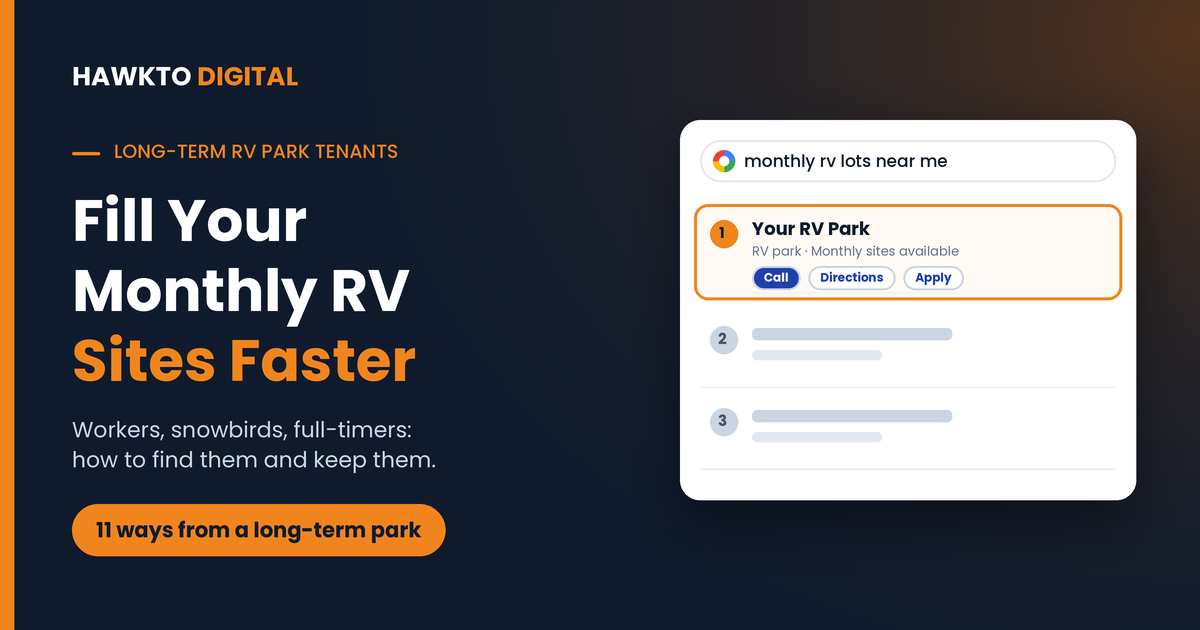
How to Get Long-Term RV Park Tenants: 11 Ways to Fill Monthly Sites
Quick answer
To get long-term RV park tenants, build a dedicated monthly sites page with rates, utilities and rules, mention monthly sites on your Google Business Profile, post openings where long-term guests look, run separate Google and Facebook ads for monthly searches, partner with employers that bring in traveling workers, answer every lead within minutes, and keep residents longer with monthly communication, renewal offers and referral rewards.
Monthly sites are the backbone of many RV parks. A long-term guest pays every month, needs no turnover cleaning, and keeps your park full in the slow season. But they search, decide and stay for completely different reasons than overnight travelers, and a lot of park marketing is built only for the overnight crowd.
I have marketed Country Home Estates, a long-term RV park in Oklahoma, since 2023, covering Google Ads, Meta ads, local SEO, the website and resident newsletters. This guide shares the 11 ways I would fill monthly sites at any park, from getting found to keeping residents for years. For the overnight side, see my complete RV park marketing guide.
In this guide
For RV park owners
Want this done for your park?
I have marketed a long-term RV park in Oklahoma since 2023: Google Maps, Google Ads, Facebook ads, the website and resident newsletters. See how I can help with RV park marketing.
Who rents monthly RV sites
Long-term RV guests usually fall into a few groups. Knowing which ones your area attracts tells you where to advertise and what to say:
| Guest type | What they need | Where to reach them |
|---|---|---|
| Traveling workers (construction, pipeline, plants, linemen, traveling nurses) | Close to the job site, reliable Wi-Fi, flexible start dates, sometimes company billing | Employers, staffing agencies, Google Ads, Facebook Marketplace |
| Retirees and snowbirds | Quiet, safe, friendly community, seasonal rates, nearby healthcare and shopping | Google Business Profile, RV directories, reviews, Facebook ads |
| Full-time RVers | Good Wi-Fi, mail and package delivery, laundry, fair monthly price | RV directories, Facebook groups, Google search |
| People between homes | Affordable monthly rate, simple move-in, clear rules | Google search, Facebook Marketplace, local listings |
Overnight travelers need a completely different message. My guide explains how to market to both types of guests without mixing them up.
11 ways to fill monthly RV sites
Part 1 · Get found by people who need a monthly site
1. Build a dedicated monthly sites page
Long-term guests search differently from overnight travelers. They type things like “monthly RV lots [city]” or “long-term RV parks near [city]”, and they need very different information before they call. Give them one page that answers everything:
- Monthly rate, and whether electricity is included or metered.
- Deposit, move-in costs and how payment works.
- Wi-Fi speed, mail and package delivery, laundry and storage.
- Pet policy, rig age or length rules, and how many people can stay.
- Current availability, with a button to apply or call.
This page is the one Google should rank for long-term searches, so give it a clear title like “Monthly RV Sites in [City], [State]”. My RV park SEO guide lists the other pages every park website needs.
2. Tell Google you offer monthly sites
Your Google Business Profile is often the first thing a long-term guest sees. Mention monthly sites in your description, add “Monthly RV sites” as a service, and post an update whenever sites open up, with a photo of the actual site. Reviews from long-term residents carry extra weight with this audience, because they show what living at your park is really like.
See the full setup in how to make your Google Business Profile the strongest in your area, or have it done through my Google Business Profile optimization service.
3. Post openings where long-term guests look
Many people looking for a monthly site search Facebook Marketplace, local Facebook groups, Craigslist and the RV directories, not just Google. Post each opening with real photos, the monthly price, what is included and how to apply. Keep your park name, address and phone number the same on every listing, as I explain in keeping your park details identical everywhere.
Part 2 · Run ads aimed at long-term guests
4. Run a separate Google Ads campaign for monthly searches
Don’t mix overnight and monthly searches in one campaign. A separate campaign for searches like “monthly RV lots near me”, “long-term RV parks [city]” and “RV parks for workers [city]” lets you write ads about monthly rates and send clicks straight to your monthly sites page.
Track calls and applications as conversions, so you know what each new resident costs. Before you start, run the break-even check in my Google Ads guide. A monthly guest who stays half a year is worth far more than a few nights’ booking, which usually makes the math easy. This is the same setup I run in my Google Ads management service.
5. Use Facebook and Instagram ads with a video tour
A 30-second video walking from the entrance to an open site, showing the hookups, laundry, Wi-Fi sign and quiet streets, answers most questions before anyone calls. Pair it with a short lead form asking when they need a site and how long they plan to stay.
Long-term site rentals can count as housing. Meta may require the Housing special ad category for them, and Google’s housing policy limits targeting for places people live. My guide to Meta’s housing ad rules explains what changes and how to get good leads anyway. See how I run Meta ads for local businesses.
Have monthly sites sitting empty?
In a free 30-minute call I will look at how your park shows up for monthly searches, compare you with the parks nearby and show you the fastest ways to fill your long-term sites.
Part 3 · Build a pipeline of workers and residents
6. Partner with employers that bring in traveling workers
Many long-term RV guests are traveling workers: construction crews, pipeline and plant workers, linemen, traveling nurses and contractors on long jobs. Find out who is hiring or building near you, then contact the project managers, HR teams and staffing agencies. Offer a simple package: a set monthly rate, one invoice for the company if they want it, and a contact person who answers the phone.
Check your local news and county permits for new plants, hospitals, warehouses and road projects. Each one can mean months of demand for nearby sites. My RV park marketing guide covers more partnership ideas.
7. Answer fast and make moving in easy
People who need a monthly site usually need it soon, and they contact several parks at once. Call back within minutes, send the application by text, and make move-in simple: a clear deposit, an online application and a site ready the same week if you can. My Facebook ads guide explains why the first five minutes after a lead comes in matter so much.
Part 4 · Keep residents longer
8. Talk to residents every month
Every resident who renews is a site you don’t have to fill again. A short monthly email or text with park news, maintenance updates, local events and reminders makes residents feel at home. For Country Home Estates, a long-term RV park I market in Oklahoma, I created a themed email newsletter for residents that was built specifically to bring in Google reviews.
My RV park marketing guide shows how email brings guests back. If you want it handled for you, my newsletter service is a one-time $300 setup and $50 per newsletter.
9. Ask long-term residents for reviews
A review from someone who has lived at your park for six months tells future residents more than any ad. Ask residents once they have settled in, after a problem is fixed quickly, and in your newsletter. Reply to every review. My RV park SEO guide covers reviews on Google and the RV review sites.
10. Reward commitment and plan renewals
Offer a small discount for 3, 6 or 12-month commitments, and send a renewal reminder two to three weeks before each stay ends. Ask residents who are leaving why, and fix what you can. A resident leaving because a job ended is normal. One leaving because of slow repairs or poor Wi-Fi is a problem you can solve before it costs you the next resident too.
11. Reward residents for referrals
Traveling workers often move in crews, and residents know other people who need a site. Offer a clear reward, such as a rent credit when someone they refer signs on for a month or more. If your park also has manufactured homes, the same idea works there, as I cover in my mobile home park marketing guide.
What to track every month
| What to track | Why it matters |
|---|---|
| Monthly site occupancy | The number that pays the bills |
| Average length of stay | Longer stays mean less turnover and steadier income |
| Leads and move-ins by source | Shows which channels bring residents, not just calls |
| Cost per new resident from ads | Tells you what you can afford to spend |
| Renewals and reasons for leaving | Shows what to fix to keep people longer |
Real results from a long-term RV park
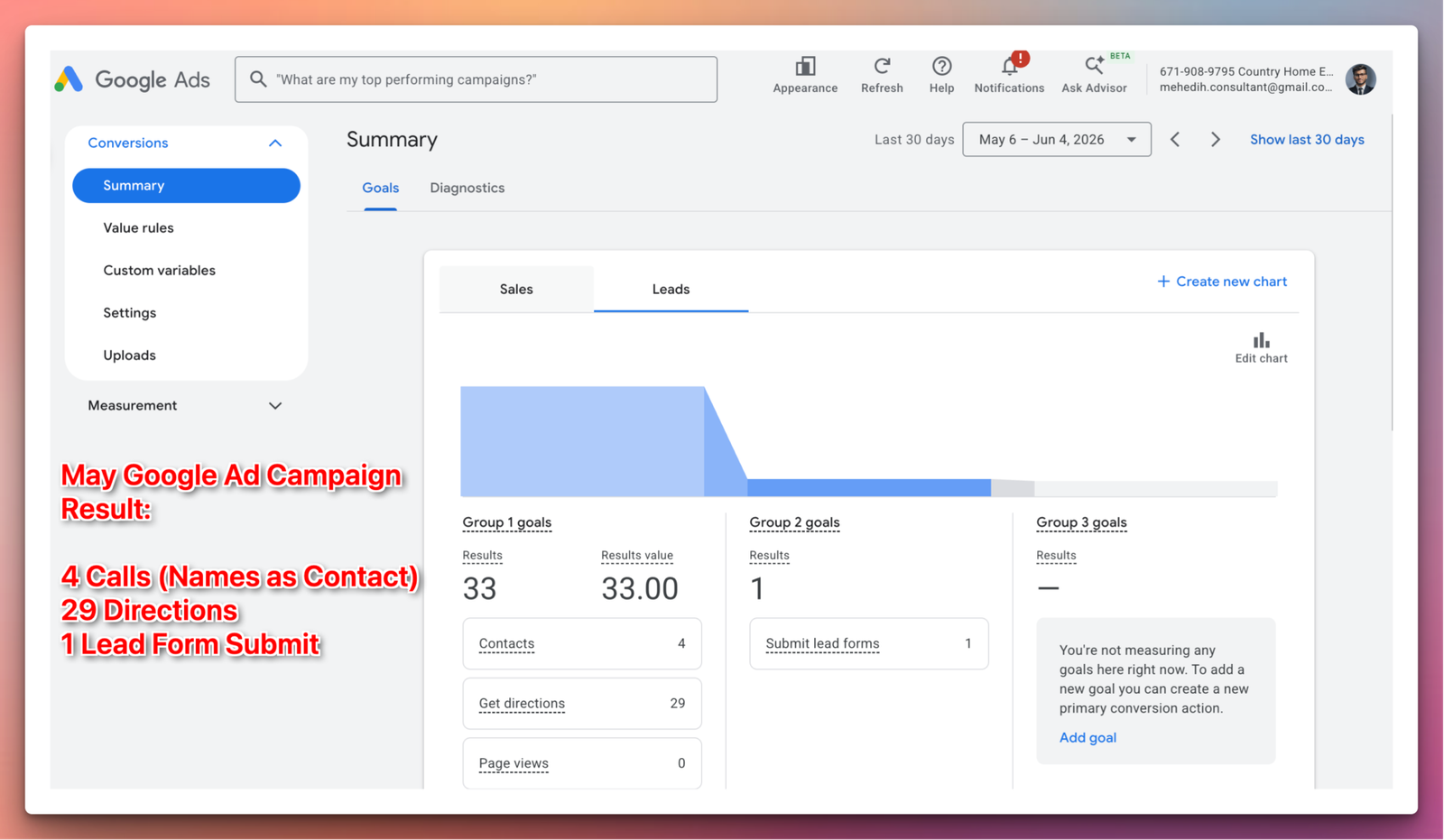
For Country Home Estates, I run Google Ads alongside local SEO, Meta ads, the website and resident newsletters, with every call, form and direction request tracked through Google Tag Manager. In May, the Google Ads campaign produced 29 direction requests, 4 phone calls and a lead form.
To compare costs before you decide, see my breakdown of what local SEO costs in 2026 and how Google Ads compares with SEO and Facebook ads.
Keep reading
Related guides for park owners
The full playbook
RV Park Marketing: 12 Proven Ways to Get More Bookings
Google, directories, ads, reviews and email for nightly and monthly guests.
Rank on Google
RV Park SEO: How to Get Your Park to the Top of Google
The 10-step plan to win the map and the top results.
Long-term residents
Mobile Home Park Marketing: 12 Ways to Fill Lots
For parks with manufactured homes and lots for rent.
Housing ads
Facebook Ads for Real Estate: 66 Leads at $11.65 Each
How to get good leads inside Meta’s housing ad rules.
Long-term RV tenants FAQ
Frequently asked questions
Answers to what RV park owners ask most about filling monthly sites.
QHow do I attract long-term tenants to my RV park?
Create a dedicated monthly sites page with rates, utilities and rules, mention monthly sites on your Google Business Profile, post openings on Facebook Marketplace and RV directories, run separate Google and Facebook ads for monthly searches, and partner with local employers who bring in traveling workers.
QWho rents monthly RV sites?
Most long-term RV guests fall into a few groups: traveling workers such as construction crews, pipeline workers and traveling nurses; retirees and snowbirds staying for a season; full-time RVers; and people between homes. Each group searches differently, so speak to the ones your area attracts.
QShould I charge less for monthly RV sites?
Parks usually charge less per night for monthly stays, because a full month of steady occupancy with less turnover is worth more than a few scattered nights. Check what parks near you charge, decide how utilities are handled, and consider a small extra discount for 3, 6 or 12-month commitments.
QDo monthly RV site ads need the Housing category on Facebook?
They can. Ads for places people live may fall under Meta’s Housing special ad category, which removes age, gender and ZIP code targeting. If your ads promote long-term stays, choosing the Housing category protects your ad account.
QHow do I keep long-term RV tenants?
Keep the park clean and quiet, fix problems quickly, keep Wi-Fi reliable, talk to residents every month, offer a small discount for longer commitments and send renewal reminders before each stay ends.
QHow much does RV park marketing cost?
It depends on the channels. My local SEO plans start at $300 a month, Google Ads management is $300 a month and Meta ads management is $300 to $400 a month, plus ad spend paid to Google or Meta. Websites start at $400.
Fill your monthly sites
Book a free 30-minute call. I already market a long-term RV park in Oklahoma. I will show you where your park stands for monthly searches and the quickest ways to bring in long-term residents.

About the author
Mehedi Hasan is the founder of Hawkto Digital and is Google, HubSpot and Semrush certified. He has marketed a long-term RV park in Oklahoma since 2023, covering Google Ads, Meta ads, local SEO, the website and resident newsletters, and works with RV parks and self storage facilities across the US. Read his story or see pricing.