Google Ads for RV Parks: The Complete Setup Guide for 2026
Quick answer
Google Ads for RV parks works best with separate campaigns for overnight travelers, monthly guests and nearby attractions, keywords that show intent to stay, a strong list of negative keywords (RV sales, rentals, repairs, storage, jobs, free camping), location targeting that reaches trip planners, ads that show hookups, amp service, pull-throughs and rates, call, location and price assets, and conversion tracking for bookings, calls and direction requests.
Google Ads can put your RV park at the top of Google within days, in front of people searching for a place to park tonight, next week or for the next six months. It can also burn money fast on people shopping for RVs, looking for repair shops or hunting for free camping.
I run Google Ads for Country Home Estates, a long-term RV park in Oklahoma I have marketed since 2023. This guide is the complete setup I use for Google Ads for RV parks, in 10 steps, written for park owners and managers. For the rest of your marketing, start with my RV park marketing guide.
In this guide
For RV park owners
Want this done for your park?
I have marketed a long-term RV park in Oklahoma since 2023: Google Maps, Google Ads, Facebook ads, the website and resident newsletters. See how I can help with RV park marketing.
How to set up Google Ads for RV parks in 10 steps
Part 1 · Build the right campaigns
1. Split your campaigns by guest type
A common mistake with Google Ads for RV parks is one campaign for everything. Overnight travelers and monthly guests search with different words, need different ads and are worth different amounts to you. Start with separate campaigns:
| Campaign | Who it reaches | Where clicks go |
|---|---|---|
| Overnight and short stays | Travelers planning a stop or already on the road | Rates and booking page |
| Monthly and long-term | Traveling workers, snowbirds, full-time RVers | Monthly sites page |
| Attractions and events | People visiting a lake, park, stadium or event near you | A guide page for that attraction, with rates |
| Your park name | People already searching for you by name | Homepage or booking page |
Separate campaigns let you set a different budget for each, write ads that match the search, and see which type of guest is actually paying off. My guide to filling monthly RV sites covers the long-term side in depth.
2. Choose keywords that mean “I need a site”
Build each campaign around searches from people ready to book, not people browsing RVs:
- Overnight: “RV park near [city]”, “RV parks [city] [state]”, “RV camping near [city]”, “RV park off I-[number]”, “pull through RV park [city]”.
- Monthly: “monthly RV lots [city]”, “long-term RV parks near [city]”, “RV parks for workers [city]”.
- Attractions: “RV parks near [lake / state park / event]”, “camping near [attraction]”.
On a small budget, use phrase match and exact match first, so your ads stay close to the searches you chose. Add “near me” versions too, because Google uses the searcher’s location to decide who sees them.
3. Block the searches that waste money
“RV” searches attract a lot of people who will never book a site. Add negative keywords from day one and check your search terms report every week. Common ones for RV parks:
| Block searches about | Example negative keywords |
|---|---|
| Buying or renting RVs | for sale, dealer, used, rental, rent an RV |
| Repairs and storage | repair, service, parts, mechanic, storage |
| Free camping | free, boondocking, dispersed, BLM |
| Jobs | jobs, hiring, workamper, salary |
| Other lodging you don’t offer | hotel, cabin (if you don’t have cabins), tent (if you don’t allow tents) |
Only block what doesn’t apply to your park. If you rent cabins or store RVs, keep those searches.
Part 2 · Target the right people in the right places
4. Set location targeting for travelers, not just locals
RV parks are different from most local businesses. Your overnight guests are usually searching from somewhere else, planning a stop in your area. For a plumber, I recommend showing ads only to people physically in the area. For an RV park’s overnight campaign, the default option, which also reaches people who show interest in your location, usually makes more sense. Google explains both options here.
- Overnight campaign: target your town and the surrounding area, with the default “presence or interest” option, so trip planners searching from home see you.
- Route-based parks: also target the stretch of highway or the cities travelers pass through on the way to you.
- Monthly campaign: target your area and the nearby cities workers commute from.
Watch the locations report after the first few weeks and exclude any areas that bring clicks but no bookings. For most other local businesses, my general Google Ads guide explains why the opposite setting is usually better.
5. Follow the housing rules for monthly ads
Long-term sites can count as a place people live. Google’s housing policy for the US does not allow personalized housing ads to target by age, gender, parental status, marital status or ZIP code. For search campaigns built on keywords, this rarely gets in the way: target by city or radius instead of ZIP codes, and write ads about the site, not the kind of person you want. Meta has similar rules, which I explain in my guide to housing ad rules on Facebook.
Already running Google Ads for your park?
In a free 30-minute call I will review your campaigns, search terms, location settings and tracking, and show you where money is leaking and where bookings are being missed.
Part 3 · Write ads RVers click
6. Put the details RVers filter on in the ad
RVers decide fast, based on whether your park fits their rig and their trip. Your ad has room for 15 short headlines and 4 descriptions, so use them for the facts that matter:
- Full hookups, 30 and 50 amp, pull-through sites, big rig friendly, maximum length.
- Distance from the highway exit or the attraction (“2 Miles Off I-40”, “5 Min to [Lake]”).
- Wi-Fi, laundry, pet friendly, gated, quiet.
- Nightly, weekly and monthly rates, or “Monthly Sites Available”.
- “Book Online 24/7” if you take online reservations.
7. Add assets for calls, directions and prices
Assets make your ad bigger and give people more ways to act without visiting your site:
- Call asset: a call button, scheduled for the hours someone answers the office phone.
- Location asset: your address and distance, linked to your Google Business Profile, so people can get directions in one tap.
- Price asset: nightly, weekly and monthly rates.
- Sitelinks: Rates, Sites and Hookups, Monthly Sites, Amenities, Directions.
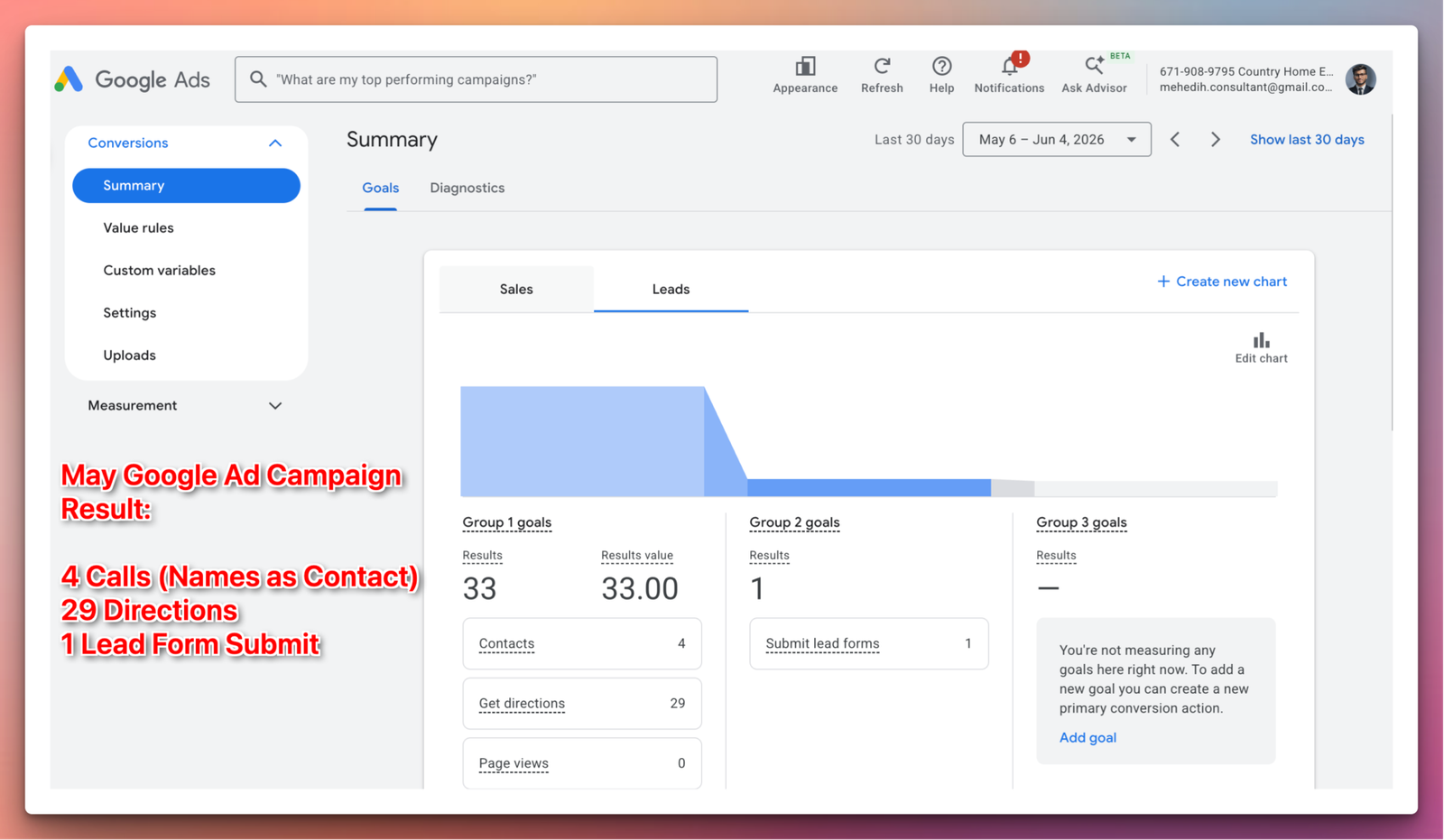
Direction requests are a big deal for RV parks, because many travelers decide while on the road. For Country Home Estates, the May campaign drove 29 direction requests in a single month.
Part 4 · Turn clicks into bookings
8. Send every click to the right page
Never send ad clicks to your homepage and hope people find the rates. Each campaign should go to its own page: the booking page for overnight stays, the monthly sites page for long-term searches, and a guide page for attraction searches. Each page needs the phone number at the top, a clear “Book now” button and the site specs RVers check.
If your site is missing these pages, they are what my RV park SEO guide recommends building anyway, and they serve both your ads and your rankings. I build them through website development for local businesses.
9. Track bookings, calls and directions as conversions
Without conversion tracking, Google Ads can’t learn what works and you can’t tell what a booking costs. Track:
- Calls from the ads and calls from your website.
- Completed reservations, including on your reservation system if it runs on a separate domain.
- Monthly site applications and contact forms.
- Direction requests from the location asset.
I set this up with Google Tag Manager, so every result can be tied back to the campaign that brought it in. Read more on why tracking comes before spending.
Part 5 · Spend wisely all year
10. Set your budget around seasons and value
Work out what a booking is worth before you set a budget. A monthly guest who stays six months is worth far more than one night, so the monthly campaign can usually afford a higher cost per lead. Across US search campaigns, the 2026 average was $5.42 per click and $66.69 per lead, according to WordStream’s 2026 benchmarks, though RV park costs vary by market and season.
- Increase the overnight budget a few weeks before your busy season, when people plan trips.
- Keep the monthly campaign running all year, since workers and snowbirds move on their own schedules.
- In slow months, push weekly and monthly stays rather than turning ads off completely.
My Google Ads guide has a 2-minute break-even check to see what you can afford per booking.
Real results from an RV park
For Country Home Estates, the May Google Ads campaign produced 29 direction requests, 4 phone calls and a lead form, all tracked through Google Tag Manager so every result could be tied back to the ads. Direction requests matter most here: they are travelers and future residents on their way to the park.
For a look at the cost side, here is one week of Google Ads for another local business client: 10 conversions at $43.14 each from $431 of ad spend.
Mistakes that waste RV park ad budgets
- One campaign for every guest. Overnight and monthly guests need different keywords, ads and pages.
- No negative keywords. “RV” searches are full of buyers, renters and repair shoppers.
- Sending clicks to the homepage. Send each campaign to the page that answers that search.
- Tracking clicks instead of bookings. Track calls, reservations, applications and direction requests.
- Turning ads off in the slow season. Shift the budget to weekly and monthly stays instead.
- Call buttons when nobody answers. Schedule call assets for office hours, and let online booking handle the rest.
Keep reading
Related guides for park owners
The full playbook
RV Park Marketing: 12 Proven Ways to Get More Bookings
Google, directories, ads, reviews and email for nightly and monthly guests.
Rank on Google
RV Park SEO: How to Get Your Park to the Top of Google
The 10-step plan to win the map and the top results.
Monthly sites
How to Get Long-Term RV Park Tenants
11 ways to fill monthly sites and keep residents longer.
Before you spend
Is Google Ads Worth It for a Small Business?
Real 2026 costs and a 2-minute break-even check.
RV park Google Ads FAQ
Frequently asked questions
Answers to what RV park owners ask most before running Google Ads.
QDo Google Ads work for RV parks?
Yes. People searching “RV park near [city]” or “monthly RV lots [city]” are ready to book, and Google Ads puts your park at the top of those results within days. They work best with separate campaigns for overnight and monthly guests, strong negative keywords and conversion tracking.
QHow much should an RV park spend on Google Ads?
Start with a budget you can keep for at least two to three months, and set it from what a booking is worth. A long-term guest is worth much more than a single night, so a common approach is a steady budget behind monthly sites, raising the overnight budget before the busy season.
QWhat keywords should an RV park use on Google Ads?
Use searches with clear intent to stay, such as “RV park near [city]”, “RV parks off I-[number]”, “pull through RV park [city]” and “monthly RV lots [city]”. Block searches about RV sales, rentals, repairs, storage, jobs and free camping.
QShould RV parks bid on their own park name?
Usually yes, if competitors or booking sites show ads on your name. A small brand campaign is cheap and keeps the top spot yours. If nobody else appears for your name, you can skip it.
QIs Google Ads or SEO better for an RV park?
Google Ads brings bookings within days, while SEO builds rankings that bring guests without paying per click. A common approach is to run ads for steady bookings while SEO grows, then adjust the ad budget as rankings improve.
QHow much does RV park Google Ads management cost?
My Google Ads management is $300 a month, month to month with 30 days’ notice, plus ad spend paid directly to Google. You keep full ownership of the ad account.
Get your park to the top of Google, today
Book a free 30-minute call. I already run Google Ads for an RV park in Oklahoma. I will show you what parks near you are bidding on and the campaign setup I would use for yours.

About the author
Mehedi Hasan is the founder of Hawkto Digital and is Google, HubSpot and Semrush certified. He has run Google Ads, Meta ads and local SEO for a long-term RV park in Oklahoma since 2023, with conversion tracking through Google Tag Manager, and works with RV parks and self storage facilities across the US. Read his story or see pricing.