
RV Park Advertising: 15 Options Compared (With Real Costs)
Quick answer
The best RV park advertising mix starts with free channels: a complete Google Business Profile, RV directory listings and email to past guests. Next comes Google Search Ads with Maps location assets to reach travelers already searching (travel clicks average $2.14), then Facebook and Instagram ads and retargeting to fill quiet weeks and monthly sites (travel clicks average $0.42). Offline options like interstate logo signs (about $230 per sign a year in Iowa) and billboards ($1,000–$5,000 a month in smaller cities) pay off only when your location fits them.
RV park advertising has never had more options, or more ways to waste money. Travelers find parks on Google, in the Maps app, on Facebook, in RV apps and directories, and on the blue signs before an exit. In September 2026, the RMS State of the Outdoor Accommodation Report found that online search has overtaken word of mouth as the top way campers discover campsites, with nearly 64% using it (Hospitality Net).
I’ve run Google Ads, Meta ads, local SEO and newsletters for Country Home Estates, a long-term RV park in Oklahoma, since 2023. This guide compares 15 ways to advertise an RV park, with what each one costs in 2026, who it suits and what I would do first. Every cost comes from a named source, listed at the end.
In this guide
For RV park owners
Want this done for your park?
I have marketed a long-term RV park in Oklahoma since 2023: Google Maps, Google Ads, Facebook ads, the website and resident newsletters. See how I can help with RV park marketing.
Know which guests you’re advertising to
Before you pick a channel, decide who the ad is for. RV parks usually serve three kinds of guests, and each one finds parks in a different way:
| Guest | How they find a park | Channels that reach them |
|---|---|---|
| Overnight travelers on the road | Search “RV park near me” in Google or the Maps app, often the same day | Google profile, Search and Maps ads, logo signs, billboards |
| Vacation guests planning a trip | Plan weeks ahead, compare parks near a lake, park or event | Facebook, Instagram, YouTube, directories, booking sites |
| Monthly guests: workers, snowbirds, traveling nurses | Search “monthly RV parks in [city]”, call several parks | Search Ads, Facebook lead ads (Housing category), referrals |
Most parks need at least two of these groups. That’s why the best advertising plans use separate campaigns, pages and offers for each one instead of a single ad trying to reach everyone.
All 15 RV park advertising options compared
Here’s every option side by side. Tap a name to jump to the details. On a phone, swipe the table sideways to see the costs.
| Option | Best for | Typical cost (2026) | Results start |
|---|---|---|---|
| 1. Google Business Profile (free) | Tonight’s “near me” searches | Free | A few weeks |
| 2. Google Search Ads | Travelers searching right now | ~$2.14 per click (travel average) | Days |
| 3. Google Maps ads (location assets) | Drivers searching nearby | Included in your Google Ads budget | Days |
| 4. Microsoft Advertising (Bing) | Extra search reach | Pay per click, budget you set | Days |
| 5. Facebook and Instagram ads | Trip planners, events, monthly leads | ~$0.42 per click (travel traffic average) | 1–2 weeks |
| 6. Retargeting ads | People who almost booked | A small share of your ad budget | Days |
| 7. YouTube video ads | Showing the park to planners | $0.10–$0.30 per view | 2–4 weeks |
| 8. RV directories and review sites | Comparison shoppers | Free listing; paid placement by quote | A few weeks |
| 9. Good Sam Parks program | Good Sam members | Not published (quote from Good Sam) | Varies |
| 10. Online booking marketplaces | Travelers who book online | Free listing; optional paid placement | A few weeks |
| 11. Interstate logo signs (blue “CAMPING” signs) | Parks near an interstate exit | From about $230 per sign a year (Iowa) | As soon as the signs go up |
| 12. Billboards | Parks on a busy travel route | $1,000–$5,000 a month (smaller cities) | As soon as it’s posted |
| 13. Local radio | Events and local reach | $25–$71 per 30-second spot (small markets) | Days |
| 14. RV shows and rallies | Meeting RVers face to face | Booths from about $575–$850 | Bookings follow the event |
| 15. Email and text messages to past guests | Repeat stays and quiet weeks | Free up to 250 contacts; paid plans from $12 a month | Same day |
The 15 RV park advertising options in detail
Part 1 · Free channels and search ads: people already looking for a park
1. Google Business Profile (free)
It isn’t technically an ad, but it’s the most valuable free ad space your park has. When a traveler searches “RV park near me”, Google shows three parks on a map above every website. Your Business Profile decides whether you’re one of them: the right primary category, your amenities, current hours, recent photos, and a steady flow of reviews with replies.
Every paid ad on this list also sends people to look you up on Google before they book. A thin profile with old reviews makes all of them work harder. My guide on how to rank higher on Google Maps and the RV park review playbook cover exactly what to fix.
My take: Fix this before you pay for anything else. It costs nothing, and it makes every other channel convert better.
2. Google Search Ads
Your ad appears when someone searches “RV parks in [city]”, “RV park near [lake]” or “monthly RV sites near me”, and you pay only when they click. LocaliQ’s 2026 search advertising benchmarks put the average cost per click for travel at $2.14 and the average cost per lead at $44.70, well below the all-industry average of $5.42 per click.
What makes RV park search ads work:
- Separate campaigns for overnight stays, monthly sites and nearby attractions, because each needs different keywords and ad copy.
- Negative keywords for searches that look similar but never book: RV sales, RV repair, RV rentals, RV storage and free camping.
- Call and location assets, so travelers can call or get directions straight from the ad.
- Booking and call tracking, so you judge the ads by bookings, not clicks.
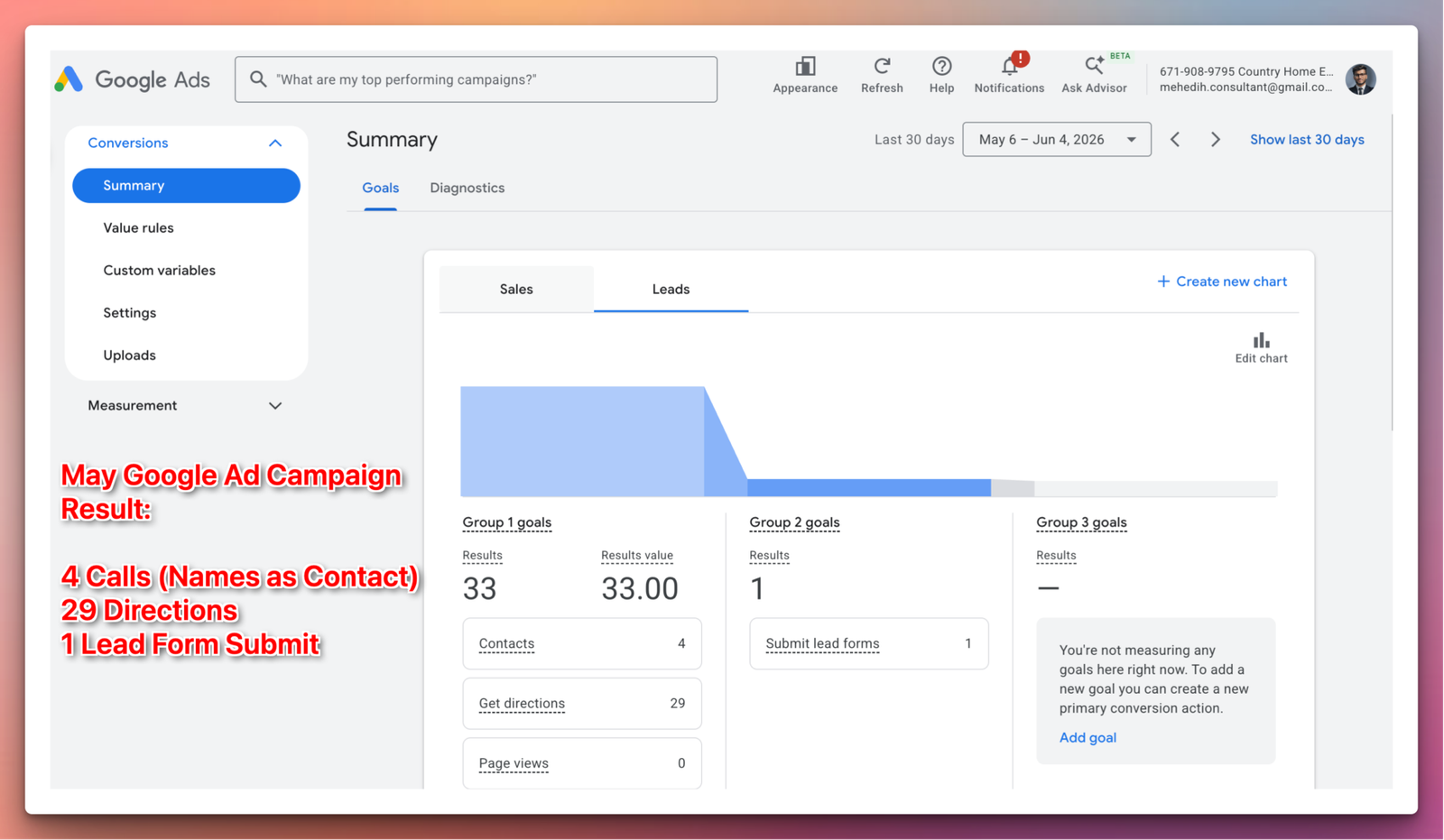
For Country Home Estates, a long-term RV park in Oklahoma, this setup brought in 29 direction requests, 4 phone calls and a lead form in one month. The full setup is in my Google Ads guide for RV parks.
My take: For most parks this is the fastest paid channel, because it reaches people who already want a site. Start here once your Google profile is in shape.
3. Google Maps ads (location assets)
Link your Google Business Profile to Google Ads and add location assets. Your park can then show its address and distance inside search ads, and appear beside, above or below results on Google Maps, including the Maps app, according to Google Ads Help. For an RV park that’s ideal: many travelers search from the road, in the Maps app, an hour or two before they need a site.
This isn’t a separate product to buy. It’s a setting inside your Google Ads account, and Maps ad clicks are billed through the same campaign budget.
My take: Always turn it on for an RV park. It takes ten minutes and puts your ads where road travelers actually look.
4. Microsoft Advertising (Bing)
Microsoft Advertising shows your search ads on Bing and its partner sites. The audience is smaller than Google’s, but some travelers use Bing by default, especially on Windows computers, and you can import your existing Google Ads campaigns instead of building new ones.
My take: Add it only once Google Ads is working and tracked. Import your best campaign, run a small test budget for a month and keep it if the cost per booking holds up.
Part 2 · Social and video ads: people planning a trip
5. Facebook and Instagram ads
Search ads catch people who are already looking. Facebook and Instagram reach travelers earlier, while they scroll through trip ideas and plan routes, which is why clicks cost less: LocaliQ’s 2026 Facebook benchmarks show travel traffic campaigns averaging $0.42 per click.
Use them to fill quiet weekdays and shoulder seasons with offers, promote event weekends, bring past guests back and generate leads for monthly sites. Ads for monthly or long-term sites usually belong in Meta’s Housing special ad category, which limits targeting (Meta’s housing audience rules).
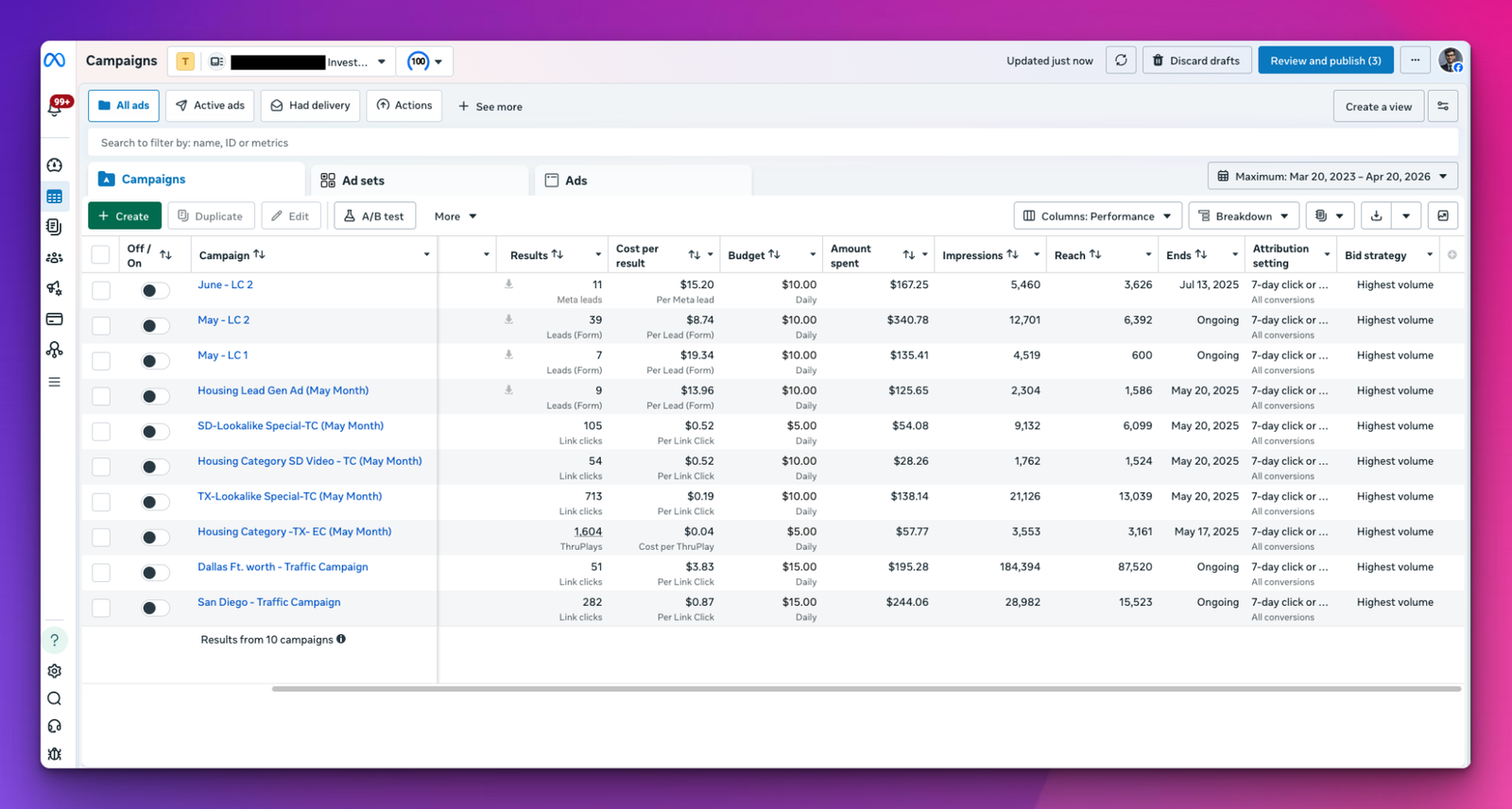
Lead campaigns built this way brought in 66 leads at $11.65 each for 724 Enterprises, a Texas real estate business advertising under the same Housing rules, against an all-industry average of $27.39 per lead. My Facebook ads guide for RV parks has the full 10-step setup.
My take: The best way to create demand instead of waiting for it. Use real video of your park and keep overnight and monthly campaigns separate.
6. Retargeting ads
Retargeting shows ads to people who already visited your rates or booking page but didn’t book. It runs on Facebook, Instagram, YouTube and Google’s display network, and it needs the Meta Pixel and Google tag on your website to work.
Because the audience is small, it needs only a small budget. A simple version: everyone who viewed your booking page in the last 30 days sees one ad with your best photo, your rates and a reason to book now.
My take: Set it up at the same time as your first Google or Facebook campaign. These are the warmest people you can advertise to.
7. YouTube video ads
LocaliQ’s YouTube cost guide puts the average at $0.10 to $0.30 per view, or $4 to $10 per thousand impressions, with most businesses starting at $10 to $50 a day. With skippable video ads you pay only when someone watches 30 seconds (or the whole ad, if it’s shorter) or interacts with it.
A 30-second drive through your park, a drone shot over the lake or a sunset at a pull-through site sells a destination park better than any photo. Target the cities your guests come from and people interested in RV travel.
My take: Worth testing if your park is a destination and you have good video. Skip it if you don’t have footage yet.
Already running ads for your park?
In a free 30-minute call I’ll review your Google and Facebook campaigns, your tracking and the parks around you, and show you where the budget is leaking.
Part 3 · RV directories and booking sites: people comparing parks
8. RV directories and review sites
RVers compare parks on sites and apps like RV LIFE, Campendium and RV Parky before they book. Most let you list or claim your park for free. Campendium, for example, lists parks for free and offers advertising and partnership options on request (Campendium’s owner FAQ).
Keep your park name, phone number, rates and amenities identical on every directory. That consistency also supports your Google ranking.
My take: Claim and complete every free listing first. Pay for featured placement only if the directory can show you how many bookings it sends.
9. Good Sam Parks program
Camping World’s Good Sam Parks program lists your park on GoodSam.com and promotes it through Good Sam, Camping World and Gander RV & Outdoors social media and emails. Parks are also included in regional brochures and a Master Catalog handed out in Camping World stores and at Good Sam shows, and you can sell Good Sam memberships and keep the revenue (Good Sam Parks program).
Fees aren’t published. A park specialist quotes them after you fill in their form.
My take: Ask for the total yearly cost, any member discount you’d have to honor, and what similar parks get from it before you sign.
10. Online booking marketplaces
Booking marketplaces let travelers find and reserve your park in one place. The RoverPass Marketplace is free for parks to list on, and in 2023 it launched paid Premium Listings that take the top three spots in search results (Modern Campground). If your park runs on Campspot’s reservation software, it can also appear on the Campspot marketplace, where campers may pay a booking fee (Campspot FAQ).
My take: Useful for overnight travelers who book at night. Make sure rates and availability sync with your reservation system so you never double-book a site.
Part 4 · On the road and offline: people driving by
11. Interstate logo signs (blue “CAMPING” signs)
Those blue signs before an interstate exit are paid business logo signs, and most states include a camping category. Iowa, for example, charges $230 per sign per year and requires at least 20 camping spaces, 24-hour public access while open and a public phone (Iowa DOT). Florida bases its fee on each exit’s traffic and urban population (Florida DOT). Most exits need more than one sign, one for each direction of travel and often one on the ramp.
My take: If your park is near an interstate and qualifies, this is one of the best-value ads you can buy. It reaches RVers at the exact moment they decide where to stop. Contact your state DOT’s logo sign program.
12. Billboards
Fit Small Business puts billboards in small and mid-size cities at $1,000 to $5,000 a month, with a national average of $3,953 for a four-week campaign. Less populated states cost much less: the Montana average was about $975.
A billboard works for an RV park when it sits on the route your guests drive, a few miles before your exit. Six words or fewer, the exit number and one reason to stop: “Full hookups. Exit 42. Open tonight.”
My take: Only worth it on the right road. Give it its own phone number or short web address so you can see what it brings in.
13. Local radio
According to Fit Small Business, a 30-second spot averages $327 nationally but costs $25 to $71 in smaller markets such as Topeka, Baton Rouge and Buffalo, and producing the ad costs $1,000 to $2,500.
Radio reaches locals, and most of your overnight guests aren’t local. It can still work for an event at your park, for reaching people whose family visits in an RV, or for monthly sites near a large employer.
My take: Rarely my first pick for an RV park. Use it for a specific event or a monthly-site push, not for general awareness.
14. RV shows and rallies
RV shows, rallies and club conventions put you in front of hundreds or thousands of RVers at once. For example, the FRVA International Convention & RV Expo in Sedalia, Missouri (July 2026, about 1,500 to 2,000 attendees) priced indoor booths at $575 to $850 (exhibitor prospectus). Add travel, staff time and printed material.
My take: Best for parks that host rallies and groups, or shows near the cities your guests come from. Bring a show-only offer, collect emails and follow up within a week.
Part 5 · Channels you already own: past guests
15. Email and text messages to past guests
Your past guests already know and like your park, so they’re the cheapest bookings you can get. MailerLite, for example, is free for up to 250 subscribers and 2,500 emails a month, with paid plans from $12 a month.
Send a short email before your busy season opens, for quiet weeks and for events nearby, and ask happy guests for a Google review. For Country Home Estates, I run monthly resident newsletters, including a Route 66-themed campaign built to bring in Google reviews. Only text guests who agreed to receive texts, and always include a way to opt out.
My take: Start collecting emails at every booking today. In a year it can be your lowest-cost source of bookings.
Also worth doing, mostly free: list your park with your local chamber of commerce and visitor bureau, partner with nearby attractions and event organizers for cross-promotion, and reach out to RV clubs that plan group trips in your area.
Where to start, based on your park
You don’t need all 15. Pick the two or three that match where your park is and who it serves, prove they work, then add more.
| If your park is… | Start with | Add next |
|---|---|---|
| Near an interstate exit, mostly overnight stays | Google profile + Google Search Ads with Maps location assets | Interstate logo signs, a billboard before your exit |
| Destination park near a lake, national park or attraction | Google profile + Search Ads for attraction searches | Facebook, Instagram and YouTube video for trip planners |
| Mostly monthly or long-term sites | Search Ads for monthly searches | Facebook lead ads in the Housing category, resident referrals |
| New park with few reviews | Google profile, directory listings, review routine | Google Search Ads from day one while reviews build |
| Quiet weekdays or shoulder season | Email to past guests with an offer | Facebook and Instagram offers, retargeting |
Whatever you choose, fix your Google profile and your website first. Ads send people to both, and a slow site with hidden rates wastes every dollar you spend. My 2-minute RV park website self-check shows whether yours is ready for paid traffic.
How to track which ads bring bookings
The only fair way to compare RV park advertising channels is cost per booking: what you spent on a channel divided by the bookings it brought in. For example, $300 of ad spend that brings 10 bookings costs $30 per booking. Compare that with what a booking is worth to your park. To get the numbers:
- Give each offline ad its own phone number or short web address, so a billboard, radio spot or directory listing can be measured.
- Tag every link you control (directories, social posts, emails) with UTM tags, so Google Analytics shows where visitors came from.
- Ask “How did you hear about us?” in your booking form and at check-in.
- Set up conversion tracking in Google Ads (through Google Tag Manager) and the Meta Pixel, so both platforms learn which clicks turn into bookings.
- Check your Google Business Profile every month for calls, direction requests and website clicks.
Real RV park and lead ad results
Here’s what tracked campaigns look like in practice. For Country Home Estates, Google Search Ads with call and location assets brought in 29 direction requests, 4 phone calls and a lead form in May, each one tracked through Google Tag Manager.
On Facebook and Instagram, lead campaigns run under Meta’s Housing rules brought in 66 leads at an average of $11.65 each for 724 Enterprises, a Texas real estate business. That’s the same setup I use for monthly RV site leads.
Every park and market is different, so treat these as examples of what well-built, tracked campaigns can do, not a promise.
7 RV park advertising mistakes
- Paying for ads before fixing your Google profile and website. Ads send people to both.
- Boosting posts instead of running campaigns. Boosts chase likes. Campaigns chase bookings.
- One campaign for overnight and monthly guests. They search differently and need different ads and pages.
- No negative keywords. Without them, search ads pay for people shopping for RVs, repairs or rentals.
- Paying for directory placement you can’t measure. If you can’t see the bookings, you can’t judge the cost.
- Buying offline ads that don’t fit your location. A billboard on the wrong road is an expensive picture.
- Judging ads by clicks or likes. Judge every channel by cost per booking.
Keep reading
Related guides for park owners
Paid search
Google Ads for RV Parks: The Complete Setup Guide
Campaigns, keywords, negatives and tracking for park owners.
Full plan
RV Park Marketing: 12 Proven Ways to Get More Bookings
How advertising fits into your whole marketing plan.
RV park advertising FAQ
Frequently asked questions
Answers to what park owners ask most about advertising.
QWhat is the best way to advertise an RV park?
For most parks: a complete Google Business Profile first, then Google Search Ads with Maps location assets to reach travelers already searching, then Facebook and Instagram ads and retargeting to fill quiet weeks and monthly sites. Add interstate logo signs or a billboard only if your park sits near the right road.
QHow much should an RV park spend on advertising?
There’s no single right number. Start each paid channel with a budget you can keep for at least two to three months, track cost per booking, and move money to the channels that bring bookings at a profit. Free channels like your Google profile, directories and email to past guests should come first, because they cost little and make paid ads work better.
QIs Google Ads or Facebook better for RV park advertising?
Google Ads reaches people already searching for a park, so it usually brings bookings faster. Facebook and Instagram reach travelers earlier, while they plan, and work well for events, offers, retargeting and monthly site leads. Most parks get the best results running both, with separate campaigns for overnight and monthly guests.
QCan my RV park get on the blue highway signs?
Usually, if you meet your state’s rules. Most states run a business logo sign program with a camping category. Iowa, for example, charges $230 per sign per year and requires at least 20 camping spaces, 24-hour access while open and a public phone. Contact your state DOT’s logo sign program for its rules and fees.
QDo billboards work for RV parks?
They can, when the billboard sits on the route your guests drive, a few miles before your exit, with the exit number and one clear reason to stop. In small and mid-size cities they typically cost $1,000 to $5,000 a month, so track each one with its own phone number or web address.
QAre RV directory listings worth paying for?
Claim every free listing first and keep your details consistent. Pay for featured placement only when the directory can show how many bookings or calls it sends, so you can compare its cost per booking with your other channels.
QHow do I know which RV park ads are working?
Give each channel its own tracked phone number or web link, ask “How did you hear about us?” in your booking form and at check-in, and set up conversion tracking in Google Ads and Meta. Then compare cost per booking, not clicks or likes.
QHow much does it cost to have you run my RV park ads?
My Google Ads management is $300 a month, and Meta ads management is $300 to $400 a month, plus ad spend paid directly to Google or Meta from your own account. Both are month to month with 30 days’ notice. See the pricing page.
Sources
Sources
Costs were checked in October 2026. Prices change, so confirm current rates with each provider before you buy.
- LocaliQ, 2026 Search Advertising Benchmarks
- LocaliQ, Facebook Advertising Benchmarks for 2026
- LocaliQ, How Much Does YouTube Advertising Cost?
- RMS, 2026 State of the Outdoor Accommodation Report (via Hospitality Net)
- Google Ads Help, About location assets
- Campendium, I own a campground: how can I work with Campendium?
- Camping World, Good Sam Parks program
- Modern Campground, RoverPass announces Premium Listings
- Campspot, Frequently Asked Questions
- Iowa DOT, Logo Signs
- Florida DOT, Logo Sign Program FAQ
- Fit Small Business, How Much Does Billboard Advertising Cost?
- Fit Small Business, Radio Advertising Costs
- FRVA 113th International Convention & RV Expo, Exhibitor Prospectus
- MailerLite, Pricing
Get an advertising plan built for your park
Book a free 30-minute call. I’ll look at your park, your location, your current ads and the parks around you, and tell you which two or three channels I’d start with and what they should cost.

About the author
Mehedi Hasan is the founder of Hawkto Digital and is Google, HubSpot and Semrush certified. He has run Google Ads, Meta ads, local SEO and newsletters for a long-term RV park in Oklahoma since 2023, and paid ads for local businesses across the US. Read his story or see pricing.